Now Reading: Eastern Nepal Without the Crowds: A Complete Regional Itinerary
-
01
Eastern Nepal Without the Crowds: A Complete Regional Itinerary

Leave Nepal's familiar circuit behind on this practical 14-day journey through Ilam's tea hills, Shree Antu, Dharan, Dhankuta, Tinjure and Koshi Tappu, with transport, costs, seasons, food, permits and quieter extensions.
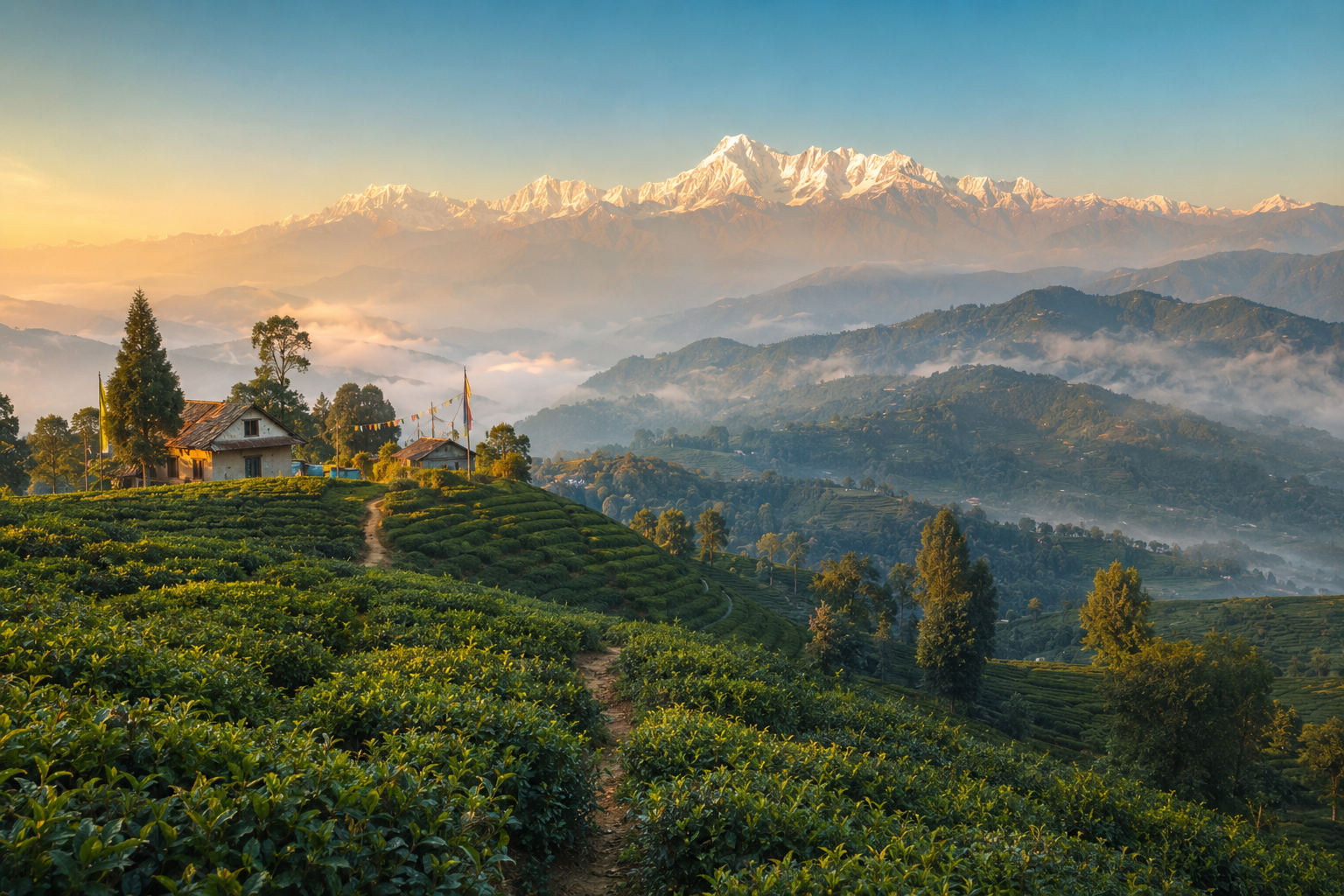
There is a moment on the road above Bhadrapur when eastern Nepal begins to reveal itself. The hot, flat Terai slips behind you. The road curls into cooler air. Tea bushes appear in clipped green lines, cardamom dries beside village homes, and a pale wall of Himalayan snow sometimes rises beyond the folds of the hills.
This is a different Nepal from the familiar circuit linking Kathmandu, Pokhara and Chitwan. It is greener, wetter and more culturally layered. Mornings begin with mist moving across tea slopes. Hill bazaars carry the smell of roasted corn, fermented greens and sweet milk tea. In the lowlands, the land opens into reed beds, river islands and the wide, restless water of the Koshi.
Eastern Nepal is not empty of visitors. Kanyam and Shree Antu can become lively with Nepali families at weekends, and pilgrimage seasons bring their own crowds. Yet travel a little more slowly, sleep in the smaller towns and visit popular viewpoints on ordinary weekdays, and the region still offers something increasingly rare: room to notice where you are.
Over the next fourteen days, you will follow that changing landscape from Ilam’s tea country to the temple courtyards and smoky evening grills of Dharan, then into the old hill streets of Dhankuta, the rhododendron forests above Basantapur and, finally, the open wetlands of Koshi Tappu. You will fly into Bhadrapur and leave from Biratnagar, tracing a natural line across the east instead of repeatedly turning back on yourself. If the road leaves you wanting more, Sandakpur, Pathibhara, Kanchenjunga and Makalu Barun are waiting beyond the main route.
Important planning note: Road conditions, domestic flight schedules, reserve fees and trekking regulations can change. Treat travel times and costs in this guide as planning ranges, then reconfirm them shortly before departure. USD conversions use a rounded planning rate of USD 1 = NPR 154, based on the Nepal Rastra Bank rate published on 19 July 2026. Your actual exchange rate may differ slightly.
The 14-Day Eastern Nepal Itinerary at a Glance
| Day | Route | Main experience | Suggested night |
|---|---|---|---|
| 1 | Kathmandu to Bhadrapur, then Ilam | First tea hills and an evening in Ilam Bazaar | Ilam |
| 2 | Ilam | Tea estates, local market and a slow hill-town day | Ilam |
| 3 | Ilam to Mai Pokhari and back | Sacred wetland, forest and village tea | Ilam |
| 4 | Ilam to Kanyam, Fikkal and Shree Antu | Tea landscapes and a community homestay | Shree Antu |
| 5 | Shree Antu to Dharan | Sunrise, the descent to the Terai and an eastern city evening | Dharan |
| 6 | Dharan | Vijayapur temples, markets and Kirati food culture | Dharan |
| 7 | Dharan to Bhedetar and Dhankuta | Hill viewpoints, waterfall country and old bazaar streets | Dhankuta |
| 8 | Dhankuta, Hile and Pakhribas | Farms, small-town life and eastern hill food | Dhankuta or Hile |
| 9 | Dhankuta to Basantapur | Cooler ridges and Limbu cultural landscapes | Basantapur |
| 10 | Tinjure ridge | Rhododendron forest and Himalayan views | Basantapur |
| 11 | Basantapur to Koshi Tappu | A full descent from the middle hills to the wetlands | Koshi Tappu |
| 12 | Koshi Tappu | Wild water buffalo habitat and grassland safari | Koshi Tappu |
| 13 | Koshi wetlands to Biratnagar | Early birding, riverside landscapes and the regional city | Biratnagar |
| 14 | Biratnagar to Kathmandu | Return flight or onward journey | Kathmandu |
Why Eastern Nepal Deserves a Journey of Its Own
The east changes quickly. Within one journey you move from humid plains to tea-covered hills, temperate forest and ridges above 3,000 metres. The food changes with the elevation. So do the languages, architecture, crops and rhythms of daily life.
Ilam is shaped by tea, ginger, cardamom, dairy farming and a long meeting of Lepcha, Limbu, Rai, Sherpa, Brahmin, Chhetri, Magar and Gurung communities. Around Dharan and the eastern hills, Kirati identity is deeply present in sacred places, food and family life. Dhankuta and Hile still feel like working hill towns rather than destinations arranged around tourists. At Koshi Tappu, human settlement gives way to riverine grassland and one of Nepal’s finest birding landscapes.
The region is also a lesson in scale. Kanchenjunga, the world’s third-highest mountain at 8,586 metres, stands beyond the tea hills. Makalu rises farther west. You will not always see them. Cloud is part of the eastern landscape, especially in summer. But on a clear autumn or spring morning, the sudden appearance of those white summits above green ridges feels almost impossible.
Who This Route Is For
- Travellers returning to Nepal who want to see beyond the classic first-time circuit
- Slow travellers interested in tea, food, markets, homestays and living culture
- Birdwatchers and nature lovers who want a quieter alternative to the busiest national parks
- Couples, families with older children and independent travellers comfortable with long road journeys
- Photographers who enjoy mist, layered hills, rural life and changing light more than fixed sightseeing checklists
This is not the ideal route for anyone who needs predictable luxury, perfectly timed transfers or constant Western-style facilities. The accommodation is often simple. Roads can be slow. Plans occasionally need to bend around weather, maintenance or local events. That uncertainty is not a flaw in the journey, but it should be understood before you begin.
The Best Time to Visit Eastern Nepal
| Season | What it feels like | Best for |
|---|---|---|
| October to early December | Clearer skies, green hills after the monsoon and comfortable walking temperatures | Mountain views, the complete circuit and first visits |
| March to April | Warmer days, spring colour and rhododendron bloom around Tinjure | Forest walks, flowers and photography |
| Late December to February | Cool to cold mornings in the hills, often clear, with possible frost at higher stops | Birding at Koshi Tappu and quiet travel |
| May | Hotter in the lowlands, hazier in the hills and increasingly humid | Tea country if you tolerate heat |
| June to September | Lush, dramatic and rainy, with cloud, leeches, flight disruption and landslide risk | Experienced flexible travellers who value greenery over views |
If this is your first trip to the region, late October through November is the most balanced window. For Tinjure’s rhododendrons, aim for late March or April, while accepting that flowering dates vary with elevation and the year’s weather. If you are tempted by the rain-washed beauty of summer, read our honest guide to travelling in Nepal during the monsoon before committing.
The Journey: Fourteen Days Through Eastern Nepal
Day 1: Fly to Bhadrapur and Climb into Ilam
Your journey begins above the Kathmandu Valley, with the city falling away beneath the wing and the Himalayan foothills rolling east in long green folds. The flight to Bhadrapur is short, yet what follows feels like a crossing between climates. Outside the airport, the air is warm and heavy. Rickshaws, motorbikes and produce vehicles move through the flatlands while the hills remain only a faint blue promise in the distance.
From Bhadrapur, travel by private car or jeep, or take local transport through Birtamod and onto the Mechi Highway. The road to Ilam usually takes around three to five hours. At first there are rice fields, roadside fruit stalls and the bright dust of the plains. Then the road begins to curl. The air cools through the open window, cardamom and ginger appear beside village shops, and the first geometric tea slopes gather near Kanyam. You will want to stop at every bend, but let the landscape introduce itself slowly. You are coming back this way with more time.
By the time you reach Ilam Bazaar, evening may already be settling between the hills. Check in, leave your luggage and walk without a list. Schoolchildren drift home in small groups. Vegetable sellers fold tarpaulins over the last bundles of greens. Somewhere nearby, milk tea is boiling with cardamom. Order a cup, wrap both hands around the warm glass and let the first day end gently.
Day 2: Tea, Market Life and an Unhurried Ilam
Ilam is easiest to understand in the morning, before the traffic fully wakes. The bazaar shutters rise one by one, fresh vegetables arrive in woven baskets, and mist rests in the folds below town. Follow the road towards nearby tea gardens where access is permitted. The bushes form careful green contours across the slope, but this is not scenery created for visitors. It is a working landscape, tended by real hands, so ask before entering planted areas or photographing workers closely.
A thoughtful tea visit begins after the photograph. Rub a leaf gently between your fingers. Ask how the tender tips are chosen, where they will be rolled and dried, and why rain, altitude and season change what finally reaches your cup. Taste orthodox tea without milk first, allowing its light, almost floral flavour to settle. Then compare it with the stronger CTC tea commonly boiled with milk and sugar. If a factory receives visitors, arrange the visit in advance rather than appearing at the gate and expecting entry.
Spend the afternoon on a short local walk, pausing at a viewpoint if the cloud lifts. Back in the market, look for Ilam cheese, seasonal fruit, scarlet akbare chillies and packets of tea labelled by local producers. There is no need to chase another attraction before dark. Eastern Nepal begins to feel generous when you stop asking it to fill every hour.
Day 3: Mai Pokhari, Forest and Sacred Water
After breakfast, the road narrows north of Ilam and slips between farms, forest and scattered homes. Mai Pokhari sits at roughly 2,100 metres. It looks close on a map, yet the bends, rougher sections and inevitable tea stops lengthen the journey. That is no hardship. Through the window you see terraces falling away, laundry bright against dark wooden houses, and children pausing on their way to school to watch the vehicle pass.
At Mai Pokhari, the temperature drops and the sound changes. Footsteps soften on damp earth. Birds move inside the forest before you see them. The lake is both an ecological place and a sacred one, its still water held by trees and small shrines. Walk gently, keep your voice low near worshippers and resist the urge to turn every sacred corner into a photograph. When mist moves across the water, the far bank disappears and the lake seems larger than it is.
Have a simple local lunch or fresh tea nearby, then return slowly to Ilam. If the road is dry and your driver knows the area, pause in a village on the way back. A conversation beside a smoky kitchen, with rain beginning softly on the roof, may become the memory that stays longest. The forest and the people around it are the day, not gaps between attractions.
Day 4: Kanyam, Fikkal and a Night in Shree Antu
The road south towards Kanyam is familiar now, but morning gives it a different colour. Tea leaves shine with dew and workers appear between the rows, baskets resting against their backs. Kanyam’s sculpted slopes are among the most recognised scenes in eastern Nepal. Come on a weekday morning if you can. At weekends and public holidays, the quiet green hills can fill with picnickers, horse rides, roadside stalls and slow traffic.
Continue through Fikkal, where sacks of produce, hardware shops, buses and lunch counters give the town its purposeful energy. Eat here, withdraw cash if the machine is working and buy anything you need before turning towards Shree Antu. Arrive while there is still light. Walk between tea plots and village homes as cooking smoke begins to rise, then return to your homestay for a meal prepared in the rhythm of the household rather than the timing of a hotel kitchen.
The room may be plain and the evening may grow colder than expected, but warmth arrives in other ways: another spoonful of rice, a story translated across the table, a flask of hot water left quietly beside your door. Ask before photographing family spaces. Learn a few names. Let the conversation find its own pace.
Day 5: Sunrise at Antu, Then West to Dharan
A knock at the door comes before dawn. Outside, the village is still dark and the path to Antu Danda is lit by torches and the occasional glow from a tea stall. At the viewpoint, the eastern sky slowly changes from ink to violet, then to a thin line of orange. On a clear morning, Kanchenjunga appears along the snowy horizon. On another morning, mist may close over everything except the nearest ridge. Both belong to Antu. A mountain hidden by cloud is not a failed sunrise.
Back at the homestay, breakfast tastes especially good after the cold start. Then comes the long descent through Fikkal towards Birtamod and west across the plains to Dharan. Allow around six to eight hours with traffic and breaks. A private vehicle makes the connection easier; public transport usually means changes and a little more patience. Watch the layers come off as the day warms and the tea hills recede behind you.
Dharan announces itself with heat, motorbikes and evening appetite. It is busier and more urban than Ilam, shaped by Gurkha histories and by the Limbu and Rai communities of the surrounding hills. After checking in, follow the smell of charcoal towards a sekuwa stall. The grill hisses, metal plates clatter and sharp pickle wakes you after the long road.
Day 6: Dharan Beyond a Transit Stop
Morning takes you uphill to Vijayapur, where bells, incense and old trees hold a quieter Dharan above the city traffic. Budha Subba, Dantakali and Pindeshwor are not museum pieces. They are active sacred places threaded into family vows, local identity and everyday worship. Dress modestly, remove shoes where required and ask before photographing ceremonies.
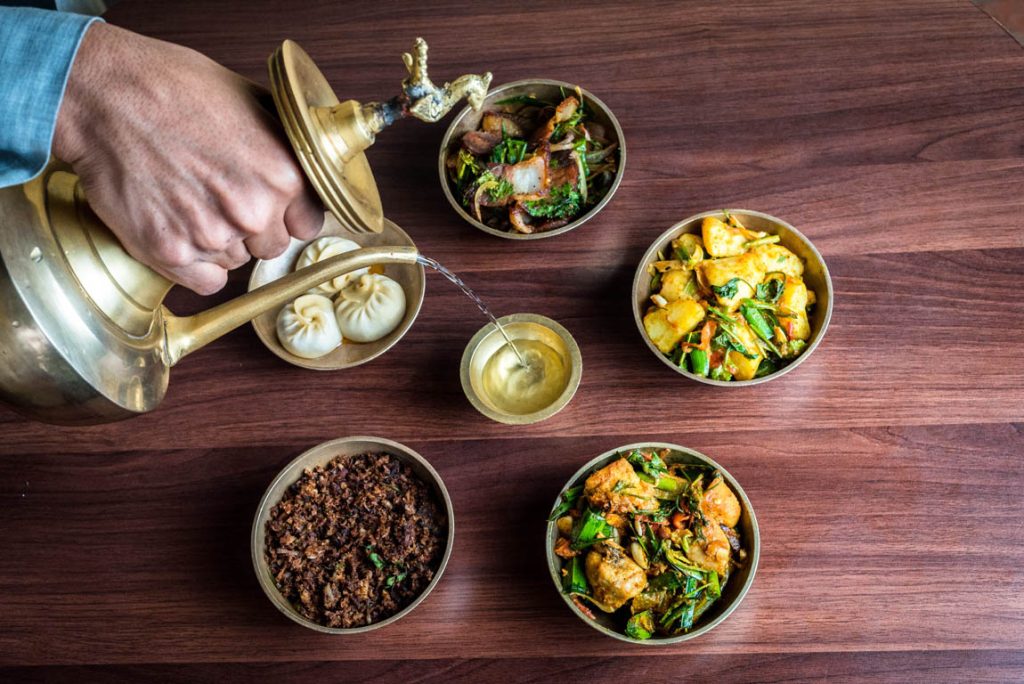
Later, return to the market streets and let lunch take its time. Dharan is one of the best places on this route to taste eastern Nepal. Kinema arrives with an aroma that may surprise you, followed by a deep fermented savouriness beside rice. Sinki and gundruk bring the bright sourness of preserved vegetables. Pork sekuwa is smoky at the edges, while akbare chilli adds a fragrant heat that grows after the first bite. If tongba is offered, sip the warm fermented millet slowly. It belongs to conversation, not hurry.
For a broader introduction before you order, read our traveller’s guide to the foods of Nepal. Remember that regional recipes vary by household and community. Ask what is local rather than demanding a dish by name.
Day 7: Bhedetar, Namaste Jharana and Dhankuta
The road out of Dharan climbs almost immediately. Windows mist at the edges, the hot plains spread wider below and, within an hour, you are reaching for the layer you packed away yesterday. Stop at Bhedetar when the sky is clear. Far below, roads and settlements flatten into haze. Continue towards Namaste Jharana if the access path is open and safe. Water fills the gorge with a cool roar, though warm weekends can be lively with local visitors. A weekday morning is gentler.
By late afternoon, Dhankuta’s old lanes and whitewashed buildings come into view. Walk through the bazaar as shopkeepers arrange the final sales of the day and cooking fires begin behind the houses. There is no headline monument waiting at the end of the street. The pleasure is the street itself, proportioned for walking and still belonging to the people who live around it.
Day 8: Dhankuta, Hile and Pakhribas
Today there is no need to pack your bag before breakfast. Drive north and east through countryside that feels intimate rather than spectacular: terraces fitted around the hill, orchards behind low walls, goats nosing at the roadside and produce jeeps carrying the harvest towards town. Hile sits higher and cooler. When cloud lifts, ridge after ridge appears beyond it.
Let a local driver shape the route around current road conditions and stop for lunch where residents eat. The kitchen may have only a few dishes, which is often a good sign. Rice arrives steaming, dal is poured at the table, and seasonal tarkari tastes of the field you passed half an hour earlier. Another helping may appear before you ask.
If you prefer fewer hotel changes, return to Dhankuta. If you want a cooler early start towards Basantapur, sleep in Hile.
Day 9: Into the Rhododendron Country of Basantapur
The road climbs north through Sindhuwa, and Basantapur waits at around 2,200 metres with colder air and darker forest. In spring, rhododendrons glow red and pink between the trees. In autumn, a clear bend in the road can suddenly open towards Makalu and Kanchenjunga. In winter, the sun may feel warm on your face while frost still holds the shaded ground.
Basantapur sits at the threshold of the Tinjure-Milke-Jaljale landscape and within a region deeply shaped by Limbu culture, alongside Rai, Gurung, Tamang, Brahmin, Chhetri and other communities. Walk close to town in the afternoon. Tea shops are good places to ask about tomorrow’s trail, the state of the road and whether the flowers have opened higher up. Arrange a local guide if visibility, route conditions or simple peace of mind make one sensible.
Accommodation is basic. Bring warm layers, cash and a small power bank. Do not assume reliable card payment, heating or fast internet.
Day 10: Walk the Tinjure Ridge
Morning comes cold in Basantapur. Breath hangs briefly in the air while tea steams beside breakfast. Set out towards the Tinjure ridge, which rises to roughly 3,000 metres. Choose the walk according to weather, road access and fitness rather than pride. A short viewpoint hike is enough to enter the forest properly. Stronger walkers can follow the ridge farther with local guidance.
In spring, petals lie on the path and entire branches burn with colour. Outside the flowering season, the forest asks you to look more closely: moss holding water, bark silvered by lichen, the sudden wingbeat of a bird inside the canopy. Then, if the cloud parts, Makalu and Kanchenjunga appear beyond an enormous sweep of country. The view feels earned even after a modest walk.
Do not confuse a short Tinjure visit with the full Tinjure-Milke-Jaljale trek. The longer route requires additional days, local route knowledge and more serious logistical planning. Weather can erase a trail quickly, and accommodation beyond the road-linked settlements is limited.
Day 11: Descend from Basantapur to Koshi Tappu
Today the whole geography of eastern Nepal seems to unroll beneath the vehicle. Leave Basantapur early, descend through Hile and Dhankuta, pass the turnings above Dharan and continue towards the plains. Wool layers disappear into your bag. The windows open. Cool forest gives way to bananas, rice fields and the broad, humid air of the Koshi basin. Allow roughly five to seven hours plus breaks, and keep the day loose enough for roadwork or traffic.
Stay beside the reserve rather than rushing through on a day trip. As evening settles, listen to how the journey changes again. Parakeets cross overhead, insects pulse in the grass and the horizon stretches flat and wide after days enclosed by hills. Dinner comes with the faint smell of river air and the promise of an early start.
Day 12: Koshi Tappu Wildlife Reserve
Before sunrise, tea arrives in the half-light and binoculars are passed across the table. Go out early, while dew still holds to the grass and the first bird calls travel clearly across the water. Koshi Tappu protects riverine grassland, marsh, scrub and wetland habitat. It is known above all for arna, Nepal’s wild water buffalo, and for an exceptional range of resident and migratory birds. Nothing is guaranteed, which is why a patient naturalist guide matters more than a hurried checklist.
The day may combine a guided walk, a vehicle excursion where permitted, time beside channels and long pauses at the edge of grassland. At first, you may notice only reeds moving in the breeze. Then your guide points out a shape, an ear, the curve of a horn. Ask your lodge or the reserve office which activities are operating, because water levels redraw this landscape through the seasons.
The Nepal Tourism Board currently lists the daily reserve entry fee as NPR 50, approximately USD 0.35, for Nepali visitors; NPR 500, approximately USD 3.25, for SAARC nationals; and NPR 1,000, approximately USD 6.50, for other foreign nationals. Confirm the fee and any activity charges before visiting. Pay at the authorised point and keep your permit with you.
Keep a respectful distance from all animals. Never pressure a driver or guide to chase wildlife for a closer photograph. Quiet observation is safer, kinder and usually more rewarding.
Day 13: Dawn Birding and Biratnagar
Go out once more before breakfast. By now your eyes have adjusted to the wetland. A shape you would have ignored yesterday becomes a kingfisher on a reed, a raptor circling above the grass or a line of winter visitors resting on open water after an extraordinary migration.
After breakfast, begin the drive towards Biratnagar. Depending on water conditions and local advice, pause responsibly near the Koshi river or barrage area. Do not build the day around a promised dolphin sighting. Stand for a moment instead and watch the river carry silt, birds and whole islands of reflected sky through the plains.
Biratnagar brings you back to traffic, commerce and evening heat. Find a local restaurant, order one last unhurried meal and look back at how far the landscape has travelled with you: from cool tea mist to rhododendron forest, then down to this warm borderland city.
Day 14: Fly Back to Kathmandu
The final morning is practical: breakfast, airport, the short flight west. Yet from the aircraft window, the east feels less like a list of places than a continuous landscape. Keep at least one buffer night in Kathmandu before an international departure. Weather, air traffic and operational changes can delay domestic flights even when the morning begins clear.
If you are arriving internationally before this journey, our Kathmandu airport, visa, SIM card, money and first taxi guide will help you organise the practical first hours.
How to Get Around Eastern Nepal
Flights
The cleanest version of this itinerary flies into Bhadrapur and out of Biratnagar. Both are connected to Kathmandu by scheduled domestic services, but frequency and fare vary by airline, season and passenger category. Book an earlier flight where possible and avoid placing an international connection on the same day.
Private Car or Jeep
A private vehicle gives the route its best balance of comfort and flexibility, particularly between Shree Antu and Dharan, around Dhankuta, and from Basantapur to Koshi Tappu. Confirm whether the quote includes fuel, driver accommodation, parking and waiting time. In the monsoon or on rough side roads, a high-clearance jeep may be more appropriate than a small car.
Public Transport
Buses, minibuses and shared jeeps connect the main towns, making the trip possible on a modest budget. They also make the timetable less predictable. Vehicles often leave when full, luggage space can be tight, and you may need to change in Birtamod, Dharan, Dhankuta or Hile. Build extra time into Days 5, 7, 9 and 11.
Self-driving is not recommended for most international visitors. Traffic behaviour, mountain roads, landslide exposure and vehicle paperwork create risks that are easy to underestimate.
How Much to Budget
Eastern Nepal can still be travelled affordably, but transport shapes the budget more than the difference between one plate of dal bhat and another. A shared jeep keeps costs low; a private vehicle buys comfort, time and the freedom to stop when cloud lifts over the hills. The following are broad 2026 planning ranges, not quotations. USD figures use the rounded rate of USD 1 = NPR 154.
| Travel style | Planning range per person for 14 days | What it assumes |
|---|---|---|
| Budget | NPR 90,000 to 140,000 USD 585 to 910 | Shared transport, simple rooms, local meals and advance domestic flight bookings |
| Comfortable independent | NPR 160,000 to 260,000 USD 1,040 to 1,690 | Private rooms, a mix of private and shared transport, guided reserve activities and more flexible meals |
| Private guided journey | NPR 260,000 and above USD 1,690 and above | Dedicated vehicle for most stages, guide support and higher-comfort stays where available |
These estimates exclude international flights, visas, travel insurance, personal shopping and optional trekking extensions. A solo traveller using private vehicles will pay considerably more per person than a couple or small group sharing the cost. Carry a contingency reserve of at least 15 per cent.
Where to Stay and What to Expect
- Ilam: Small hotels, guesthouses and a few more polished resorts in and around the tea landscape.
- Shree Antu: Community homestays and modest guesthouses. Book ahead for weekends and sunrise seasons.
- Dharan: The widest choice on the route, from practical city hotels to comfortable midrange properties.
- Dhankuta and Hile: Simple hotels and lodges suited to short stays.
- Basantapur: Basic lodges, limited heating and fewer reliable online booking options.
- Koshi Tappu: Wildlife lodges and tented-style accommodation, often including meals and guided activities.
- Biratnagar: Business hotels with dependable city facilities before the return flight.
Message accommodation directly to confirm hot water, attached bathrooms, heating, Wi-Fi, card payment and driver rooms. A listing may be technically accurate while creating the wrong expectation. “Hot water available” can mean one bucket at a set time. “Wi-Fi” may work only near reception. Flexibility makes the journey gentler.
What to Eat in Eastern Nepal
Food is one of the strongest reasons to travel slowly here. Look beyond a fixed checklist and ask what the kitchen makes well that day.
- Ilam tea: Taste it plain before adding milk or sugar so you can notice its aroma and lightness.
- Kinema: Fermented soybean with a powerful savoury smell and a deep, earthy taste.
- Gundruk and sinki: Fermented leafy greens or radish, served as soup, curry or pickle.
- Local pork and sekuwa: Particularly associated with the food culture around Dharan and the eastern hills.
- Akbare khursani: A round, fragrant chilli with serious heat. Begin cautiously.
- Tongba: Fermented millet steeped with hot water and sipped through a filtered straw. Drink moderately and never before a road journey if you are driving.
- Chhurpi and Ilam cheese: Dairy products ranging from soft cheese to very hard dried chhurpi.
- Dal bhat: The reliable daily plate, changing subtly with local vegetables, pickles and meat.
Drink treated, filtered or properly boiled water. Choose food cooked fresh and served hot, especially in the lowland heat. Carry oral rehydration salts and a reusable bottle with a reliable purification method.
Permits, Guides and Entry Requirements
The core 14-day circuit does not enter a restricted trekking area. You will need to pay the relevant entry fee at Koshi Tappu, and local guides are strongly recommended for wildlife activities and unfamiliar forest walks.
The rules change when you add Kanchenjunga or restricted parts of Taplejung. Nepal’s current restricted-area fee for the specified Taplejung wards is USD 20, approximately NPR 3,080, per person per week for the first four weeks, then USD 25, approximately NPR 3,850, per week beyond four weeks. Permits must be arranged through a registered trekking agency, and a licensed guide remains compulsory. Nepal revised restricted-area rules in 2026, including provisions for solo applicants, so verify the current process with the Department of Immigration and your agency before paying.
Read our overview of Nepal’s trekking rules, guides and permits before adding any serious trek. Permit rules are legal requirements, not optional paperwork.
Four Ways to Extend the Journey
1. Sandakpur from Ilam: Add 2 to 3 Days
Sandakpur rises to 3,636 metres on the Nepal-India border and offers an extraordinary Himalayan panorama in clear weather. Access and border arrangements can be confusing because routes interact with the frontier. Use a knowledgeable local operator, carry your passport and verify exactly where you are permitted to walk or drive. Do not improvise a border crossing.
2. Pathibhara, or Mukkumlung: Add 3 to 5 Days
The sacred hill in Taplejung, known as Pathibhara Devi to Hindu pilgrims and Mukkumlung within Limbu spiritual tradition, reaches about 3,794 metres. Reaching the pilgrimage trail requires a long road journey and conditions change with weather and construction. The altitude is high enough to deserve respect. Ascend slowly, carry warm and waterproof layers, and do not assume that road access removes the risk of altitude illness.
3. Kanchenjunga Trek: Add About 18 to 24 Days
Kanchenjunga is not a casual side trip. It is a remote high-altitude journey with long approaches, limited services and serious weather exposure. Plan it as a major trek through a registered agency with a licensed guide, appropriate restricted-area and conservation permits, evacuation-capable insurance and buffer days.
Before considering it, read our guide to altitude sickness in Nepal. Fitness does not prevent altitude illness, and the safest itinerary is the one willing to slow down or turn back.
4. Makalu Barun: Make It a Separate Expedition
Makalu Barun belongs to the wider eastern story, but it does not combine neatly with this road circuit. Access through Tumlingtar and the Arun Valley, challenging terrain and limited infrastructure deserve a dedicated itinerary. Explore the possibilities in our complete guide to Makalu Barun National Park.
What to Pack for the East
- Breathable clothes for the Terai and warm layers for Basantapur and Tinjure
- A light insulated jacket and a waterproof outer layer
- Walking shoes with grip, plus sandals or light shoes for towns
- Leech socks or long hiking socks during wet months
- Sun hat, high-factor sunscreen and insect repellent
- Binoculars for Koshi Tappu
- Reusable water bottle and reliable purification system
- Power bank, torch and offline maps
- Cash in small notes, with enough reserve for remote stops
- Personal medication, oral rehydration salts and a simple first-aid kit
- Passport copies, insurance details and digital backups
Pack for temperature change, not simply for the season named on the calendar. On Day 11 you can leave a cold ridge in the morning and arrive in subtropical heat by afternoon.
Health and Safety
- Road travel: Avoid unnecessary night driving, use seatbelts where fitted and choose experienced local drivers.
- Weather: Landslides, flooding, fog and flight delays are most likely during the monsoon, but disruption can happen in any season.
- Heat: Dharan, Koshi Tappu and Biratnagar can be hot and humid. Start early, drink regularly and rest at midday.
- Altitude: The core route briefly reaches around 3,000 metres at Tinjure. Pathibhara, Sandakpur and longer trekking extensions require more careful acclimatisation.
- Wildlife: Follow reserve staff and guides. Do not walk into grassland or river habitat alone.
- Insurance: Carry cover appropriate to your activities and maximum altitude. Ordinary sightseeing cover may exclude trekking or evacuation.
- Connectivity: Download maps and key numbers before leaving larger towns. Mobile coverage can disappear in forest, valleys and remote road sections.
How to Travel Here Responsibly
“Off the beaten path” should never mean treating a community as undiscovered. People live, work, worship and raise families in every landscape on this route. Travel with the awareness that you are a guest in someone else’s ordinary world.
- Stay in locally owned hotels and community homestays where possible.
- Buy tea and crafts from identifiable local producers, not simply the most photogenic roadside stall.
- Ask before entering tea fields, homes, kitchens, shrines or agricultural land.
- Do not photograph people closely without consent, especially children and worshippers.
- Carry a reusable bottle and refuse avoidable single-use plastic.
- Use trained local nature guides and respect viewing distances at Koshi Tappu.
- Pay agreed prices fairly. Bargaining should not become a contest over an amount that matters far more to the seller than to you.
- Learn the context of Kirati sacred landscapes rather than reducing them to sightseeing stops.
For a fuller introduction to respectful behaviour, dress and temple etiquette, read our culture and etiquette guide for visitors to Nepal.
Eastern Nepal Itinerary FAQs
How many days do I need for Eastern Nepal?
Fourteen days gives the tea hills, middle hills and Koshi wetlands enough space without turning every other day into a punishing transfer. With only one week, choose either Ilam and Shree Antu or Dharan, Dhankuta and Koshi Tappu. Do not attempt the entire circuit in seven days.
Is Eastern Nepal really free from crowds?
No destination is guaranteed to be crowd-free. Kanyam, Shree Antu, Bhedetar and Pathibhara are popular with domestic visitors, especially at weekends, public holidays and pilgrimage times. The wider region still receives fewer international tourists than Nepal’s classic routes. Travel midweek, stay overnight and begin early for a calmer experience.
Do I need a guide for this itinerary?
Not for the entire core road circuit. A nature guide is highly recommended at Koshi Tappu, and a local guide is sensible for unfamiliar forest or ridge walks. Restricted trekking extensions such as Kanchenjunga must follow current agency, permit and licensed-guide rules.
Can I travel through Eastern Nepal by public transport?
Yes. Main towns are linked by buses, minibuses and shared jeeps. You will need flexibility, local help and extra transfer time. A hybrid approach works well: public transport between major centres, then hired local vehicles for Mai Pokhari, Shree Antu, Tinjure and the reserve.
Is the route suitable for families?
Yes for families comfortable with long drives and simple accommodation. Slow the itinerary, book private transport for the longest transfers and skip demanding ridge walks with very young children. The core route does not require high-altitude trekking.
Which airport should I use?
Use Bhadrapur for Ilam and Shree Antu, and Biratnagar for Dharan and Koshi Tappu. Flying into Bhadrapur and out of Biratnagar creates an efficient one-way circuit.
What is the single best month for this trip?
November offers the best overall balance of clearer mountain views, comfortable hill weather, manageable road conditions and strong birding potential. April is the better choice if rhododendron bloom is your priority.
A Final Thought: Let the East Unfold Slowly
Eastern Nepal does not hand itself to you as a neat sequence of famous sights. It arrives in fragments: the clean bitterness of tea tasted where it grew, wet leaves shining beside Mai Pokhari, smoke curling from a Dharan grill, a rhododendron petal on the Tinjure path, the heavy wingbeat of a bird crossing the Koshi at dawn.
The road will sometimes be longer than promised. Cloud may hide the mountains. A bus may leave late, a homestay room may be colder than expected, and the finest meal of the journey may appear in a place you never wrote down.
That is why this part of Nepal deserves time. Do not come only to collect Ilam, Dharan or Koshi Tappu as names. Come to feel the country change under you, from warm plains to tea hills, from temple courtyards to forest ridges, and back down to a river wide enough to hold the morning sky.
Stay Informed With the Latest & Most Important News
Previous Post
Next Post
- Kathmandu Travel Guide: What to See, Where to Stay, Eat and How to Get Around
- From Mustang to the World: Shinta Mani Mustang Named the No. 1 Luxury Hotel on Earth
- Best Places to Visit in Nepal: A Complete Region-by-Region Guide for Every Traveller
- Trekking in Nepal: The Complete Guide to Choosing and Planning Your Himalayan Trek
- Beyond the Mountains: Why Nepal Could Become One of the World’s Great Food Destinations