Now Reading: Pokhara to Muktinath by Cable Car: Inside Nepal’s 81km World-Record Ambition
-
01
Pokhara to Muktinath by Cable Car: Inside Nepal’s 81km World-Record Ambition
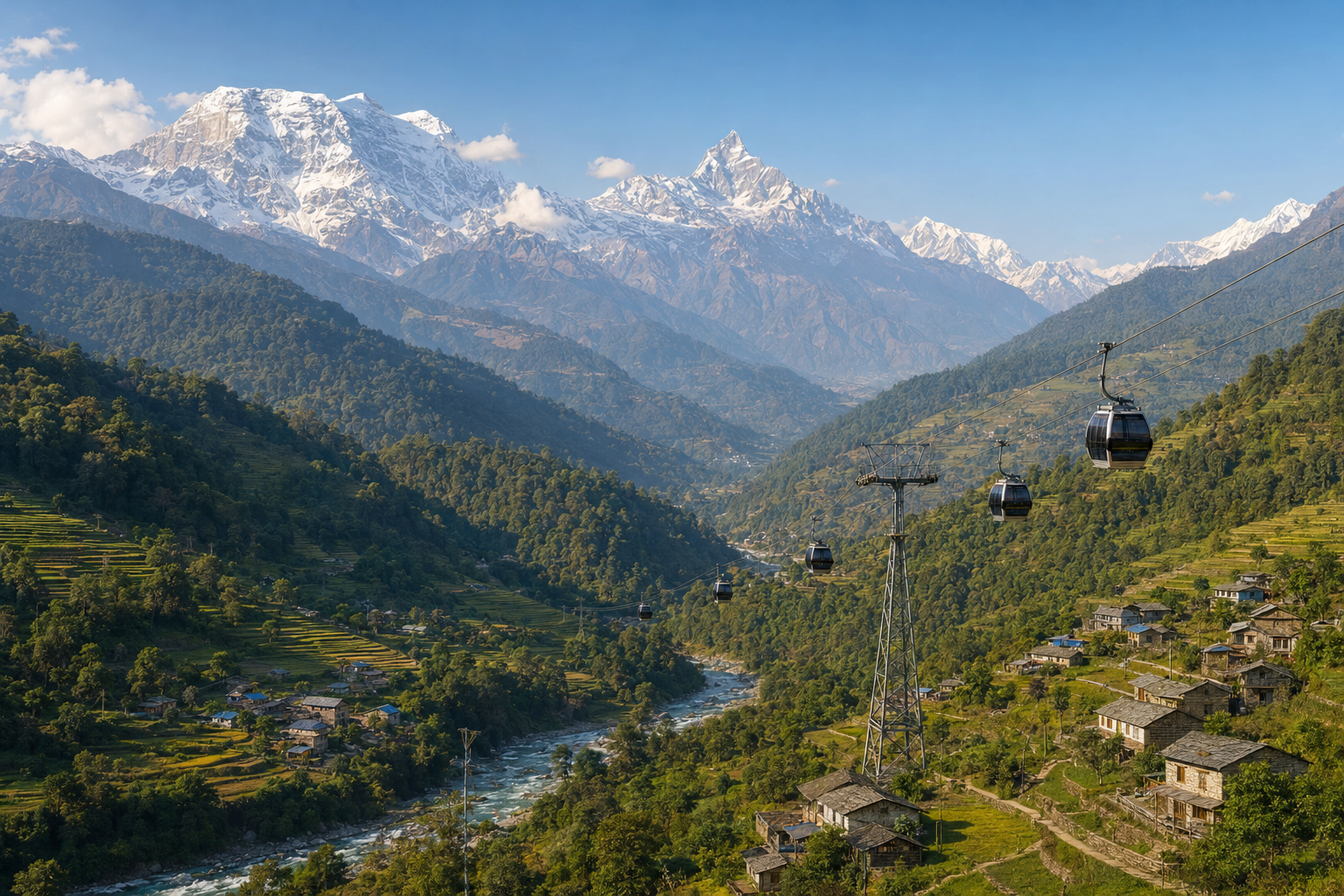
Pokhara to Muktinath by Cable Car: Inside Nepal’s 81km World-Record Ambition

Nepal is considering an 81.041-kilometre cable-car system from near Birethanti to Muktinath. Explore its extraordinary route, world-record claim, current status, opportunities and environmental questions.
Picture the journey for a moment.
You leave the soft, rain-washed hills near Birethanti, where the Modi Khola runs below terraces of rice and millet. A gondola carries you above the stone steps of Ulleri and the rhododendron forests around Ghorepani. The green slowly thins. The Kali Gandaki opens beneath you. Whitewashed villages appear among orchards and wind-shaped cliffs. By the time the cabin approaches Muktinath, the air outside is colder, the land has turned ochre and the Himalaya feels less like scenery than a presence.
It sounds almost impossible: an aerial journey of more than three and a half hours, crossing the great geographical transition from Nepal’s wet middle hills to the high, dry country of Mustang.
For now, it is still an imagined journey.
The proposed Pokhara to Muktinath cable car, more accurately the Sheraphant or Nayapul to Muktinath cable car, is one of the boldest tourism and transport ideas Nepal has ever considered. At a planned length of 81.041 kilometres, it is being presented as a future world-record cable car system. If completed broadly as designed, it would be far longer than any existing single public cable-car route and longer than the total network of many celebrated urban gondola systems.
Yet the size of the promise makes careful questions more important, not less. Could this transform pilgrimage and mountain travel? Could it spread opportunity through Gandaki Province? And can a project of this scale cross the Annapurna landscape without weakening the forests, communities and slow human journeys that make the region valuable in the first place?
First, what exactly is being proposed?
Although the project is often called the Pokhara to Muktinath cable car, the planned lower terminal is not beside Phewa Lake or in central Pokhara. The alignment begins at Sheraphant in Modi Rural Municipality, Parbat, close to the Birethanti and Nayapul gateway used by travellers entering the Annapurna region. From there, it would travel north through parts of Parbat, Kaski, Myagdi and Mustang before ending at Chengresi, below the Muktinath temple area.
The distinction matters for travellers. Pokhara would remain the principal tourism hub and likely arrival point for many passengers, but reaching the lower cable-car terminal would still require a road transfer.
| Proposed feature | Current published plan |
|---|---|
| Total length | 81.041 km |
| Lower terminal | Sheraphant, near Birethanti/Nayapul in Parbat |
| Upper terminal | Chengresi, below the Muktinath temple area in Mustang |
| Elevation | Approximately 1,009 m to 3,653 m |
| Stations | 20 in the 2026 draft Environmental Impact Assessment |
| Towers | 442 |
| Passenger gondolas | 871, with space for 10 passengers in each |
| Operating speed | Up to 7 metres per second |
| Projected non-stop journey | About 3 hours 36 minutes |
| Maximum electricity demand | About 13 MW |
| Approved investment estimate | NPR 57.64 billion, listed by the Government of Nepal as about USD 439.34 million |
| Developer | Muktinath Darshan Pvt. Ltd. |
| Development model | Build, Own, Operate and Transfer (BOOT) |
These figures describe a proposal under review. The final design, station arrangement, cost, capacity and operating plan may change before construction.
The planned route, from monsoon green to Mustang gold
Few transport routes anywhere could offer such a dramatic change of landscape. The alignment would begin among warm river valleys and cultivated hillsides, rise towards forests familiar to Poon Hill trekkers, enter the deep Kali Gandaki corridor, and continue through the old trading villages of lower Mustang.
The draft environmental study identifies 20 points along the alignment:
| Landscape section | Places along the proposed alignment | What defines the journey |
|---|---|---|
| Lower hills | Sheraphant, Bhukbesi, Ulleri and Ghorepani | Terraces, river valleys, stone settlements and rhododendron forest |
| Middle Kali Gandaki | Sikha, Ghar, Narchyang, Kabre, Pahirothaplo, Ghasa and Lete | Waterfalls, steep gorge country and the transition towards drier forest |
| Thak Khola | Kobang, Tukuche, Chokhopani, Marpha and Thini/Jomsom | Thakali villages, apple orchards, broad riverbeds and fierce afternoon winds |
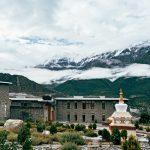
| Upper Mustang approach | Eklebhatti, Kagbeni, Khinga and Chengresi | Ochre cliffs, sacred river landscapes, Tibetan-influenced settlements and the approach to Muktinath |
This is not an empty corridor waiting to be crossed. It is a lived landscape of farms, forests, pilgrimage paths, teahouses, monasteries and villages with their own rhythms. Ghorepani wakes to bootsteps before sunrise. Marpha smells of timber smoke and apple. Kagbeni gathers around narrow lanes where wind carries dust from the Kali Gandaki. Any transport system passing through these places will change more than journey times.
Travellers who want to understand the route on foot can read our complete guide to the Annapurna Circuit. Those continuing north from Kagbeni can also explore our guide to Upper Mustang and the old kingdom of Lo.
Would it really be the longest cable car in the world?
In ordinary language, the answer would probably be yes, if the full 81.041-kilometre system is completed as currently designed. But world records in ropeway engineering are divided into precise categories, so the honest answer needs a little care.
Guinness World Records currently lists Mexico City’s Cablebús Line 2, measuring about 10.56 kilometres, as the longest public-transit cable-car route. It separately recognises Bolivia’s Mi Teleférico, with roughly 33 kilometres of track across several lines, as the largest public-transit cable-car network. Vietnam’s Phu Quoc system holds a different record for the longest non-stop three-rope cable car, at almost 7.9 kilometres.
The Muktinath proposal is more than seven times the length of the current record-holding public-transit route and well over twice the total length of the recognised Bolivian network. That makes Nepal’s ambition genuinely extraordinary.
However, no world record exists merely because a project appears on paper. Its final title would depend on what is actually built, whether passengers must change systems or disembark between sections, how the line is technically classified, and whether a recognised record body verifies it. For now, the fairest description is this: Nepal is proposing an 81-kilometre passenger cable-car system that could become the longest of its kind in the world.
Why the idea carries such power
A pilgrimage opened to more people
Muktinath is not simply a high-altitude attraction. Known to Tibetan Buddhists as Chumig Gyatsa, or the Hundred Waters, it is sacred to both Hindus and Buddhists. Pilgrims arrive to pray, bathe beneath the 108 water spouts and stand before the small eternal flame where earth, water, fire and air meet in one place.
The existing journey can be difficult for older devotees, families with young children, people with disabilities and anyone whose health makes rough roads or long walks impractical. A well-designed cable car could make the pilgrimage possible for thousands who currently hold Muktinath in their hearts but cannot comfortably reach it.
Accessibility will still need thoughtful design. Step-free stations, suitable toilets, sheltered waiting areas, medical support, clear altitude advice and a dignified final connection between the upper terminal and temple would matter as much as the gondolas themselves.
A new kind of Himalayan journey
Most cable cars deliver a short burst of altitude. This one would be a journey in its own right. A passenger could watch Nepal’s climate and geology unfold through the window over several hours, almost like turning the pages of a living atlas.
If intermediate tickets and sensible stopovers are allowed, the stations could encourage slower journeys rather than a single race to the temple. Visitors might pause for a night in Ghorepani, walk between two villages, visit an orchard in Marpha, or spend time in Kagbeni before continuing. The system could become a spine for many smaller local experiences.
Jobs and wider tourism income
The draft environmental reporting anticipates substantial employment during both construction and operation. Beyond direct jobs, there could be demand for local transport, food, guiding, accommodation, maintenance, farm produce and handicrafts.
But stations alone do not guarantee local prosperity. If passengers move from a company bus to a company gondola, eat in a company restaurant and sleep in a company resort, communities may see traffic passing overhead without receiving much benefit. Local procurement, fair leases, skills training, community shares and space for independent businesses would decide whether the cable car creates a corridor of opportunity or merely a corridor through the mountains.
An alternative to difficult roads and uncertain flights
The road through the Kali Gandaki has improved access enormously, but rain, landslides, dust, snow and maintenance can still make mountain travel unpredictable. Flights between Pokhara and Jomsom are quick when they operate, but wind and visibility often shape the schedule.
An electric cable system could offer another form of mass transport and might reduce some road journeys. It should not, however, be described casually as immune to weather. High winds, lightning, icing and severe storms can also interrupt ropeway operations. Reliability will depend on conservative operating limits, forecasting, redundant power, regular maintenance and safe places for passengers if a section closes.
The environmental question cannot be a footnote
The proposed line passes through one of Nepal’s most treasured protected landscapes. The Annapurna Conservation Area is not only a dramatic backdrop. Its forests, river systems and high-altitude habitats support wildlife, store water, protect slopes and sustain local livelihoods.
Reporting based on the 2026 draft Environmental Impact Assessment indicates that the project could affect around 229 households and require the removal of more than 24,500 trees across government, community and conservation forests. The proposed footprint includes stations, hundreds of towers and a long right-of-way corridor. Construction would also bring temporary roads, worker camps, excavation, spoil, noise and movement through sensitive terrain.
A cable car can produce less direct exhaust than thousands of individual vehicles, but “electric” does not automatically mean “low impact”. The full calculation must include forest loss, construction materials, electricity supply, new visitor demand, water use, waste, slope stability and the lifetime maintenance of 81 kilometres of infrastructure.
This is where Nepal has an opportunity to set a higher standard. The environmental assessment should be treated as a tool for changing and improving the design, not as paperwork to clear before construction. Tower locations should avoid the most sensitive habitats. Tree removal figures and compensatory planting should be independently verified. Wildlife movement, erosion, noise and water quality should be monitored for years, with results made public.
The landscape is the project’s greatest asset. Damaging it to sell a view of it would be a contradiction Nepal cannot afford.
What happens to the old road, the trail and the teahouse?
The cable car debate is sometimes framed as modernity against nostalgia, but the real choice is more practical. Nepal does not have to choose between access and walking. It does have to decide whether new infrastructure will complement local journeys or make them economically fragile.
Along the Annapurna and Kali Gandaki corridors, a visitor’s spending is distributed in small amounts: a plate of dal bhat in one village, tea in another, a room for the night, a guide’s wage, a porter’s work, apples bought beside the road. Fast transport can concentrate that spending at a few terminals.
Thoughtful ticketing could soften the effect. A flexible hop-on, hop-off model would allow passengers to combine short cable-car sections with village walks, cycling, road travel and trekking. Stations could include counters for local guides and homestays. Trailheads should remain clearly connected, and independent businesses should have fair access to commercial spaces.
The road will remain essential for residents, freight, emergency access and travellers who prefer to move at ground level. The trails will continue to offer something no cabin can reproduce: the smell of damp forest after rain, the effort of the climb, the conversation at a teahouse stove and the gradual understanding of distance earned one step at a time.
The cable car does not need to erase that journey. Done carefully, it could give travellers another way to enter it.
Seven tests the project should pass
- Transparent environmental scrutiny: Publish the final assessment, mitigation commitments, monitoring results and design changes in language local communities can use.
- Meaningful local consent and compensation: Consult affected households before decisions are fixed, compensate land and livelihood losses fairly, and create a clear process for grievances.
- Benefits that remain in the mountains: Reserve space for local businesses, train and hire locally, buy regional produce, and share revenue with communities along the route.
- Protection of pilgrimage: Keep the Muktinath temple area peaceful, manage visitor numbers and waste, and ensure that commerce does not overwhelm worship.
- World-class emergency planning: Design for earthquakes, wind, lightning, icing, landslides and power failure, with credible evacuation arrangements for every section.
- Responsible station development: Avoid a ribbon of oversized resorts. Buildings should respect water limits, local architecture, landscape scale and waste-treatment capacity.
- Integration rather than replacement: Connect the cable car with buses, roads, trails, homestays and local guides so that access grows without hollowing out the economy beneath it.
Where does the project stand in July 2026?
The project has moved beyond a casual concept, but it has not reached the stage where travellers can plan a cable-car journey.
- On 5 June 2025, Investment Board Nepal approved proposed investment of NPR 57.64 billion under a BOOT model and formed a committee to negotiate the Project Development Agreement with Muktinath Darshan Pvt. Ltd.
- The detailed project report was subsequently submitted for appraisal.
- In February 2026, the Ministry of Forests and Environment published notice of the project’s Environmental Impact Assessment for public feedback.
- An Investment Board Nepal update from March 2026 said experts reviewing the detailed project report and negotiation response had identified gaps and proposed actions to address them.
That means several important steps, including environmental clearance, final agreements, financing, detailed engineering, land access and construction, still determine what happens next. There is no confirmed opening date, and no official passenger fare has been announced. Any ticket prices or firm completion dates circulating online should therefore be treated as estimates rather than booking information.
Pokhara to Muktinath cable car FAQs
Is the Pokhara to Muktinath cable car operating?
No. As of 22 July 2026, it remains a proposed project moving through appraisal, negotiation and environmental review. Tickets are not on sale.
Does the cable car start in Pokhara?
Not in Pokhara city. The planned lower terminal is at Sheraphant near Birethanti/Nayapul in Parbat. Pokhara would still function as the main tourism gateway for many passengers.
How long would the journey take?
The draft plan projects a non-stop end-to-end journey of approximately 3 hours and 36 minutes. Actual passenger time could be longer where transfers or operating stops are required.
How high would the cable car go?
The proposed alignment rises from roughly 1,009 metres to an upper terminal around 3,653 metres at Chengresi. Muktinath temple itself sits higher, at approximately 3,800 metres, so the final connection to the sacred complex will be an important part of the access plan.
How much will a ticket cost?
No official fare has been confirmed. Prices quoted by travel companies or on social media are speculative at this stage.
Will it be the world’s longest cable car?
If the full 81.041-kilometre passenger system is built as proposed, it could become the world’s longest cable-car system of its kind. A formal record would depend on the completed design, technical category and independent verification.
Will the cable car replace trekking to Muktinath?
No transport can replace the experience of travelling slowly through the Annapurna and Kali Gandaki landscapes. It could change visitor patterns, however. Flexible station access and strong connections to trails and local businesses will determine whether trekking and cable travel support one another.
A record worth having, if Nepal gets it right
There is something unmistakably Nepali about the ambition behind this project. In a country where geography shapes almost every journey, the idea is to rise above the obstacle and turn the crossing itself into an experience.
One day, a cabin may really leave the green folds below Ghorepani and arrive hours later beneath the bare, luminous mountains of Muktinath. For an elderly pilgrim, that ride could fulfil a lifelong prayer. For a child looking down at the Kali Gandaki, it could become the memory that defines Nepal. For villages along the route, it could bring new work and new possibilities.
But the best measure of success will not be an 81-kilometre figure or a plaque declaring a world record. It will be whether forests still hold the slopes, whether local families share in the prosperity, whether trails remain alive, and whether pilgrims step out into the Muktinath wind with the same sense of humility the sacred landscape has always asked of them.
Nepal has the chance to build the world’s longest cable car. The greater achievement would be to build the world’s most thoughtful one.
Research and status note: This article was reviewed on 22 July 2026 using the Investment Board investment announcement, the Ministry of Forests and Environment EIA notice, Investment Board Nepal’s March 2026 project update, the Government of Nepal’s Fiscal Risk Statement and Strategies 2025, and current Guinness World Records cable-car records. Project details may change as reviews and negotiations continue.
Related Posts
Stay Informed With the Latest & Most Important News
Previous Post
Next Post

- Kathmandu Travel Guide: What to See, Where to Stay, Eat and How to Get Around
- From Mustang to the World: Shinta Mani Mustang Named the No. 1 Luxury Hotel on Earth
- Best Places to Visit in Nepal: A Complete Region-by-Region Guide for Every Traveller
- Trekking in Nepal: The Complete Guide to Choosing and Planning Your Himalayan Trek
- Beyond the Mountains: Why Nepal Could Become One of the World’s Great Food Destinations