Now Reading: Manaslu Circuit Trek: The Complete 2026 Guide
-
01
Manaslu Circuit Trek: The Complete 2026 Guide
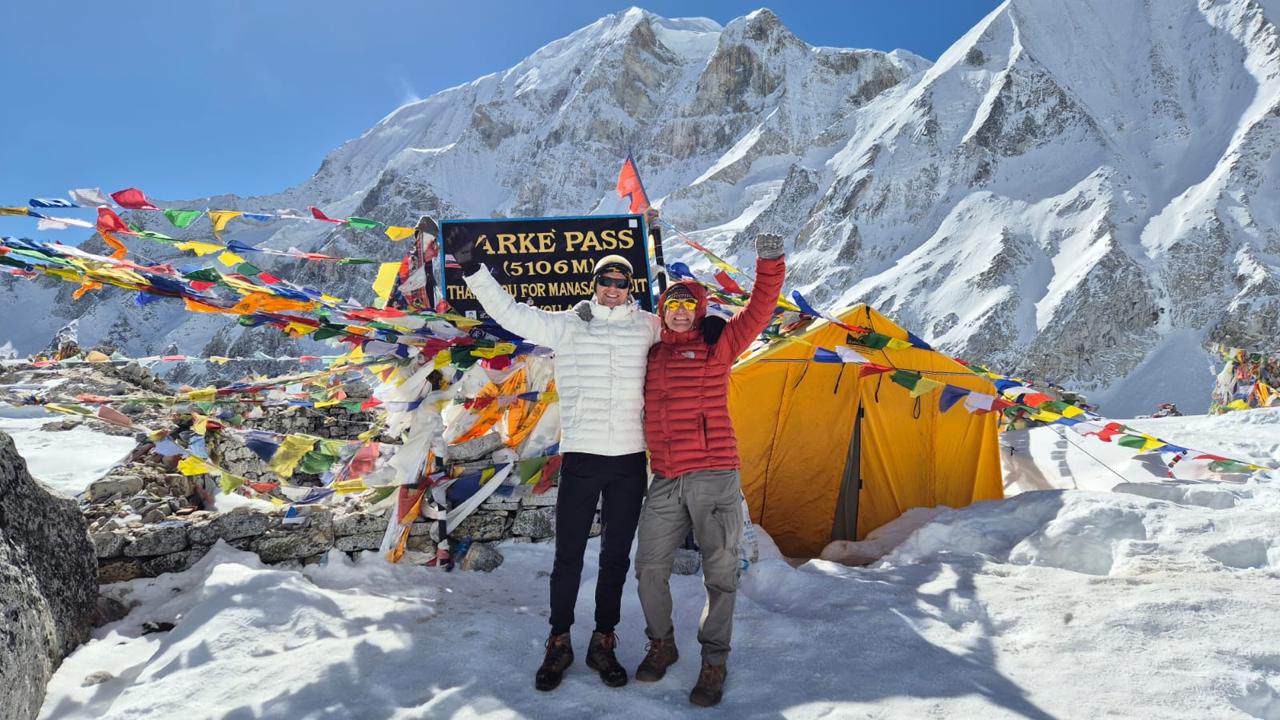

A practical 2026 guide to the Manaslu Circuit Trek, including the route, 15-day itinerary, Larkya La, permits, solo-traveller rules, costs, packing and altitude safety.
The road beyond Arughat does not ease you into the Manaslu Circuit. It rattles, bucks and curls above the Budhi Gandaki, where the river flashes white between dark walls of rock. Dust slips through the jeep windows. Waterfalls drop from impossible heights. By the time you reach Machha Khola, your shoulders are tired, your phone signal is fading, and the journey already feels much farther from Kathmandu than the map suggests.
That feeling of leaving the familiar behind is part of Manaslu’s pull. The trail begins in warm, green river country and climbs steadily towards stone villages, Buddhist monasteries, yak pastures and the thin, cold air of Larkya La. Above it all stands Manaslu, 8,163 metres of snow, ice and shadow, revealing itself slowly rather than all at once.
This complete 2026 guide is for travellers who want the practical truth as well as the romance: how long the trek takes, which permits you need, what changed for solo travellers in 2026, how hard the pass really feels, where to acclimatise, what the teahouses are like, what to budget, and how to prepare without turning the whole journey into a military operation.
Manaslu Circuit Trek at a Glance
| Location | Gorkha and Manaslu regions, north-central Nepal |
|---|---|
| Typical duration | 14 to 18 days including road travel |
| Walking distance | Roughly 170 to 180 kilometres, depending on the route and road access |
| Highest point | Larkya La, approximately 5,106 metres |
| Usual starting point | Machha Khola, reached by road from Kathmandu |
| Usual finishing point | Dharapani, followed by road travel through Besisahar |
| Difficulty | Challenging high-altitude trek, with no technical climbing |
| Best seasons | March to May and late September to November |
| Accommodation | Simple local teahouses |
| Guide rule | A licensed guide and registered trekking agency remain compulsory |
| 2026 solo-traveller rule | Individual restricted-area permit applications are now permitted, but unsupported solo trekking is not |
Important: Permit fees, road conditions and local charges can change. Treat the figures in this guide as a carefully checked planning baseline, then ask your registered trekking agency to reconfirm everything before your permits are issued.
Why Choose the Manaslu Circuit?
Manaslu is often described as the quieter alternative to the Annapurna Circuit, but that is only part of the story. It is quieter, certainly. You can still walk for long stretches with the river, wind and mule bells as your main companions. Yet the trek is not simply an emptier version of somewhere else. It has its own rhythm.
The lower valley is humid and exuberantly green. Banana leaves lean over the trail, monkeys move through the trees, and the Budhi Gandaki keeps appearing below you, sometimes broad and brown, sometimes squeezed into a furious white channel. Higher up, the architecture changes. Flat-roofed stone houses replace the painted lodges of the lower hills. Chortens stand at village entrances. Mani walls guide you past fields of barley and potatoes. The language, clothing, food and religious life increasingly reflect the valley’s long relationship with Tibet.
Then there is Manaslu itself. At Lho and Shyala, the mountain stops being a distant name and becomes a physical presence, filling the end of the valley with a white, fluted wall. In the early morning, its ridges catch the sun while the village remains blue with cold. Smoke rises from kitchen roofs. Somewhere, a kettle begins to whistle. These are the moments the trek gives back to you long after the aching knees have been forgotten.
Manaslu is also a good fit for trekkers who find the commercial energy of the Everest route overwhelming but still want a major Himalayan journey. It has teahouses, hot meals and established stages, yet it retains a stronger sense of remoteness. For a wider comparison of Nepal’s classic routes, see our guide to the best trekking routes in Nepal.
Is the Manaslu Circuit Right for You?
This trek is not technically difficult. You do not need climbing experience, ropes or mountaineering skills in normal conditions. What you do need is patience, steady fitness and respect for altitude.
Most days involve five to seven hours of walking, often on uneven stone paths with repeated climbs and descents. The pass day can take eight to ten hours, beginning before dawn in freezing conditions. Accommodation becomes more basic as you climb, menus become shorter, and phone coverage becomes unreliable. The road journey at the beginning and end is long, rough and occasionally delayed by landslides or traffic.
You are likely to enjoy Manaslu if you have already completed multi-day hikes, can walk on consecutive days without needing luxury at the end, and are comfortable letting weather and mountain conditions shape the plan. It is less suitable as a first-ever hike for someone who dislikes cold, has very limited time, or wants certainty around transport, Wi-Fi and private bathrooms.
If you are deciding between this trail and the more developed route to the west, our Annapurna Circuit guide will help you understand the differences in access, scenery, crowds and comfort.
A Thoughtful 15-Day Manaslu Circuit Itinerary
There are faster itineraries, but the Manaslu Circuit is not improved by rushing. The following plan gives the body time to adapt and leaves a little room for the unpredictable nature of mountain travel. Walking times are approximate and will vary with weather, trail conditions, pace and lodge location.
Day 1: Kathmandu to Machha Khola, around 870 metres
Leave Kathmandu early. The first part of the drive follows the Prithvi Highway before turning towards Dhading, Arughat and the rougher road north. Expect a long day, commonly eight to ten hours and sometimes more. The final section can be dusty, muddy or deeply rutted, depending on the season.
Machha Khola is a small roadside settlement beside the river. The first evening is for stretching stiff legs, eating an early dal bhat and listening to the Budhi Gandaki in the dark.
Day 2: Machha Khola to Jagat, around 1,340 metres
The trek begins among subtropical vegetation, hot springs, cliff-side paths and suspension bridges. The valley can feel almost tropical, especially in spring or early autumn. Jagat is a handsome stone village and an important permit checkpoint, marking the entrance into the regulated section of the route.
Day 3: Jagat to Deng, around 1,860 metres
The trail threads through villages such as Salleri, Sirdibas and Philim before climbing and descending above the river. Waterfalls stream down the opposite wall of the gorge. Beyond the junction for Tsum Valley, the path turns towards the quieter upper Budhi Gandaki.
Day 4: Deng to Namrung, around 2,630 metres
The air begins to cool. You pass through forest, cross the river repeatedly and notice the first clear signs of Tibetan Buddhist culture. Stone mani walls appear beside the trail, and the villages feel more enclosed by mountain walls. Namrung is a comfortable place to stop before the higher country begins in earnest.
Day 5: Namrung to Lho or Shyala, around 3,180 to 3,500 metres
This is one of the trek’s great transition days. The valley opens, fields spread around the villages, and Manaslu begins to dominate the skyline. Lho has a beautiful monastery above the settlement and one of the classic views of the mountain. Shyala sits higher in a broad amphitheatre of peaks and can be a wonderful overnight stop when conditions and lodge availability allow.
Day 6: Lho or Shyala to Samagaun, around 3,530 metres
The walk is not especially long, which is exactly what you want at this altitude. Samagaun is the main settlement of the upper valley, a cluster of stone houses, fields and lodges beneath Manaslu. Arrive slowly, drink well and resist the temptation to treat the short day as an invitation to race.
Day 7: Acclimatisation day in Samagaun
Do not think of this as a day off. Think of it as the day that helps make the pass possible. A gentle walk to Birendra Lake is suitable for many trekkers. Stronger, well-acclimatised walkers may continue towards Manaslu Base Camp, while Pungyen Gompa offers another beautiful option with wide valley views.
The aim is to climb higher during the day and return to sleep in Samagaun, while paying close attention to any headache, nausea, unusual fatigue or disturbed coordination. Our detailed guide to altitude sickness in Nepal is worth reading before you leave home, not when symptoms begin on the trail.
Day 8: Samagaun to Samdo, around 3,860 metres
The path rises gradually through a wide, austere valley. Vegetation thins, the sky feels larger, and yak herds replace the lower valley’s mules and goats. Samdo is a compact village close to the Tibetan border, built for wind and winter. The afternoon should be quiet, with warm layers on before the sun disappears.
Day 9: Acclimatisation and contingency day in Samdo
This second acclimatisation day is one of the best safety investments in the itinerary. A gradual hike towards the border viewpoint or surrounding ridges can help the body adjust, but the exact route should be chosen with your guide. The day also creates breathing room if earlier road or weather delays have affected the schedule.
Day 10: Samdo to Dharamsala, around 4,460 metres
This is a short but important climb to the final lodge before Larkya La. Dharamsala, also called Larkya Phedi, is basic and exposed. Rooms may be crowded in peak season, water can freeze overnight, and the menu is limited. Pack your bag for the morning before dinner, charge what you can, and go to bed early even if sleep comes lightly.
Day 11: Cross Larkya La, around 5,106 metres, to Bimthang, around 3,590 metres
The day usually begins between 3:00 and 5:00 am. Headlamps pick out stones, breath hangs in the air, and the first hours pass in a small pool of light. The climb is long rather than brutally steep, but altitude makes every step deliberate.
At the pass, prayer flags pull hard in the wind and the view opens towards Himlung Himal, Cheo Himal, Kang Guru and the Annapurna range. Do not linger too long if the weather is changing. The descent towards Bimthang is sustained and can be icy, loose or hard on tired knees. Reaching the lodge, taking off your boots and wrapping both hands around a hot drink can feel as satisfying as the pass itself.
Day 12: Bimthang to Gho or Tilije, around 2,300 metres
Morning in Bimthang is often luminous, with snowy ridges rising beyond the meadow. The trail then descends into rhododendron and pine forest, crossing streams and returning gradually to thicker air. After the stark upper valley, the smell of damp earth and trees can feel almost luxurious.
Day 13: Tilije to Dharapani and onward to Besisahar
The Manaslu route meets the Annapurna Circuit at Dharapani. Depending on road conditions and timing, you may continue by local jeep towards Besisahar or stop along the way. This transport day is rarely elegant, but it is part of the modern circuit.
Day 14: Besisahar to Kathmandu
Return to Kathmandu by road. Traffic can stretch the journey, so avoid booking an international flight for the same evening. A hot shower, clean clothes and a meal that did not arrive by mule will feel wonderfully extravagant.
Day 15: Buffer day in Kathmandu
Keep one flexible day before flying home. Mountain roads, illness and weather do not care about tight flight connections. Use the time to rest, explore or simply sit somewhere warm and let the trek settle. Our Kathmandu neighbourhood guide can help you choose a comfortable base before and after the trek.
Manaslu Permits and Trekking Rules for 2026
Manaslu is both a conservation area and a restricted border region. That means more paperwork than on many of Nepal’s standard routes. Your registered trekking agency will normally arrange the documents, but you should still understand what you are paying for.
1. Manaslu Restricted Area Permit
For the Gorkha Manaslu restricted area, the official 2026 fee is USD 100 per person for the first seven days from September to November, followed by USD 15 for each additional day. From December to August, the fee is USD 75 for the first seven days and USD 10 for each additional day.
This permit is processed through the Department of Immigration by a registered trekking agency. It is not a permit you simply buy at the trailhead.
2. Manaslu Conservation Area Permit
The Manaslu Conservation Area Permit, usually shortened to MCAP, costs NPR 3,000 for most foreign visitors and NPR 1,000 for SAARC nationals. Children under ten do not require the conservation-area entry permit.
3. Annapurna Conservation Area Permit
You also need an Annapurna Conservation Area Permit, or ACAP, because the route exits through Dharapani into the Annapurna region. The standard entry fee is the same as MCAP: NPR 3,000 for foreign visitors and NPR 1,000 for SAARC nationals.
4. TIMS Card
The Nepal Tourism Board’s current route list includes the Manaslu Circuit among treks requiring a trekking-agency-issued TIMS card and a licensed guide. The listed charge is NPR 2,000 for most foreign trekkers and NPR 1,000 for SAARC nationals, payable through the agency system. Because advice online remains inconsistent, ask your agency to show the full permit breakdown in writing rather than relying on an old blog post or forum comment.
5. Local municipality charge
A local charge may also be collected by Chumnubri Rural Municipality, commonly reported at around NPR 1,000. Confirm the current amount and where it is payable with your agency.
What changed for solo travellers in March 2026?
The old minimum of two foreign trekkers for restricted-area permit applications was removed in March 2026. A single foreign traveller can now apply for access to restricted areas including Manaslu.
That does not mean you can walk the Manaslu Circuit completely alone. Your trip must still be organised through a registered trekking agency, and you must still be accompanied by a licensed guide. The practical meaning of the change is simple: you no longer need to find another paying trekker merely to qualify for the permit.
Rules elsewhere in Nepal vary by route and can be confusing. Before paying, compare your agency’s advice with the latest Department of Immigration permit notice and the Nepal Tourism Board TIMS guidance.
The Best Time to Trek Manaslu
Autumn: late September to November
Autumn is the classic season. The monsoon has washed dust from the air, mountain views are often crisp, and the days are generally stable. October offers the most reliable conditions, but it is also the busiest month. Teahouses at Samagaun, Samdo and Dharamsala can fill quickly, and guide availability becomes tighter.
Late September can still carry monsoon moisture, while late November brings colder nights and a greater chance of snow. Both can be rewarding for travellers willing to accept a little more uncertainty.
Spring: March to May
Spring brings warmer lower valleys and rhododendron colour through the forests. March can be cold at the pass, April is often the best balance, and May may bring haze, cloud and pre-monsoon storms. The trail is usually quieter than in October, though snow conditions on Larkya La still require careful checking.
Winter: December to February
Winter can deliver brilliant skies and profound silence, but it is a serious undertaking. Heavy snow may close the pass, high lodges may shut, water freezes and temperatures at Dharamsala can fall far below freezing. Only consider it with an experienced local team, flexible dates and proper cold-weather equipment.
Monsoon: June to early September
The lower route is exposed to heavy rain, swollen rivers, leeches, landslides and difficult road access. Cloud can hide the mountains for days. The landscape is intensely green and villages are quiet, but for most travellers this is not the season to choose for a first Manaslu Circuit.
For a wider view of Nepal’s seasons, festivals and regional weather, read our month-by-month guide to the best time to visit Nepal.
What the Larkya La Crossing Really Feels Like
Larkya La is the physical and emotional high point of the circuit. It is not a knife-edge pass or a technical climb. In good conditions, the route is broad and walkable. The challenge comes from the altitude, cold, distance and unpredictability of snow.
The morning begins in darkness. Your water bottle may already be rimmed with ice. The world outside the lodge is silent except for zips, boots and the soft conversations of guides checking their groups. The climb unfolds slowly over moraine and open ground. Sunrise reaches the highest summits first, turning them pale gold while you remain in shadow.
The pass itself can be windy and bitterly cold. Take photographs, breathe, absorb the view, then begin the long descent before fatigue and afternoon weather build. Trekking poles are extremely helpful. Microspikes may be recommended when the trail is icy, particularly early or late in the season. Your guide should make that decision based on current conditions, not a packing list written months earlier.
Altitude, Acclimatisation and Health
The route rises from below 1,000 metres to more than 5,000 metres. Fitness helps you walk, but it does not make you immune to altitude illness. The safest itinerary is one that climbs gradually, includes acclimatisation days and allows descent without argument when symptoms become concerning.
A mild headache can have several causes on a trek, including dehydration, sun and poor sleep. A worsening headache combined with nausea, unusual exhaustion, loss of appetite or dizziness deserves attention. Confusion, poor coordination, breathlessness at rest or a wet cough are emergencies. The correct response to serious altitude illness is descent and medical help, not stubbornness.
Drink regularly, eat even when your appetite fades, avoid alcohol high on the route and keep the acclimatisation days. Discuss acetazolamide with a qualified clinician before travelling. It should not be used as a substitute for a sensible ascent profile.
Travel insurance should cover trekking above 5,000 metres, emergency medical treatment and helicopter evacuation. Read the altitude limit and exclusions rather than trusting the product name. Our guide to trekking insurance for Nepal explains what to look for in a policy.
Teahouses, Food and Everyday Comfort
Rooms
Most teahouse rooms are simple twin rooms with plywood or stone walls, basic beds, a foam mattress, blanket and shared bathroom. Lower down, you may find attached bathrooms and hot showers. Higher up, toilets are more basic, water may freeze, and a bucket wash may be more realistic than a shower.
Carry a proper sleeping bag rated for cold Himalayan nights. Teahouse blankets are useful but should be treated as an extra layer, not your entire sleep system.
Food
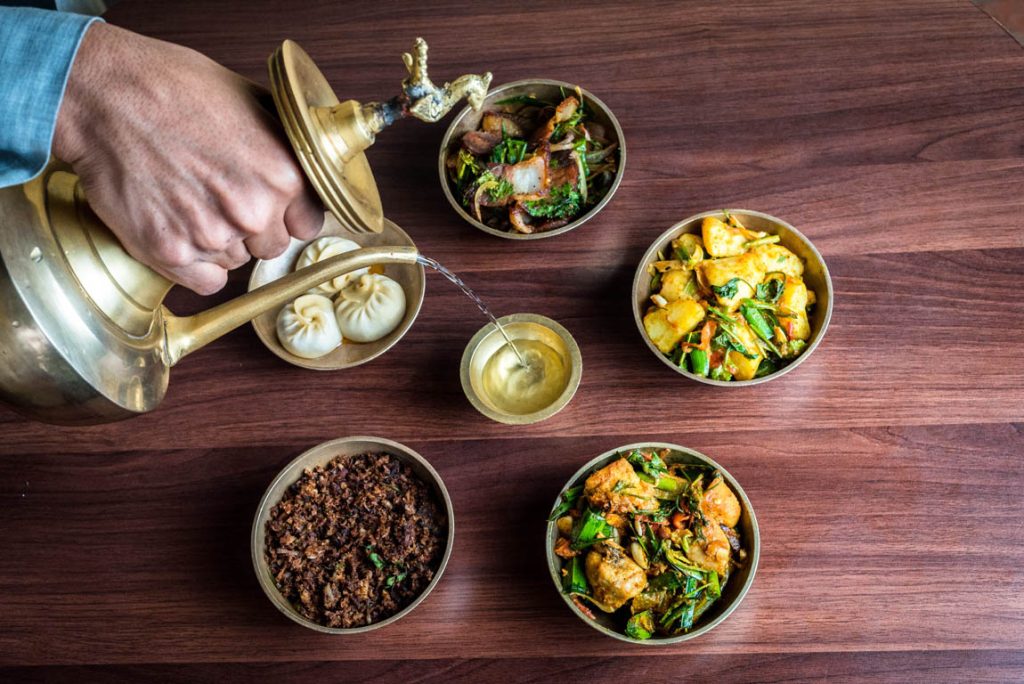
Dal bhat is the dependable heart of the trail: rice, lentils, vegetable curry, greens, pickle and usually free refills. You will also find noodle soup, fried rice, potatoes, pasta, eggs, porridge, Tibetan bread and momos in larger villages. Menus become shorter and prices rise with altitude because almost everything has travelled by mule, porter or jeep.
Order local, simple meals when possible. They are often fresher, warmer and easier for the kitchen to prepare than an ambitious imitation of a Western dish. At altitude, a bowl of garlic soup or steaming thukpa can feel like medicine even when it is simply dinner.
Water
Avoid building your hydration plan around disposable plastic bottles. Carry two reusable bottles or a bottle and hydration bladder, then purify tap or stream water with a filter, chlorine dioxide or another reliable method. Keep a backup treatment in case your filter freezes or fails.
Electricity, charging and connectivity
Charging is usually available for a fee, but power can be limited and solar systems depend on the weather. Carry a high-capacity power bank and keep electronics warm at night. Mobile coverage is intermittent. Some lodges offer paid Wi-Fi, but it should be treated as a pleasant surprise rather than a promise.
How Much Does the Manaslu Circuit Cost in 2026?
Manaslu usually costs more than a standard teahouse trek because of the restricted-area permit, compulsory guide, multiple conservation permits and long road transfers.
| Expense | Planning range |
|---|---|
| Restricted Area Permit | USD 75 to 100 for the first week, plus extra days according to season |
| MCAP | NPR 3,000 for most foreign visitors |
| ACAP | NPR 3,000 for most foreign visitors |
| TIMS | NPR 2,000 for most foreign trekkers and NPR 1,000 for SAARC nationals |
| Local municipality charge | Commonly reported at around NPR 1,000, subject to confirmation |
| Licensed guide | Often around USD 30 to 45 per day, depending on experience and inclusions |
| Porter | Often around USD 25 to 35 per day, depending on load, insurance and season |
| Teahouse room | Usually modest, but often conditional on eating dinner and breakfast at the lodge |
| Meals and drinks | Budget more each day as altitude increases |
| Road transport | Varies widely between local bus, shared jeep and private jeep |
| Full package | Commonly about USD 1,300 to 2,200 or more, depending on group size and inclusions |
Ask for a written list of inclusions. Some prices cover permits, guide, porter, transport, meals and accommodation. Others cover only a guide and paperwork. Cheap quotes can become expensive once meals, staff insurance, transport and taxes are added.
Tips are not legally compulsory, but they are an established part of trekking culture. Base them on service, trip length and team size. Give tips directly, ideally in a small group meeting where guides and porters are acknowledged by name.
Getting to the Trail and Back
The usual approach is by road from Kathmandu to Machha Khola. Public buses are cheaper but slow and crowded. Shared jeeps are faster and more comfortable, though “comfortable” is relative on the final unsealed section. A private jeep offers flexibility but becomes expensive for one or two people.
At the end, trekkers descend to Dharapani and connect with the road towards Besisahar. Road construction continues to change where walking ends and vehicle travel begins. In the monsoon, landslides can interrupt the route. In peak season, jeeps can fill quickly.
Build at least one spare day into the end of your Nepal itinerary. Our step-by-step Nepal trip-planning guide covers visas, money, transport and the small preparations that make arrival easier.
What to Pack for Manaslu
You are packing for several climates at once. The first days may be warm enough for a light shirt. The pass morning may be well below freezing. A flexible layering system is more useful than one enormous coat worn over unsuitable clothes.
- Broken-in trekking boots with reliable grip
- Light camp shoes or sandals
- Moisture-wicking base layers
- Fleece or active insulation
- Warm down or synthetic jacket
- Waterproof jacket and trousers
- Warm hat, sun hat, liner gloves and insulated gloves
- Trekking trousers and thermal leggings
- Cold-rated sleeping bag
- Trekking poles
- Headlamp with spare batteries
- Reusable water bottles and purification system
- Sunglasses with strong UV protection and high-factor sunscreen
- Personal first-aid kit and prescribed medication
- Power bank, charging cables and waterproof document pouch
- Toilet paper, hand sanitiser and a small pack towel
- Microspikes when current snow and ice conditions justify them
For a full layering system and advice on what to bring from home versus buy in Kathmandu, use our complete Nepal trekking packing guide.
Training for the Trek
Start training at least eight to twelve weeks before departure if your current routine is light. The most useful preparation is not a single heroic workout. It is the quiet consistency of walking, climbing and recovering, then doing it again.
- Build to one long hill walk each week
- Add a second walking day to practise moving on tired legs
- Use stairs or steep inclines when hills are unavailable
- Strengthen calves, quadriceps, glutes and core
- Practise descending, which often causes more soreness than climbing
- Walk in the boots and daypack you will use in Nepal
- Keep some mobility and recovery work in the plan
No training programme can pre-acclimatise you to 5,000 metres at home unless you already live high. Fitness gives you a stronger base, but the mountain still requires a slow ascent.
Choosing a Guide and Trekking Agency
Your guide will shape the journey more than the logo on the agency website. Ask who will actually lead the trek, how many Manaslu crossings they have completed, what first-aid training they hold, and how the company insures and equips its staff.
- Confirm that the agency is government registered
- Ask for the guide’s licence and experience
- Check the guide-to-trekker ratio
- Request a clear acclimatisation plan
- Ask how the team handles heavy snow, illness and road disruption
- Confirm staff insurance, wages, equipment and maximum porter loads
- Get all inclusions and exclusions in writing
- Be wary of an itinerary that saves money by removing acclimatisation days
A good guide does more than show the path. They notice when your appetite changes, know which lodge is likely to have space, understand the moods of the weather, translate conversations, and help you enter village life with more humility than a map alone can teach.
Responsible Trekking in the Manaslu Region
The Manaslu Circuit passes through living communities, not a scenic corridor built for visitors. Ask before photographing people, monasteries or ceremonies. Walk to the left of mani walls and chortens unless local signs indicate otherwise. Dress respectfully in villages and religious spaces. Keep public displays of frustration in perspective when food is slow or facilities are basic.
Reduce plastic waste by purifying water. Carry batteries, wrappers and hygiene products back to a place with proper disposal. Use refillable toiletries, avoid campfires and keep showers brief where water and fuel are scarce.
Spend locally where you can. Buy tea, snacks and handicrafts from small village businesses. Pay fair prices rather than bargaining over an amount that means little to your trip but matters to the person carrying supplies into the valley.
Adding Tsum Valley
Tsum Valley branches away from the main circuit near Lokpa and leads into a culturally distinct Buddhist valley of monasteries, caves, farmland and traditional villages. It adds roughly a week or more, depending on the itinerary, and requires its own restricted-area permit.
The extension suits travellers with three weeks or more who value cultural immersion as much as high-pass drama. It also increases cost, permit complexity and time at altitude, so it should be planned as a meaningful journey rather than bolted on as a hurried side trip.
Frequently Asked Questions
Can I trek the Manaslu Circuit alone in 2026?
You may now apply as a single foreign traveller for a restricted-area permit, but you cannot trek independently without support. You still need a licensed guide, and the journey must be arranged through a registered trekking agency.
Do I need previous high-altitude experience?
It is not legally required, but previous experience above 3,500 or 4,000 metres is valuable. At minimum, you should have completed multi-day hikes and understand how your body responds to long days, cold and basic accommodation.
Is Manaslu harder than Everest Base Camp?
Many trekkers find Manaslu more demanding because it is longer, quieter, less developed and includes a major pass day. Everest Base Camp reaches a slightly higher sleeping and walking environment in places, but the infrastructure is stronger and the route is busier. Difficulty depends on itinerary, weather and individual response to altitude.
Is Manaslu harder than the Annapurna Circuit?
The two are comparable, but Manaslu generally feels more remote and logistically demanding. Annapurna has a broader range of accommodation and easier access to transport in many sections. Larkya La and Thorong La are both serious high passes that deserve acclimatisation and good judgement.
Can beginners do the Manaslu Circuit?
A fit, well-prepared beginner can complete it with a sensible itinerary and experienced guide, but it is not the gentlest introduction to trekking in Nepal. A shorter lower-altitude trek first can make the experience safer and more enjoyable.
Are there ATMs on the trail?
Do not rely on finding a working ATM after leaving Kathmandu. Carry enough Nepali rupees for drinks, snacks, charging, showers, Wi-Fi, tips and unexpected transport. Split the cash between secure places and keep smaller notes for teahouses.
Can I use a drone?
Do not assume that recreational drone use is permitted. Conservation areas and restricted regions require prior approvals, and local religious or security sensitivities also matter. The NTNC states that drones are prohibited without permission from the relevant authorities.
How far in advance should I book?
For October, book several months ahead if you want a particular guide or small group. Spring is often easier, but permit processing, staff arrangements and road transport still require planning. Leave enough time in Kathmandu for paperwork and equipment checks.
A Final Thought
The Manaslu Circuit is sometimes sold as Nepal before tourism, but that phrase is too simple. Tourism is already part of the valley. Roads are moving forward, lodges are changing, and young people leave for education and work just as they do elsewhere. The region is not frozen in time for travellers to discover.
What remains special is the pace at which the landscape reveals itself. You begin beside a hot, restless river. Days later, you are drinking butter tea beneath monastery walls. Then, before sunrise, you are walking through the cold towards a pass more than five kilometres above the sea. The journey does not offer comfort every hour, and that is part of why it stays with you.
Go prepared. Choose people who treat their staff well. Give your body time. Listen when the mountain asks you to slow down. Manaslu does not need to be conquered. It needs to be walked with patience, one village, one breath and one careful step at a time.
Continue planning: Read our guides to trekking insurance, packing for a Nepal trek, altitude sickness, and planning your first trip to Nepal.
Stay Informed With the Latest & Most Important News
Previous Post
Next Post
- Kathmandu Travel Guide: What to See, Where to Stay, Eat and How to Get Around
- From Mustang to the World: Shinta Mani Mustang Named the No. 1 Luxury Hotel on Earth
- Best Places to Visit in Nepal: A Complete Region-by-Region Guide for Every Traveller
- Trekking in Nepal: The Complete Guide to Choosing and Planning Your Himalayan Trek
- Beyond the Mountains: Why Nepal Could Become One of the World’s Great Food Destinations