Now Reading: Nepal Is Not a Commodity: A Letter to Travellers and the People Who Make Videos About Us
-
01
Nepal Is Not a Commodity: A Letter to Travellers and the People Who Make Videos About Us
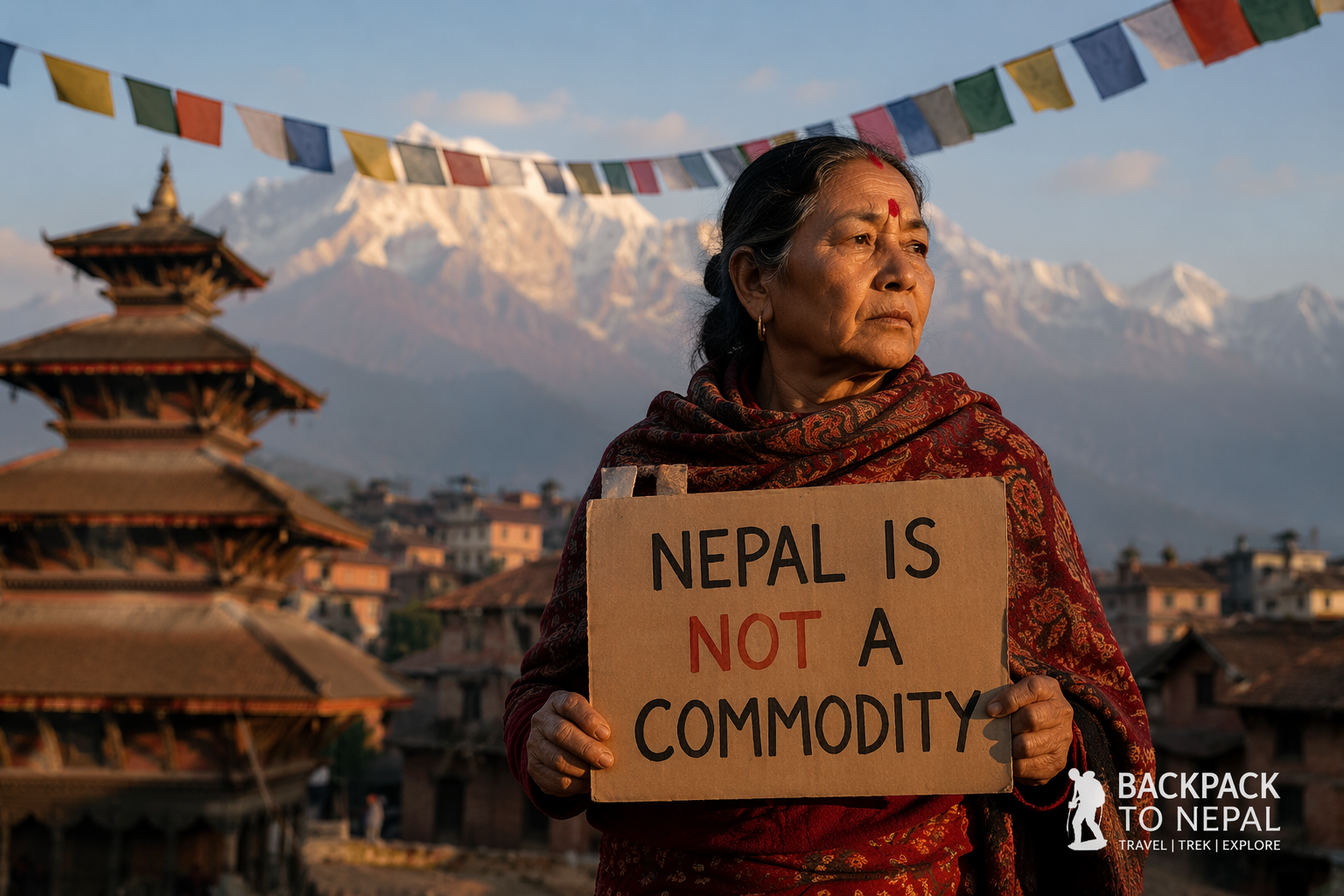
Nepal Is Not a Commodity: A Letter to Travellers and the People Who Make Videos About Us

A responsible look at a worrying new trend in travel content, and why Nepal, and Thamel in particular, deserves better stories than the ones being sold about her. A letter to creators, platforms, viewers, and travellers.
The story we refuse to be told
You have probably seen the video by now, or one just like it. The thumbnail is suggestive. The title promises something naughty. A young man with a selfie stick walks through the narrow, neon-washed lanes of Thamel at night, whispering into his phone camera as if he were a war reporter smuggling out a dispatch. He winks at the viewer. He hints, insinuates, nudges (“you know what I mean”), and leaves just enough unsaid to stay monetisable while saying quite a lot.
Over the past year, a small but very loud group of Indian travel vloggers has figured out that a particular kind of framing of Kathmandu, and of Thamel in particular, drives clicks. The formula is familiar to anyone who has watched this genre evolve. You exoticise the place. You sexualise its women. You hint that its laws are lax and its morals for sale. You package the whole thing as “travel tips for the bros,” and you sit back while the algorithm rewards you. The comments sections fill up. And somewhere, a young man in Lucknow or Ahmedabad or Pune starts planning his trip to Nepal with completely the wrong idea of what he is coming for.
This article is not written in anger, though anger would be fair. It is written because Nepal has been trying to say something for a long time, and it feels like the right moment to say it more plainly.
We are not your fantasy. We are a country.
Let’s talk about what Thamel actually is
Before we get to the distortion, let us just establish what the place actually is, because it matters.
Thamel is a tourist hub in the heart of Kathmandu, about a ten-minute walk from the city centre, but commercially a little world of its own. It is a warren of hotels, restaurants, bookshops, trekking gear outlets, cafés, souvenir stalls, travel agencies, and small bars. It is where mountaineers buy their last down jackets before flying out to Lukla. It is where retired couples from Germany find their guide for the Annapurna Circuit. It is where Buddhist pilgrims from Sri Lanka pick up prayer flags to take home. It is where a French painter spends three weeks sketching temples, where an Israeli backpacker finally exhales after army service, where a Korean student buys her first singing bowl.
Thamel is loud, colourful, sometimes chaotic, and unapologetically commercial. Like any tourist quarter anywhere in the world, it has a nightlife. It has bars where locals and foreigners drink together, live music venues where Nepali bands play covers of Bob Marley and originals in Nepali, and restaurants serving everything from dal bhat to wood-fired pizza.
It is not a red-light district. It has never been one. The idea some creators have recently picked up, that Thamel is some sort of South Asian Patpong where anything goes for the right price, is not a mild exaggeration or a tonal misjudgement. It is a fabrication, and it is hurting real people.
The real people who pay the price
Here is the thing about a country being reframed as a sex tourism destination. The people who suffer first, and worst, are never the people the creators think they are performing for. They are the women of that country.
Nepali women, and we are talking about students, shopkeepers, waitresses, trekking guides, entrepreneurs, teachers, mothers walking their children home from school, have been reporting, over and over again, that they are now being approached, photographed without consent, propositioned, and harassed by tourists who arrived with expectations manufactured thousands of miles away by a man with a ring light. Tour guides in Pokhara talk about clients who ask, with a nervous laugh, whether “the rumours are true.” Hotel receptionists have had to turn away guests who assumed certain services came with the room. Nepali women living abroad describe the quiet, sick feeling of watching their homeland get reduced to a punchline in someone else’s reel.
This is not a hypothetical harm. It is a live, compounding injury being done to real people. And it is being done for a few hundred thousand views.
Nepali men pay a price too, in the lazy assumption that they are either complicit pimps or passive bystanders to a trade that does not exist in the form the videos imply. Legitimate local businesses, the restaurants, the craft shops, the trekking agencies that have spent decades building their reputations, find themselves tarred by association. And Nepal’s tourism sector, which has worked so hard since the post-earthquake rebuilding years and through the pandemic to grow its image beyond Everest and into cultural, wellness, and adventure tourism, watches that work get undermined in a fortnight by a clip that goes viral.
What Nepal actually is, in case anyone has forgotten
Nepal is the birthplace of Siddhartha Gautama, the Buddha. It is a country where Hindu and Buddhist traditions have coexisted and intertwined for thousands of years, producing a civilisational ethic in which the guest, or atithi, is understood to be a form of the divine. The Sanskrit phrase atithi devo bhava (“the guest is god”) is not a tourism-board slogan. It is a deeply held cultural value that generations of Nepalis have extended to visitors, often at real personal cost.
That ethic comes with a condition attached that the new breed of content creator seems to have missed. The guest is honoured. The guest is fed before the host eats. The guest is given the best seat, the warmest blanket, the cleanest water. In return, the guest is expected to behave like a guest. With respect. With humility. With some awareness that they are being welcomed into someone else’s home.
A man who arrives in Kathmandu imagining that its women are for sale has not come as a guest. He has come as a looter.
And Nepal is so much more than one corner of the imagination can hold. It is a country of some of the most spectacular mountain landscapes on earth, a craft tradition (woodcarving, thangka painting, metalwork) that predates most European capitals, a food culture of extraordinary regional variety, and a democratic experiment, with all its difficulties and debates, that belongs to Nepalis alone. It is a country of eight of the world’s fourteen highest peaks, of Lumbini and Pashupatinath and Boudhanath, of the Terai plains and the high Himalayan valleys, of dozens of languages and hundreds of ethnic communities living in a geography that would humble any cartographer.
To reduce all of this to a few leering minutes of handheld footage in a neon alley is not just bad taste. It is a failure of imagination that borders on cultural vandalism.
About the comparison nobody asked for
The comparison sometimes being implied in these videos (to Thailand, to Amsterdam, to other destinations that have, through their own complicated histories, developed legal or semi-legal sex industries) is lazy on its own terms and insulting to Nepal. Those countries have their own contexts, their own laws, their own debates about tourism and exploitation. Nepal’s context is different. Its laws are different. Its social and cultural fabric is different. And Nepalis have never asked to be ranked on a menu of supposed destinations for this kind of tourism.
Nepali law criminalises human trafficking, commercial sexual exploitation, and a range of related offences. Enforcement is imperfect, as it is everywhere, but it is taken seriously by the authorities and by civil society alike. The country has a strong domestic women’s rights movement, anti-trafficking organisations that have done globally respected work on cross-border exploitation, and a press that covers these issues with care and courage. The idea that any of this adds up to “an easy destination” for predatory behaviour is not just wrong. It is an insult to every Nepali who has spent their career working against exactly that.
And Nepal does not want to be Thailand. It does not want to be anywhere else. It wants to be Nepal, on its own terms, developing its own tourism strategy, protecting its own people, writing its own story.
So whose responsibility is this?
Whenever a harmful trend takes off online, there is a tendency to blame the algorithm and leave it at that. The algorithm is not innocent, but the algorithm is not alone.
The platforms, meaning YouTube, Instagram, TikTok, and the rest, have community standards that, in principle, prohibit content sexualising people without consent, content promoting the exploitation of minors, and content that clearly incites harassment. In practice, enforcement of content in South Asian languages, or content aimed at South Asian audiences, has lagged behind enforcement in English-language markets. That is a resourcing choice and a policy choice, and viewers and governments are entitled to demand that it be revisited.
The creators carry the most direct responsibility. It is entirely possible, and it is done every single day by dozens of excellent Indian travel vloggers, to make compelling, successful, monetisable content about Nepal without reaching for the cheapest possible frame. The difference between a creator who films Thamel as a vibrant tourist neighbourhood and one who films it as an open-air brothel is not talent or access. It is intent, and it is character. Viewers who care about the genre should reward the first kind of work and starve the second.
The viewers are where this ends or continues. An economy of attention is exactly that, an economy. When a video portraying Nepal as a sexual playground gets three million views and fifty thousand likes, the creator learns a lesson and the next one gets commissioned. When the same video gets reported, unliked, commented on critically, and circulated by people willing to say publicly that they find it disgraceful, the economics shift. The viewer is not a passive consumer of this content. The viewer is a funder.
A friendly note to travellers who are reading this before your trip
If you are planning to visit Nepal, welcome. We are genuinely glad to have you. Here are a few things worth knowing before you come.
The vast majority of Indian visitors to Nepal, and Indians are by a significant margin the largest group of international visitors, come as respectful tourists, family travellers, and pilgrims, and they are warmly received as such. The small minority who turn up with the wrong ideas make life harder for everyone else. Please do not be that minority.
Nepali women are not a feature of your itinerary. They are citizens of the country you are visiting, going about their lives, and the right default when you encounter them is the same as it would be in any country on earth. Polite. Unintrusive. Uninterested in photographing or approaching them without good reason. The question of whether something is “allowed” misses the point. The question is whether it is decent.
The laws covering sexual harassment, public indecency, filming without consent, and related offences apply to foreign visitors just as much as they do to locals. Enforcement has tightened noticeably in recent years, partly in response to exactly the kinds of content being discussed here. Tourists have been detained. Videos have been used as evidence. The assumption of impunity that some vloggers try to cultivate is itself a fiction, and an increasingly dangerous one for anyone who believes it.
A few more practical things. Dress modestly at religious sites. Take your shoes off where you are asked to. Do not touch statues, prayer wheels, or offerings without being invited. Do not haggle aggressively over small amounts, because the few rupees you save end up costing much more than you realise. Tip your guide and your porter generously, because their work is hard and the mountain does not care about anyone’s Instagram. Learn namaste and dhanyabad. Eat the dal bhat. Walk slowly. Look up.
And if you see another visitor behaving in a way that embarrasses your own country and dishonours Nepal, please say something. One traveller willing to say “this isn’t okay” to another traveller does more than any law ever will.
What Nepal is actually asking for
Nepal is not asking for censorship. Nepal is not asking for tourists to stop coming. Quite the opposite. Tourism is a vital part of the economy and of the cultural exchange that Nepalis, who are some of the most internationally curious people you will ever meet, genuinely value. Nepal is not even really asking for apologies, though one or two from the worst offenders would not go amiss.
What Nepal is asking for is the minimum that any country on earth is entitled to expect from the global image economy. To be represented accurately. To be spoken about with the dignity due any nation. To have the line between real travel journalism and exploitative fiction respected by those who trade in the first and profit from the second.
The Himalayas do not need to be sensationalised to be interesting. Thamel does not need to be slandered to be worth filming. The women of Nepal do not need to be spoken about to be seen. The country has a story, an old, complicated, luminous story, that is more than capable of holding an audience’s attention on its own terms, without anyone having to invent a sleazier one to sell on the side.
So, to the creators who are tempted by the easy frame. There is better work available to you, and the better work will outlast the worse.
To the viewers. You are not obliged to keep watching.
To the travellers. Come as guests.
And to Nepal. The people who love you, at home and in every diaspora community watching this trend with anger and heartbreak, are not keeping quiet about it. The record is being corrected, in every comment section, every counter-video, every conversation like this one. The story this country tells about itself is still its own to tell.
Namaste.
Related Posts
Stay Informed With the Latest & Most Important News
Previous Post
Next Post
- Kathmandu Travel Guide: What to See, Where to Stay, Eat and How to Get Around
- From Mustang to the World: Shinta Mani Mustang Named the No. 1 Luxury Hotel on Earth
- Best Places to Visit in Nepal: A Complete Region-by-Region Guide for Every Traveller
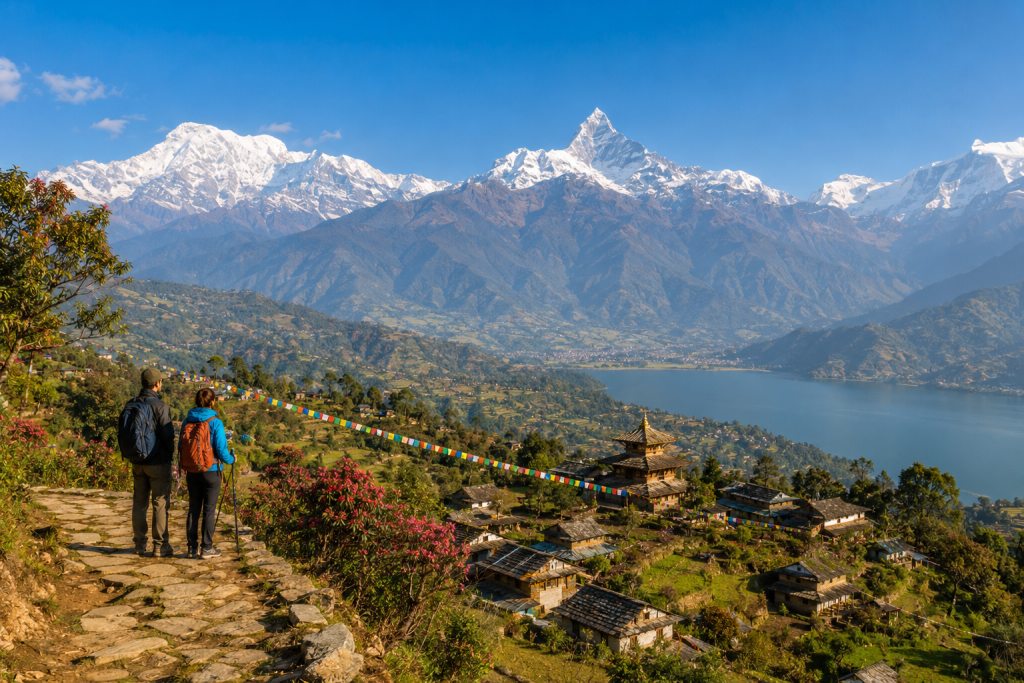
- Trekking in Nepal: The Complete Guide to Choosing and Planning Your Himalayan Trek
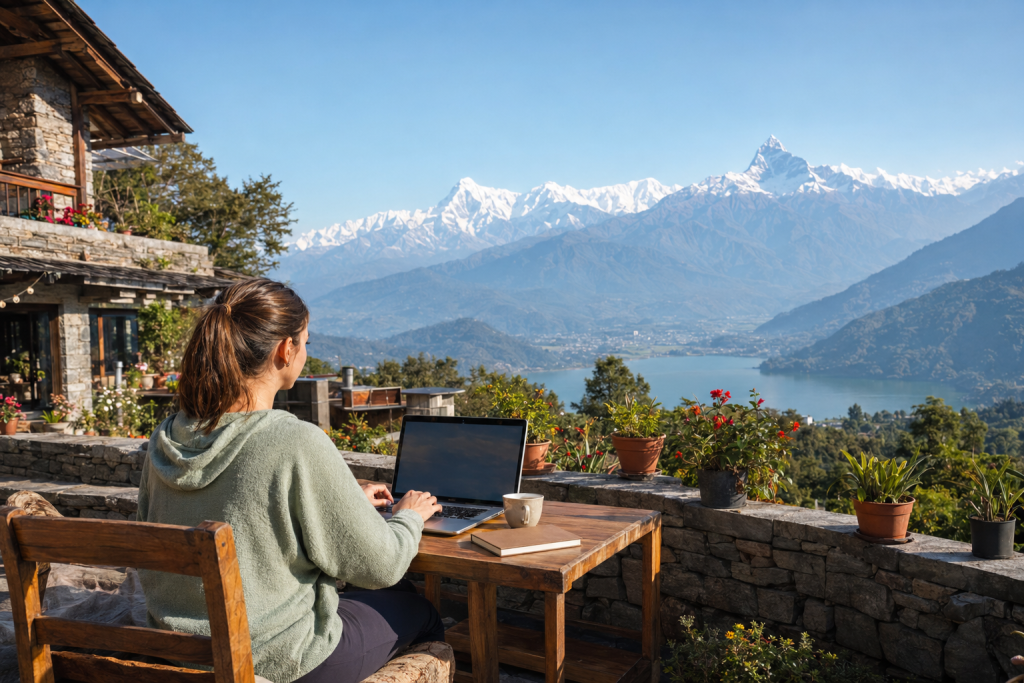
- Beyond the Mountains: Why Nepal Could Become One of the World’s Great Food Destinations
ExoWatts
Great content! Keep up the good work!