Now Reading: Happy New Year 2083: What the New Year Looks, Tastes, and Feels Like in Nepal
-
01
Happy New Year 2083: What the New Year Looks, Tastes, and Feels Like in Nepal

Nepali New Year 2083 falls on 14 April 2026. Here's what Naya Barsha really looks, tastes, and feels like across Nepal.
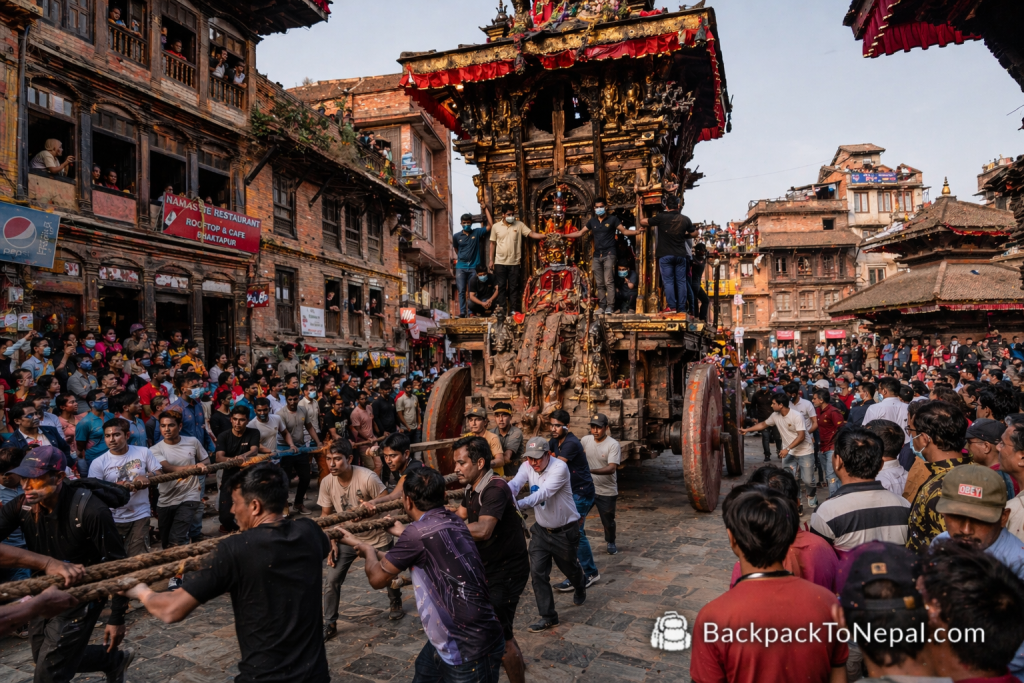
Somewhere in Bhaktapur right now, a massive wooden chariot is creaking through narrow cobblestone lanes while hundreds of hands pull at ropes from both sides of the street. In Thimi, clouds of orange vermillion powder are filling the air. In Pokhara, the Lakeside strip is humming with music, the smell of sel roti drifting from every corner. And somewhere up in the hills, a family is gathered around a kitchen table before sunrise, saying quiet prayers and sharing food.
Today is Baisakh 1, 2083 BS. It is Nepali New Year, and Nepal is alive with it.
If you have ever wanted to experience a country at its most joyful, most rooted, and most itself, this is the day. Here is everything you need to know about what Naya Barsha actually means, where celebrations happen, and what to expect if you are lucky enough to be in Nepal right now.
What Is the Nepali New Year?
Nepal does not ring in the new year on January 1st. The country runs on the Bikram Sambat (BS) calendar, an ancient Hindu solar calendar that sits approximately 56 to 57 years ahead of the Gregorian system. So while the rest of the world is still in 2026, Nepal is stepping into the year 2083.
The Nepali New Year falls on the first day of the month of Baisakh, which lands in mid-April each year. This year, Baisakh 1, 2083 BS is today: April 14, 2026.
It is the official public holiday for the new year in Nepal, and it is the one day when the entire country, across all its ethnic groups, languages, and religious traditions, turns toward the same celebration. More than 60 ethnic communities mark this date in their own way, from the Newar communities of the Kathmandu Valley to Brahmin families in the central hills to Tharu and Maithili communities in the Terai.
Nepalis call it Naya Barsha (new year) or Navavarsha. You might hear people greet each other with “Naya Barshako Shubhakamana”, which translates roughly as “best wishes for the new year.” Say it to anyone you meet today and watch their face light up.
Temples, Prayers, and the Spiritual Heart of the Day
Long before the street festivals begin and the sel roti hits the pan, many Nepalis have already been to the temple. Baisakh 1 is, at its core, a deeply religious day. Families wake before sunrise, bathe, and make their way to their local mandir or clan deity shrine to offer flowers, rice, and incense, and to seek blessings for the year ahead. In Kathmandu, the ghats along the Bagmati River at Pashupatinath fill with devotees from the earliest hours of the morning: men and women in fresh clothes, carrying brass plates of offerings, moving quietly through the smoke of butter lamps.
The atmosphere is different from a typical festival crowd. It is reverent, almost meditative, with the ringing of bells and the murmur of prayers cutting through the cool morning air. At Changu Narayan, Swayambhunath, and countless neighbourhood temples across the country, the same ritual unfolds: shoes left at the gate, palms pressed together, a moment of stillness before the celebrations begin. The concept behind all of it is punya, the accumulation of holy merit, and Baisakh 1 is considered one of the most auspicious days of the year to seek it. For visitors, attending a temple in the morning is one of the most quietly moving ways to begin Naya Barsha.
Why Baisakh? The Calendar Behind the Celebration
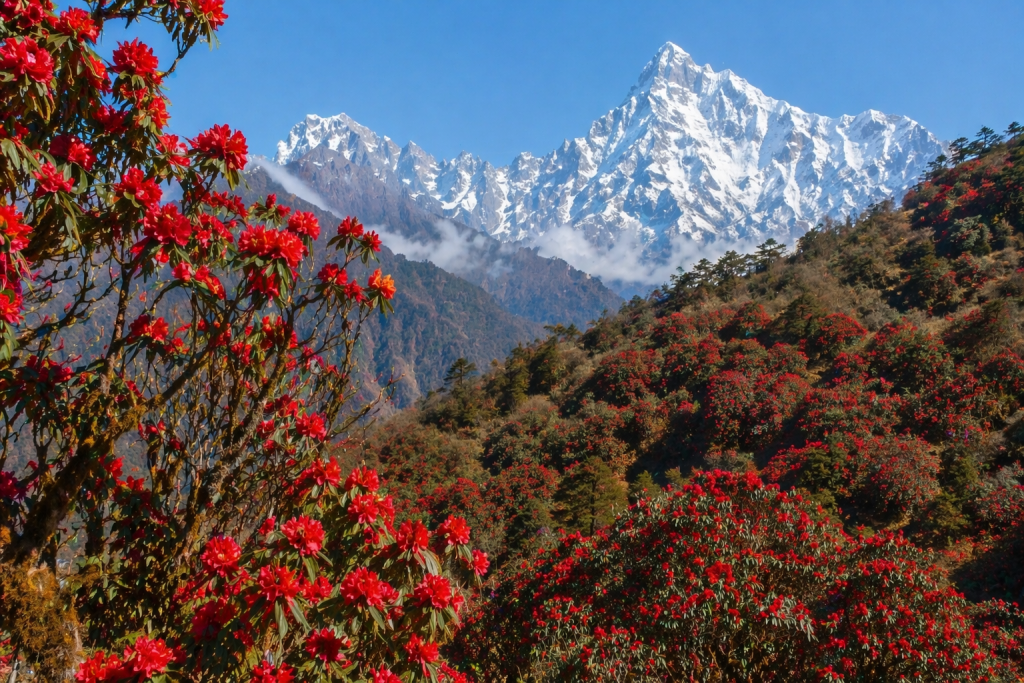
The timing is not arbitrary. Baisakh falls in the heart of spring, when rhododendrons are blazing red across the hillsides and the air carries the first warmth after winter. In many parts of Nepal it follows the harvest season, making it a natural moment of completion and renewal.
The Bikram Sambat calendar is based on the Hindu Panchanga system and uses solar cycles rather than the purely lunar reckoning of some other calendars. This is why Naya Barsha lands on roughly the same Gregorian date each year: always mid-April, always in that sweet spot when the mountains are clear and the valleys are blooming.
There is something poetic about a new year that is tied to seasons and agricultural rhythms rather than an arbitrary midnight countdown. Nepal does not flip a calendar page. It watches the land come back to life and calls that the new year.
Bisket Jatra: The Most Dramatic New Year Celebration in the Valley
If you want the most visually intense, historically rich experience of Naya Barsha, you need to be in Bhaktapur.
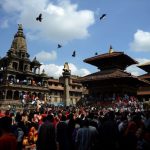
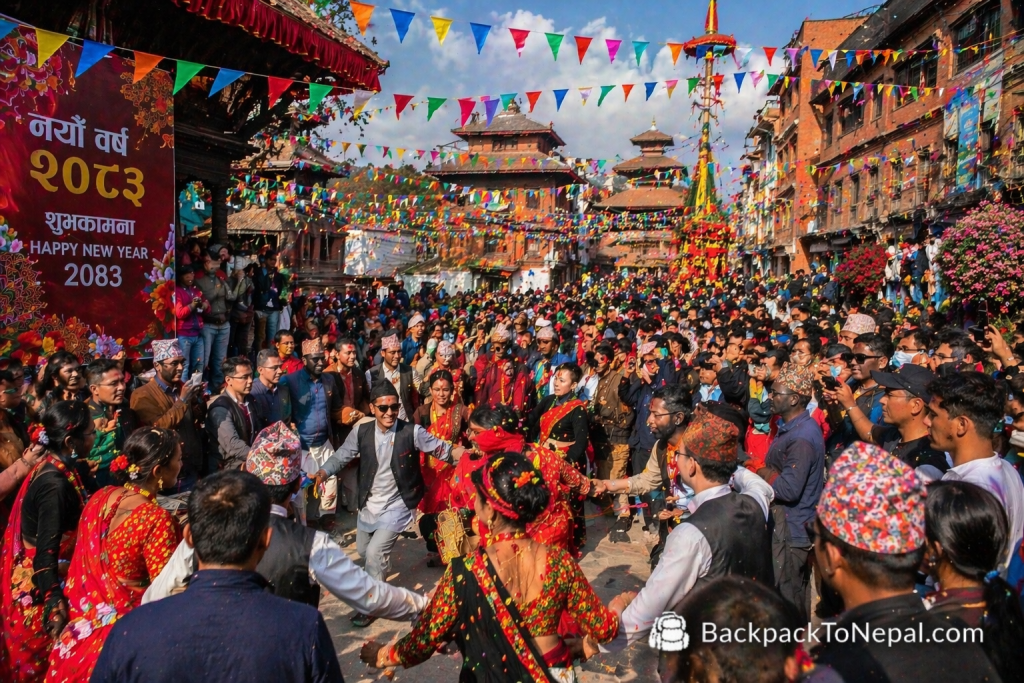
Bisket Jatra is a nine-day festival centred on Bhaktapur’s Taumadhi Square, and it is one of the oldest continuous festivals in the Kathmandu Valley. It begins a few days before Baisakh 1 and runs into the first days of the new year, reaching its peak today.
The centrepiece is a chariot tug-of-war. Two enormous wooden chariots, built entirely by hand without mechanical tools, carry the deities Bhairava and Bhadrakali through the city’s narrow lanes. Teams from the upper and lower parts of town pull the chariots in opposite directions, and the result is loud, sweaty, and completely absorbing to watch. Whoever wins the tug gets the honour of hosting the deity’s chariot in their part of town, a point of serious local pride.
The other signature ritual is the raising and then pulling down of a ceremonial wooden pole called the lingo. Standing around 25 metres tall, it is erected before the new year and brought down on Baisakh 1, the moment it falls marking the official start of 2083. It is a powerful symbol: the end of the old year, the destruction of evil, and the beginning of something new.
The festival name itself comes from a Newar word meaning “festival of the snake’s death,” a reference to an ancient legend involving a cursed princess whose husbands kept dying overnight because of serpents emerging while she slept. A brave young man finally defeated the serpents, and Bhaktapur has been celebrating that victory ever since.
Bisket Jatra is not a performance put on for tourists. It is living heritage, and the whole city participates. For visitors, the experience is extraordinary, but do stay behind the ropes during chariot processions for your own safety, remove shoes when entering temple areas, and be respectful of the ritual elements you are witnessing.
Sindoor Jatra and the Tongue-Piercing Festival: What Happens in Nearby Towns
The celebrations do not stop at Bhaktapur’s city walls. Two nearby towns have their own extraordinary traditions on Baisakh 1 and the day after.
In Madhyapur Thimi, the streets erupt into colour. Dozens of palanquins carrying deities are paraded through the town while participants throw handfuls of bright orange and red vermillion powder into the air. It looks chaotic and joyful in equal measure, not unlike Holi in its visual effect, though the ritual significance is entirely different. It is called Sindoor Jatra, and it represents the victory of good over evil and the arrival of prosperity in the new year.
In Bode, a quieter but deeply striking ceremony takes place the day after Naya Barsha. A volunteer from the Shrestha clan, following a tradition believed to date back to King Jagajyoti Malla, has an iron spike pierced through his tongue and spends the entire day walking through the village carrying flaming torches. It is believed to bring good fortune and protection from drought and illness to Bode for the coming year. Only locals from a specific lineage can take part. For visitors, it is humbling to watch.
How the Rest of Nepal Celebrates
Outside the Kathmandu Valley, Naya Barsha takes on different shapes depending on community and region.
In the central hills, Brahmin and Chhetri families wake before dawn for ritual baths in rivers, visit clan deities, and gather for lavish family meals. The house is cleaned from top to bottom the day before, new clothes are worn, and offerings are made at local temples. There is a strong sense of moral reset in the air: old debts settled, grievances released, intentions set for the year ahead.
In the Terai, Maithili and Tharu communities bring their own folk traditions to the occasion, with singing, decorated homes, and shared sweet dishes.
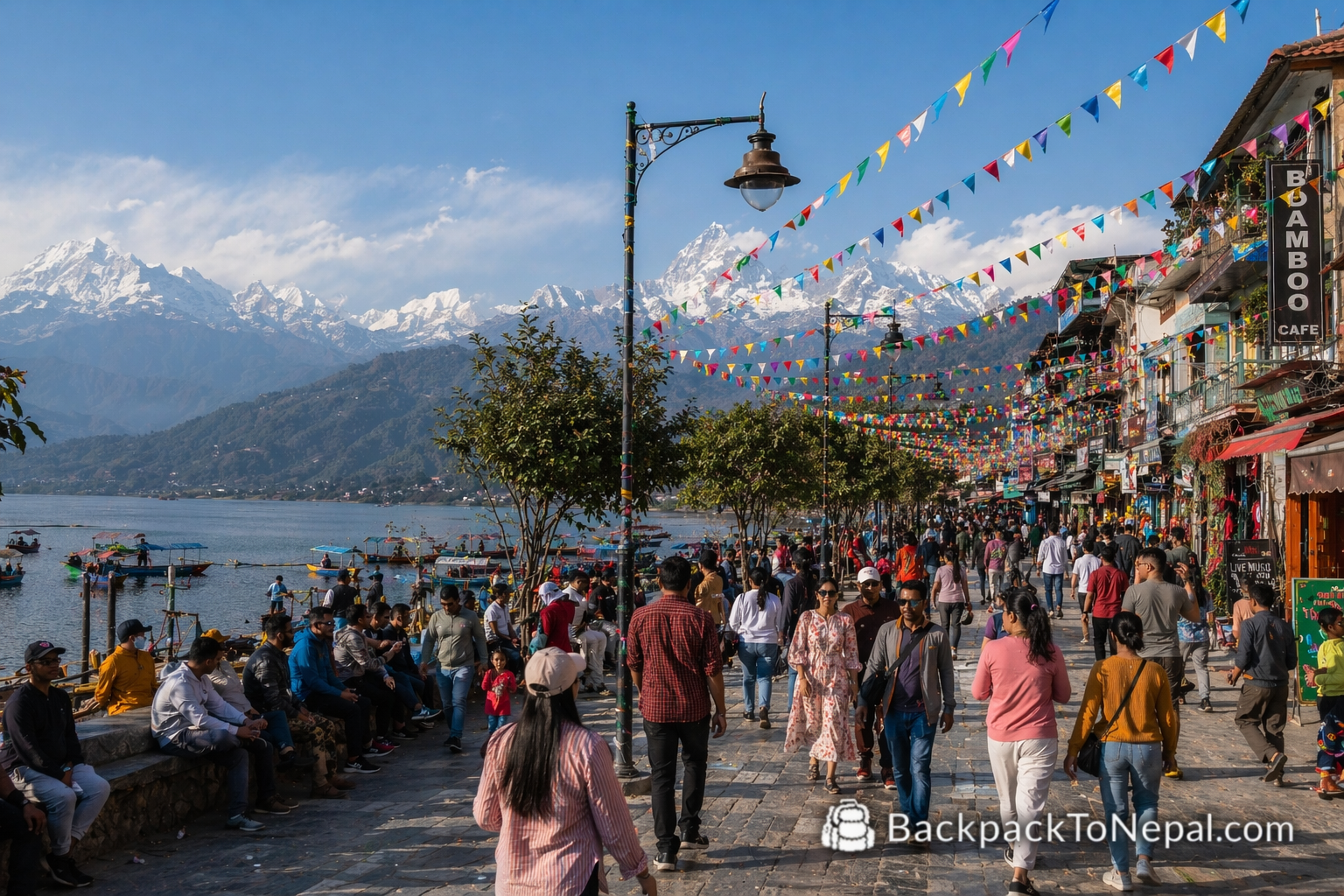
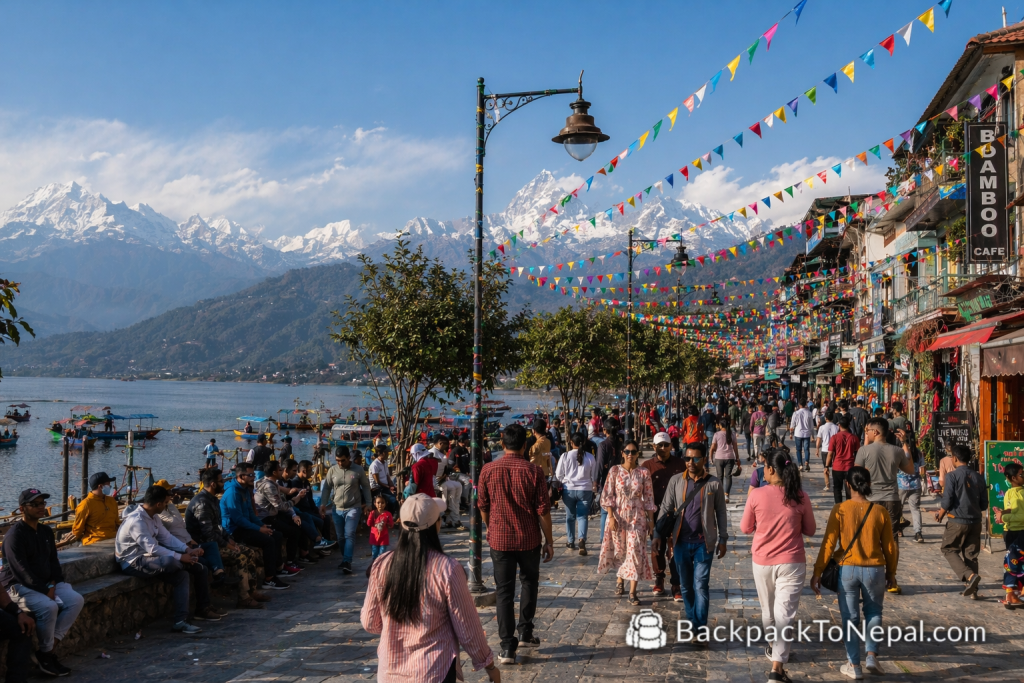
In Pokhara, Lakeside transforms into a multi-day street festival that draws travellers from across Nepal and around the world. Restaurants and cafes push outdoor seating onto the pavements, live music runs late into the evening, and the whole strip takes on the energy of a big open-air party. If you are in Pokhara right now and have not wandered down to Lakeside yet, go this afternoon.
Wherever you are in Nepal today, something is happening near you. Ask your guesthouse host, your trekking guide, your dal bhat server. They will point you somewhere.
The Food of Naya Barsha
Nepali celebrations are never complete without food, and New Year is no exception.
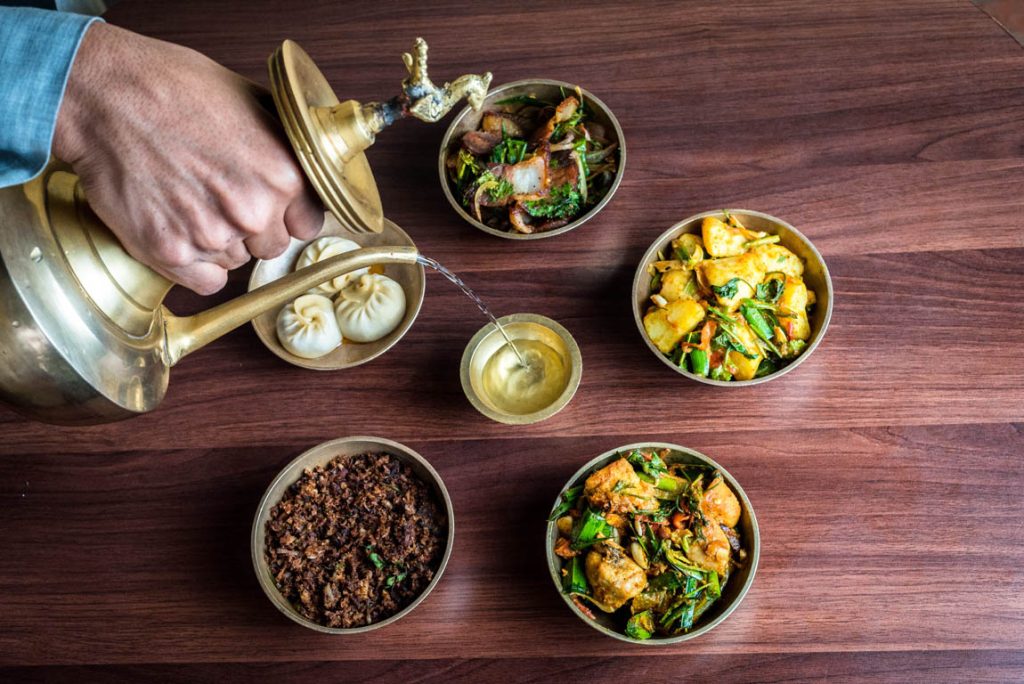
Sel roti is the one you will smell before you see it: a ring-shaped sweet bread made from rice flour, deep-fried until golden and crispy, and eaten warm with tea or milk. It appears at practically every major Nepali festival, and for good reason. It is addictive.
Samay baji is the ceremonial Newari platter you will find in Kathmandu Valley homes: beaten rice, lentil cakes, boiled egg, ginger, dried meat, and a small cup of aila (home-distilled grain spirit). Each element carries ritual significance, and eating it together is an act of cultural continuity.
Yomari, a steamed dumpling filled with chaku (molasses and sesame), and chatamari, a thin rice flour crepe sometimes called the Nepali pizza, round out the festival spread. At street stalls around Bhaktapur and Kathmandu, you will also find soup momos being ladled out in generous portions.
If a Nepali family invites you to share a meal today, say yes without hesitation. That invitation is one of the best things Nepal can offer you.
Practical Notes for Travellers in Nepal Today
A few things worth knowing if you are on the ground right now.
Government offices, banks, and many businesses are closed for Naya Barsha. Stock up on cash before heading out: street vendors and market stalls at festival gatherings almost universally operate on cash only. ATMs in Kathmandu and Pokhara are generally well-stocked for the holiday, but get what you need this morning rather than trying to find a working machine at midday.
If you are in Bhaktapur for Bisket Jatra, the chariot processions can get extremely crowded and physically intense. Keep your bag in front of you, wear closed shoes, and follow the guidance of festival organisers about where spectators should stand. The experience is worth every logistical inconvenience.
Temple visits are appropriate and welcomed, but dress modestly: shoulders and knees covered, shoes removed before entering courtyards. Non-Hindus are restricted from entering the inner sanctums of some temples, but the outer areas are open and the atmosphere is worth being part of.
If you are trekking in the hills today, do not be surprised if your teahouse serves sel roti for breakfast, if your guide is in a particularly warm mood, or if you arrive at a village to find it celebrating. Naya Barsha reaches even the most remote corners of Nepal.
Naya Barsha 2083: A New Year Worth Showing Up For
There is something that sets Nepal’s new year apart from the countdowns and fireworks you might know from home. The celebrations here are older than anyone can reliably trace. They are rooted in agriculture and seasons and mythology. They involve whole communities pulling together, literally, to mark the turn of the year. They smell like fried rice dough and incense. They sound like drums and temple bells and the creak of ancient chariot wheels.
If you are in Nepal today, step outside. Say Naya Barshako Shubhakamana to the first person you meet. Follow the sound of the drums. Try the sel roti. Let the day happen around you.
And if you are still planning your Nepal trip, make a note: mid-April is one of the finest times to visit. The mountains are clear, the trails are good, the rhododendrons are out, and the country is in the mood to celebrate. Next year, 2084 BS, Naya Barsha falls on April 14, 2027. Put it in your calendar now.
Naya Barshako Shubhakamana. Happy New Year 2083.
Related Posts
Stay Informed With the Latest & Most Important News
Previous Post
Next Post
- Kathmandu Travel Guide: What to See, Where to Stay, Eat and How to Get Around
- From Mustang to the World: Shinta Mani Mustang Named the No. 1 Luxury Hotel on Earth
- Best Places to Visit in Nepal: A Complete Region-by-Region Guide for Every Traveller
- Trekking in Nepal: The Complete Guide to Choosing and Planning Your Himalayan Trek
- Beyond the Mountains: Why Nepal Could Become One of the World’s Great Food Destinations