Now Reading: Volunteering in Nepal: How to Find Ethical Opportunities and What to Expect
-
01
Volunteering in Nepal: How to Find Ethical Opportunities and What to Expect
Volunteering in Nepal: How to Find Ethical Opportunities and What to Expect

Thinking about volunteering in Nepal? Learn how to find ethical programmes, avoid voluntourism traps, and make a genuinely positive impact on your trip.
There is a moment, somewhere between your first cup of sweet milk tea and your third week in a mountain classroom, when Nepal stops being a destination and starts being something far harder to leave behind. Volunteering here has a way of doing that. It rewires your sense of what matters, slows your pace, and hands you a perspective that no temple visit or trek to base camp can quite replicate. But it only works that way when it is done right.
The world of volunteer travel is crowded with good intentions, and Nepal, unfortunately, has attracted more than its share of programmes that look meaningful on Instagram but deliver little of lasting value to the communities they claim to serve. This guide is here to help you cut through the noise, find an opportunity that genuinely fits your skills, and arrive prepared for a deeply rewarding experience.
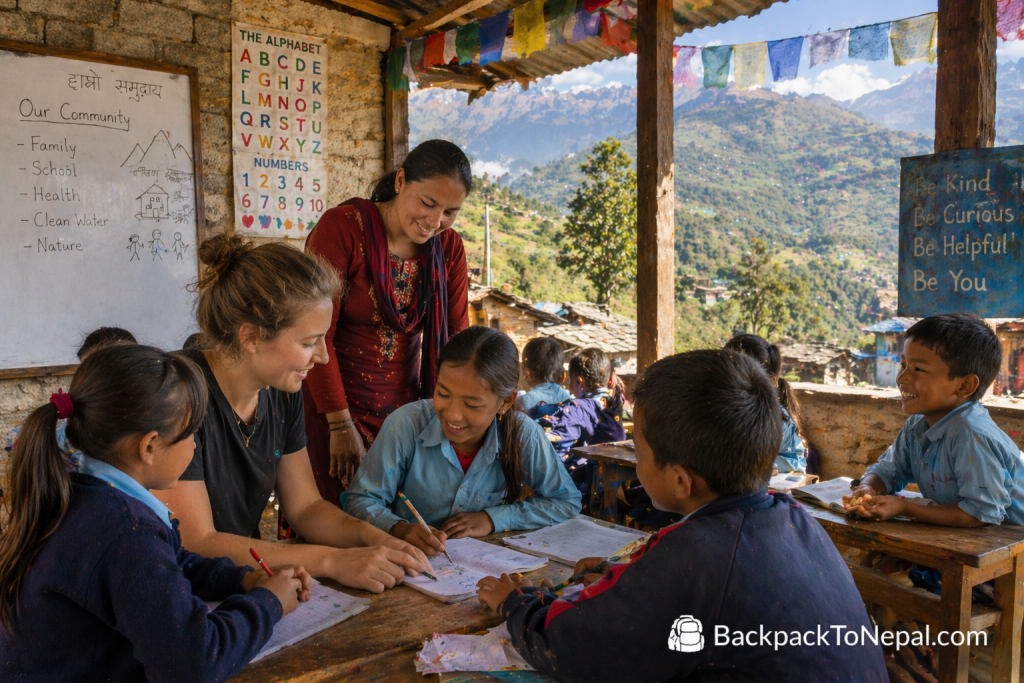
Ethical Volunteering vs. Voluntourism: Knowing the Difference
Let us start with the uncomfortable truth. A significant portion of what markets itself as “volunteer travel” in Nepal is actually voluntourism: short placements designed primarily to give paying visitors a feel-good experience, with community benefit as a secondary consideration. The signs are not always obvious, but once you know what to look for, they become hard to miss.
Red flags worth watching for include placements at orphanages that allow unskilled foreigners to work with children, programmes that rotate volunteers every one or two weeks (too short for any meaningful contribution), organisations that charge very high fees but are vague about how the money is used, and projects that seem to exist to give volunteers a “story” rather than to fill a genuine local need.
Ethical programmes, by contrast, tend to look quite different. They ask about your skills and experience before accepting you. They have clear community-driven goals that existed before volunteers arrived and will continue after you leave. They are transparent about their finances and partnerships. They work with, rather than in place of, local people. And they will tell you honestly what you can and cannot realistically contribute in the time you have available.
A good rule of thumb: if the programme feels like it was designed around what you need from it rather than what the community needs from you, keep looking.
Where Volunteers Can Genuinely Add Value
Nepal has real, documented needs across several sectors, and these are the areas where a committed, skilled volunteer can make a meaningful contribution.
Education
English language skills remain in high demand, particularly in rural schools where trained English teachers are scarce. Volunteers who are qualified teachers, or who have significant tutoring or mentoring experience, can support local teachers rather than replacing them. The key word there is “support.” The goal should always be to strengthen the capacity of Nepali educators, not to position yourself as the hero of the classroom.
Conservation and Environmental Work
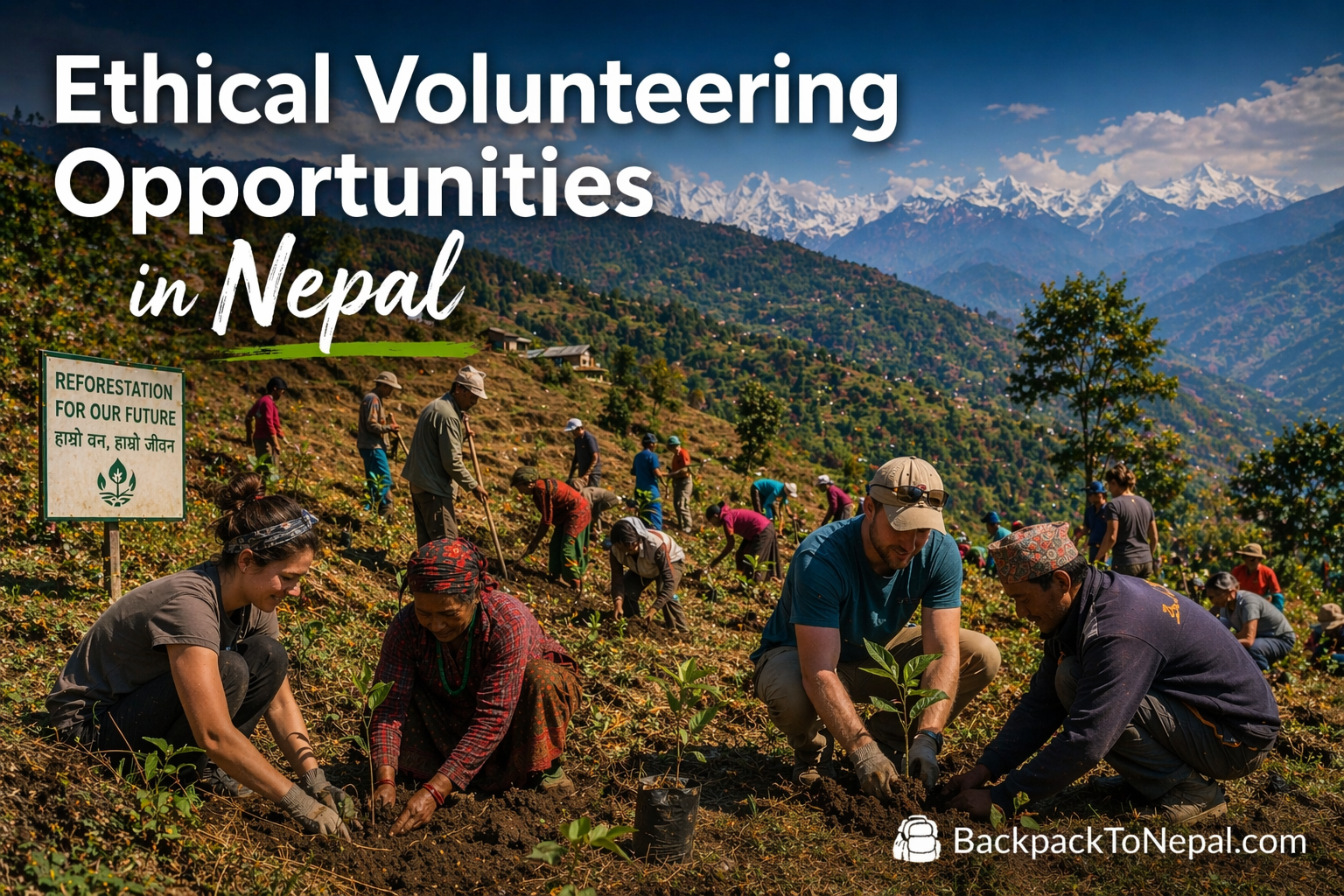
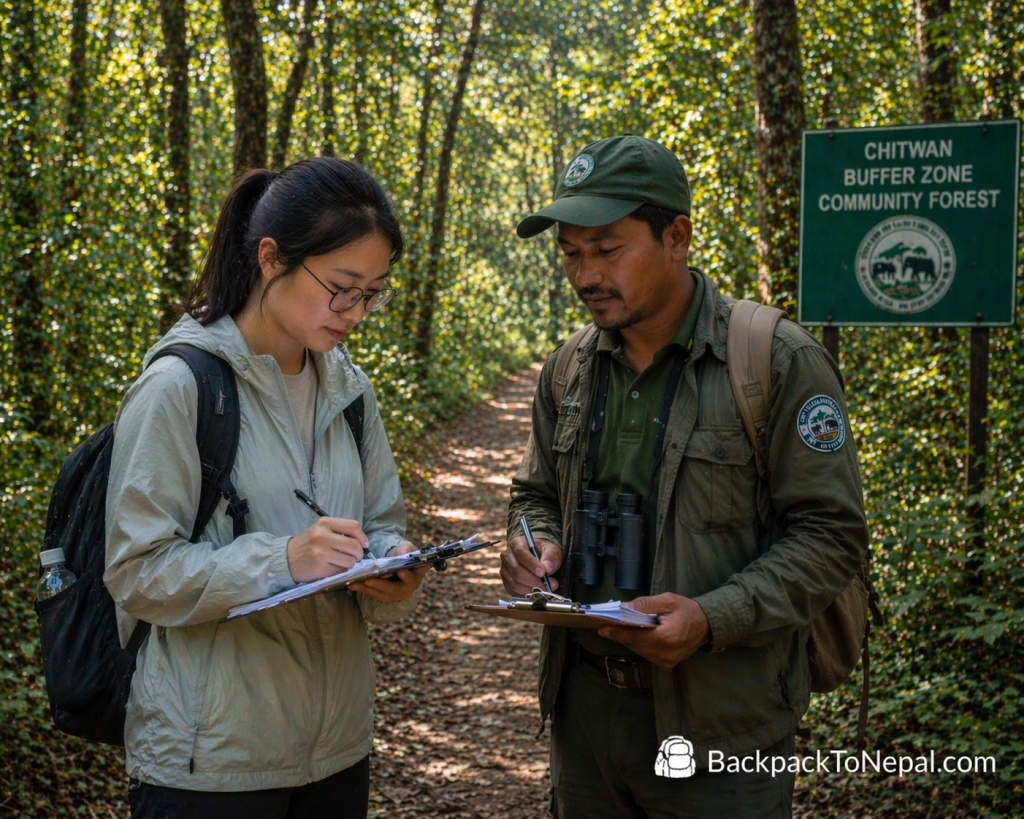
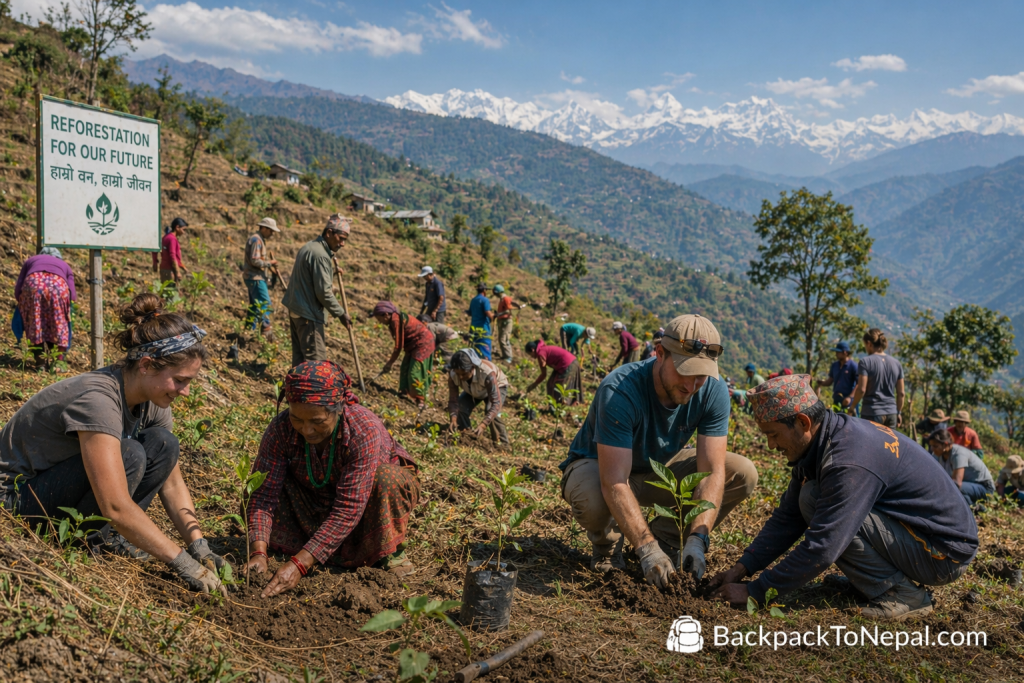
Nepal’s extraordinary biodiversity faces real pressure from deforestation, habitat loss, and the effects of climate change. Organisations working on reforestation, wildlife monitoring, and community conservation programmes can benefit from volunteers willing to do physically demanding fieldwork. This is especially true in buffer zones around national parks like Chitwan and Bardia.
Community Development and Infrastructure
In the years following the 2015 earthquakes, and in communities still recovering in more remote areas, there is an ongoing need for support in areas like sustainable construction, water and sanitation projects, and livelihood programmes. Volunteers with backgrounds in engineering, public health, agriculture, or social work tend to be best placed here.
Healthcare Support
Qualified medical professionals, including doctors, nurses, paramedics, and physiotherapists, are welcomed by a number of established health NGOs, particularly those working in areas with limited access to healthcare. Note the emphasis on “qualified”: this is not a sector where enthusiasm substitutes for credentials.
Vetted Organisations and How to Do Your Own Due Diligence
A handful of organisations have built solid, long-standing reputations for ethical volunteer programmes in Nepal. Volunteer Nepal (volunteernepal.org.np) is a Nepali-run NGO with programmes across education, environment, and community development. The Umbrella Foundation focuses on vulnerable children through community-based rather than orphanage models. Green Volunteers and Workaway both list vetted placements, though you will still need to research individual hosts carefully.
Beyond name recognition, here is how to properly vet any programme before you commit:
- Ask who runs it. Is it locally founded and locally led, or primarily managed by foreigners from abroad? Local leadership is generally a good sign.
- Request a breakdown of your fees. A trustworthy organisation will show you clearly how placement fees are split between programme costs, staff salaries, community projects, and operational expenses.
- Look for long-term community partnerships. Ask how long the organisation has been working with a particular community and what evidence of impact they can share.
- Read independent reviews. Go beyond the testimonials on the organisation’s own website. Platforms like GoOverseas and GoAbroad have independently submitted reviews that paint a more balanced picture.
- Ask the hard question: what happens when volunteers are not here? If the answer reveals that the project stalls without outside help, that is a dependency problem, not a success story.
Realistic Costs and How Long You Should Plan to Stay
Volunteering in Nepal is not free, and it is worth being clear-eyed about the economics. Most reputable placement organisations charge a programme fee that covers your accommodation, meals, in-country orientation, and often airport pickup. These fees typically range from around USD 250 to USD 600 per month, depending on the organisation and the location. Programmes based in Kathmandu tend to cost more than rural placements.
On top of that, you will need to cover your international flights, your Nepal visa (USD 30 for 15 days, USD 50 for 30 days at the time of writing, though always check current rates), travel insurance, and personal expenses. Budget an additional USD 300 to USD 500 per month for incidentals, local transport, weekend travel, and the inevitable dal bhat habit you will develop.
As for duration, the minimum placement that most reputable organisations accept is four weeks, and many prefer three months or longer. There is a reason for this. The first week or two of any volunteer placement is essentially orientation, adjustment, and relationship-building. You only begin to be genuinely useful after that initial phase has passed. If you can commit for two to three months, you will leave having contributed something real. A two-week placement rarely achieves the same depth, however well-intentioned.
What Daily Life Actually Looks Like
Romanticise it a little, and the reality will still hold up. Volunteer life in Nepal is genuinely rewarding, but it is also structured, sometimes unglamorous, and shaped by rhythms very different from home.
A typical day might start early: breakfast with your host family or fellow volunteers, often rice or roti with tea, by seven or seven-thirty. Work hours usually run from around eight until mid-afternoon, with a long lunch break that doubles as the main meal of the day. Evenings are your own, though internet access and entertainment options in rural placements will be limited. That is not a complaint. It turns out that slow evenings, conversation, and the occasional card game are good for the soul.
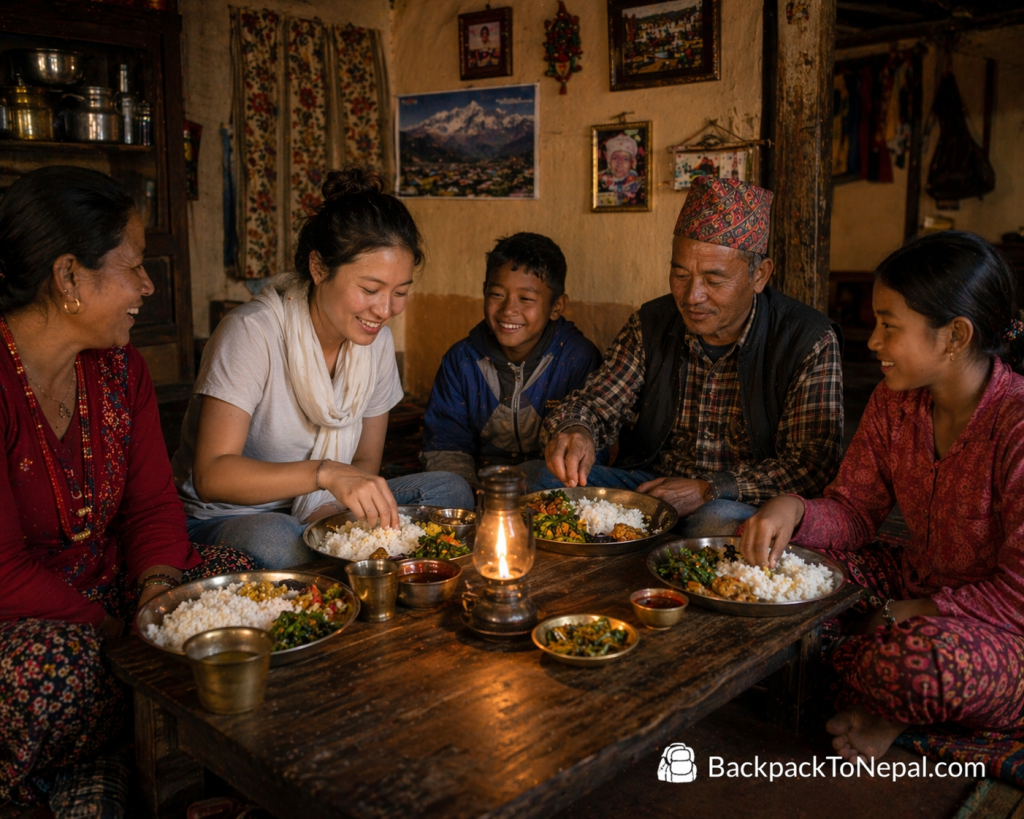
Most volunteers are placed either in homestays with local families or in volunteer houses. Homestays are the richer experience: you pick up Nepali phrases faster, understand daily life more intimately, and form connections that often last long after you have returned home. Conditions are comfortable but simple. Hot showers may be solar-powered and therefore dependent on the weather. Power cuts are not unusual in more remote areas. Mobile data can be patchy.
Cultural Etiquette and What Is Expected of You
Nepal is a deeply respectful society, and volunteers who arrive with cultural awareness tend to integrate far more smoothly and be far more effective in their work.
Dress modestly, particularly in village and religious settings. Covering your shoulders and knees is standard practice and carries real social weight outside of tourist hubs. Remove your shoes before entering homes and temples. Accept food and drink with your right hand, and if offered tea, accept graciously even if you have already had three cups.
Learn a handful of Nepali phrases before you arrive. “Namaste,” “dhanyabad” (thank you), and “mitho chha” (it is delicious) will earn you genuine warmth. People notice and appreciate the effort, even when your pronunciation is terrible.
Patience is not just a virtue here, it is a necessity. Things move at their own pace. Meetings start late. Plans change. Projects take longer than expected. The volunteers who struggle most are the ones who arrive with rigid timelines and a problem-solving mindset calibrated for a faster world. Nepal will gently but firmly ask you to recalibrate.
An Honest Conversation About What Volunteering Cannot Fix
This section matters, and it deserves to be said plainly.
Volunteering in Nepal will not solve poverty, end deforestation, or fix systemic inequalities that have deep historical and political roots. A six-week placement, however heartfelt, cannot substitute for sustainable local employment, policy change, or long-term institutional investment. If you arrive believing your presence is going to transform lives in a fundamental way, you are setting yourself up for frustration, and potentially doing more harm than good by perpetuating a narrative of outside rescue.
What volunteering can do is contribute meaningfully, in a small and specific way, to a project with a long time horizon. It can build genuine human connections across cultures. It can challenge your own assumptions about development, poverty, and what a good life looks like. And it can leave you with a far more nuanced understanding of Nepal than any tourist itinerary could offer.
Go with humility. Go as a learner as much as a contributor. And go ready to receive as much as you give.
How Volunteering Deepens Your Connection to Nepal
There is a version of Nepal that most travellers never see: the early morning conversations with a host mother while she sorts rice, the way a village teacher lights up when a student finally grasps something difficult, the slow unfolding of trust between an outsider and a community that has every reason to be cautious. Volunteering opens those doors.
When you are not moving from attraction to attraction, you start to see the country differently. You notice the patterns in daily life. You understand, in a lived rather than theoretical way, what the challenges actually are and how resilient and resourceful the people navigating them are. Nepal stops being a backdrop and becomes a place with real texture and complexity.
Many volunteers describe their time here as among the most formative experiences of their lives. Not because it was always easy, but precisely because it was not. Because it asked something of them. Because it gave back in proportion to what they brought.
Ready to Take the Next Step?
If you have read this far and feel the pull, trust it. But take the time to do it properly. Research your organisation thoroughly. Be honest about your skills and the time you can genuinely commit. Arrive with realistic expectations and an open mind. And go knowing that the most meaningful thing you might bring is not your expertise or your energy, but your willingness to listen, learn, and let Nepal change you a little.
Start your search, reach out to two or three organisations with the questions in this guide, and give yourself the gift of an experience that goes far deeper than the surface. Nepal has a way of staying with you. Volunteering there has a way of staying with you even longer.
Related Posts
Stay Informed With the Latest & Most Important News
Previous Post
Next Post
- Kathmandu Travel Guide: What to See, Where to Stay, Eat and How to Get Around
- From Mustang to the World: Shinta Mani Mustang Named the No. 1 Luxury Hotel on Earth
- Best Places to Visit in Nepal: A Complete Region-by-Region Guide for Every Traveller
- Trekking in Nepal: The Complete Guide to Choosing and Planning Your Himalayan Trek
- Beyond the Mountains: Why Nepal Could Become One of the World’s Great Food Destinations