Now Reading: The Mountains Are Still Calling: How to Reach Nepal When the Middle East Skies Are Closed
-
01
The Mountains Are Still Calling: How to Reach Nepal When the Middle East Skies Are Closed
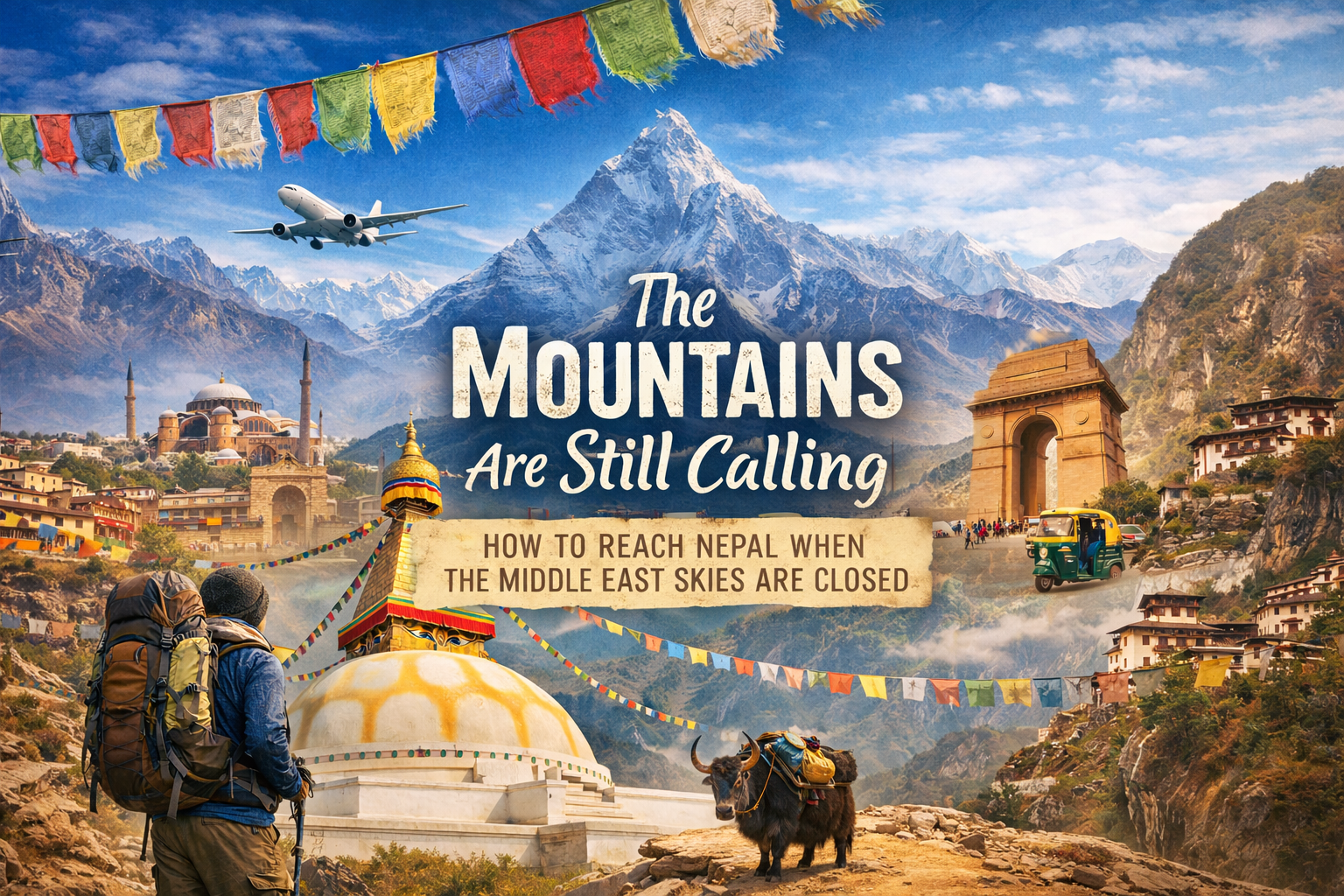
The Mountains Are Still Calling: How to Reach Nepal When the Middle East Skies Are Closed

If Nepal has been on your bucket list, and honestly, if it has not been, why not, you might be staring at flight booking screens right now feeling more confused than ever. The escalating conflict in the Middle East has thrown a real spanner into global aviation, and the usual routes many of us have relied on to get to Kathmandu have either been cancelled, rerouted, or priced into the stratosphere.
But here is the thing: the Himalayas have not gone anywhere. Everest is still standing magnificently where it always has. The prayer flags are still fluttering over Annapurna. And Nepal itself, thousands of kilometres from the conflict zone, is completely peaceful, open, and waiting for you.
So let us talk about how to actually get there.
What’s Actually Happening Up in the Skies
First, a quick bit of context, because it helps to understand why your usual search results are looking so grim.
In late February and early March 2026, following a major escalation between the US, Israel, and Iran, several Gulf nations, including the UAE, Qatar, Kuwait, Bahrain, and others, temporarily closed portions of their airspace to civilian aircraft. That is a big deal for Nepal travel, because the Gulf has long served as the world’s go-to transit corridor between Europe, Africa, the Americas, and South Asia.
Carriers like Emirates, Qatar Airways, and Etihad, the workhorses of the Kathmandu route, temporarily suspended certain routes, citing airspace closures and safety requirements. Nepal’s own carriers felt the pinch too: Nepal Airlines suspended its Kathmandu to Dubai service, while Himalayan Airlines halted flights to Dubai and Dammam until further notice.
The knock-on effect? Economy class fares on some Europe to Kathmandu routes have nearly doubled in recent weeks, according to travel operators.
Not ideal. But, and this is the important part, it is not the end of the world either. There are genuinely excellent alternative routes, and some of them might even turn out to be better travel experiences than the ones you originally planned.
The Good News: Nepal Is Still Very Much Open
Before we dive into routes, let us be clear about something. Even though Nepal is thousands of kilometres from the conflict zone, it remains peaceful and open to tourists. Only the international air travel connections have been affected by airspace closures in the Middle East.
In fact, Nepal was having a brilliant year before all this kicked off. According to the Nepal Tourism Board, Nepal welcomed 115,442 foreign tourists in February 2026, a 19.15 percent increase compared to the same month of the previous year. Tourism officials are staying upbeat too. As Nepal’s tourism authorities put it, “Nepal is an adventure destination and tourists will come. What we need right now is clear messaging and well-prepared strategies.”
So with that said, let us get you there.
Route 1: Via Istanbul, The Underrated Star of the Show
If there is one route that has quietly been a hidden gem for Nepal travellers, it is through Istanbul with Turkish Airlines. And right now, it might just be your very best option.
Istanbul is the only city in Turkey with direct flights to Kathmandu, and Turkish Airlines, part of Star Alliance, operates this route. The flight from Istanbul to Kathmandu takes around eight hours. Long, yes, but Turkish Airlines is genuinely one of the most comfortable carriers in the world, with excellent food and service to soften the journey. Turkish Airlines also has wide connections available from all over America and Europe through to Istanbul and then onward to Nepal.
The beauty of the Istanbul route is that it flies north of the Middle East conflict zone entirely, routing through Central Asian airspace and completely avoiding the affected regions. It is not a workaround. It is simply a different, very good path.
Tip: Turkish Airlines has a generous free stopover programme. If you find yourself in Istanbul for a layover of more than a certain number of hours, consider tacking on a day or two in one of the world’s most spectacular cities. The Grand Bazaar and a bowl of Turkish lentil soup could be a fine opening act to a Himalayan adventure.
Route 2: Via New Delhi, The Closest and Most Frequent Option
India is Nepal’s closest neighbour and largest source of visitors, and the Delhi to Kathmandu corridor is one of the busiest and most reliable air links in Asia. From New Delhi, there are five airlines with direct services to Kathmandu: Air India, Bhutan Airlines, FlexFlight, IndiGo Airlines, and Nepal Airlines.
If you are coming from Europe, the UK, or North America, flying into Delhi first and then hopping across to Kathmandu is a very sensible plan. Flights from London, Paris, Frankfurt, or New York to Delhi are plentiful and well priced, and the connecting flight to Kathmandu takes under two hours.
Routing through Delhi gives you far more alternative carrier choices than routing through a single smaller hub, which matters a lot right now when seats on some routes are filling up fast.
From major Indian cities like Mumbai and Bengaluru, you will also find direct connections. From Bengaluru, Air India Express and Nepal Airlines both offer non-stop flights, and from Mumbai, IndiGo Airlines and Nepal Airlines provide direct services.
Tip: If you have a day or two to spare in Delhi, do not waste them in the airport. Old Delhi’s Chandni Chowk market, the Red Fort, and a proper butter chicken dinner will set you up beautifully for the spiritual Himalayan adventure ahead.
Route 3: Via Bangkok, The Southeast Asian Sweet Spot
Bangkok is fast becoming the star of this particular crisis, and honestly, it deserves every bit of the spotlight. Thailand, along with Singapore, Vietnam, Indonesia, and Malaysia, has become one of the top choices for travellers seeking reliable alternatives to Gulf-routed journeys.
From Bangkok, you can fly non-stop to Kathmandu with Nepal Airlines or Thai Airways, and from Bangkok’s Don Muang airport, Thai AirAsia and Thai Lion Air also offer non-stop connections. The Bangkok to Kathmandu flight is short and sweet, typically around three to four hours, making it one of the most comfortable transit options available.
For travellers from Australia and New Zealand, Bangkok has long been the natural gateway to Nepal, and that logic holds especially true right now. Sydney, Melbourne, and Perth all have excellent daily connections to Bangkok, from where you can slot neatly onto a Kathmandu flight.
Tour operators have noted that some tourists are even turning unplanned layovers into mini holidays, exploring cities and cultural sites during flight delays. Bangkok, with its temples, street food, and vibrant energy, is particularly good at turning a transit into a treat.
Tip: Suvarnabhumi Airport in Bangkok is large, modern, and easy to navigate. Book your Bangkok to Kathmandu leg separately if you want more flexibility. Budget carriers like Thai AirAsia offer very competitive fares.
Route 4: Via Singapore, The Premium Choice
For those who do not mind paying a little more for a smooth, stress-free journey, Singapore is arguably the world’s best transit hub, and it connects beautifully to Kathmandu. Silk Air, a subsidiary of Singapore Airlines, flies several connecting flights to Nepal, and travellers from Australia, Europe, and America can route through Singapore with ease.
Singapore’s Changi Airport consistently ranks as the world’s best, and layovers there barely feel like layovers. There are gardens, cinemas, swimming pools, and enough restaurants to keep you happily occupied for hours.
Tip: If your layover in Singapore is more than five hours, you can sign up for a free city tour through Singapore’s transit programme. A quick spin past Marina Bay Sands and the Gardens by the Bay is a lovely bonus on the way to the Himalayas.
Route 5: Via Kuala Lumpur, The Budget-Friendly Alternative
Kuala Lumpur’s KLIA airport is another solid option that tends to slip under the radar. Kuala Lumpur is among the top international layover cities offering frequent and cost-efficient flights to Tribhuvan International Airport. AirAsia, with its extensive Southeast Asian network, makes KL a particularly attractive hub for budget-conscious travellers.
Fares through Kuala Lumpur can be noticeably cheaper than through some of the more premium hubs, especially if you are flexible with your travel dates.
Route 6: Via Seoul, The Long Way Round That’s Worth It
This one might raise an eyebrow or two, but hear us out. Korean Air operates flights between Seoul and Kathmandu, and with Seoul as a layover, anyone from any region of the world can fly to Kathmandu. Korean Air has wide networks across the globe.
For travellers coming from North America’s West Coast, routing through Seoul is actually remarkably efficient. The Pacific crossing to Seoul is direct, and the Seoul to Kathmandu leg is smooth and well serviced. It is also a wonderful excuse to spend a day or two in one of Asia’s most dynamic cities.
Route 7: Via Chinese Cities, The Northern Corridor
China’s aviation sector has routes that largely avoid Middle Eastern airspace altogether, making Chinese hub cities another viable corridor. Air China, Sichuan Airlines, China Eastern, China Southern, and Tibet Airlines all carry on flights to Kathmandu via cities including Chengdu, Lhasa, and other Chinese hubs.
The Lhasa route in particular is a remarkable and unusual path to Nepal. Flying over the Tibetan plateau, you will get some of the most dramatic aerial views on the planet before descending into Kathmandu. If you have ever wanted to see the roof of the world from above, this is the route.
Practical Advice Before You Book
A few things are worth keeping in mind as you plan:
Book flexible fares. This is genuinely important right now. Book flexible or refundable fares when routing through geopolitically sensitive regions. The price difference is small. The protection is significant.
Check insurance carefully. Not all travel insurance policies automatically cover airspace closures linked to conflict. Check whether your travel insurance policy explicitly covers airspace closure due to war or conflict. If it does not say it, assume it does not cover it.
Move fast on alternative seats. During mass disruption events, seats on alternative carriers fill within hours, so if your original flight is cancelled, do not delay in searching for alternatives.
Consider an IATA-certified travel agent. In volatile booking environments, a good agent can genuinely save the day. IATA agents can issue tickets, manage involuntary refunds, and rebook across carriers in ways consumer booking sites simply cannot.
Stay current. The situation is evolving. Airlines are updating their schedules regularly, and some Middle Eastern routes may partially reopen as the crisis develops. Keep an eye on the Nepal Tourism Board and your airline’s website for the latest.
Don’t Let This Put You Off
Here is the honest truth: getting to Nepal has always required a bit of planning and a connecting flight or two. The current disruptions have complicated things, but they have not made the destination any less extraordinary.
Nepal is approaching its peak spring trekking season. April and May offer arguably the finest conditions for high-altitude hiking, with clear skies, blooming rhododendrons, and the Himalayas at their most photogenic. The teahouses along the Annapurna Circuit are ready. The Everest Base Camp trail is calling. Kathmandu’s chaotic, beautiful streets are as alive as ever.
The mountains have been there for millions of years. A geopolitical disruption, however serious, will not close them. And with a bit of creative routing through Istanbul, Bangkok, Delhi, or Singapore, you will find that the path to Nepal remains very much open.
Pack your layers, charge your camera, and book those alternative flights. The Himalayas are waiting.
Always check the latest travel advisories from your government and airline before booking. Flight routes and availability are subject to change as the regional situation evolves.
Stay Informed With the Latest & Most Important News
Previous Post
Next Post

- Kathmandu Travel Guide: What to See, Where to Stay, Eat and How to Get Around
- From Mustang to the World: Shinta Mani Mustang Named the No. 1 Luxury Hotel on Earth
- Best Places to Visit in Nepal: A Complete Region-by-Region Guide for Every Traveller
- Trekking in Nepal: The Complete Guide to Choosing and Planning Your Himalayan Trek

- Beyond the Mountains: Why Nepal Could Become One of the World’s Great Food Destinations