Now Reading: Arriving in Nepal in 2026: Kathmandu Airport, Visa, SIM Cards, Money and Your First Taxi
-
01
Arriving in Nepal in 2026: Kathmandu Airport, Visa, SIM Cards, Money and Your First Taxi
Arriving in Nepal in 2026: Kathmandu Airport, Visa, SIM Cards, Money and Your First Taxi

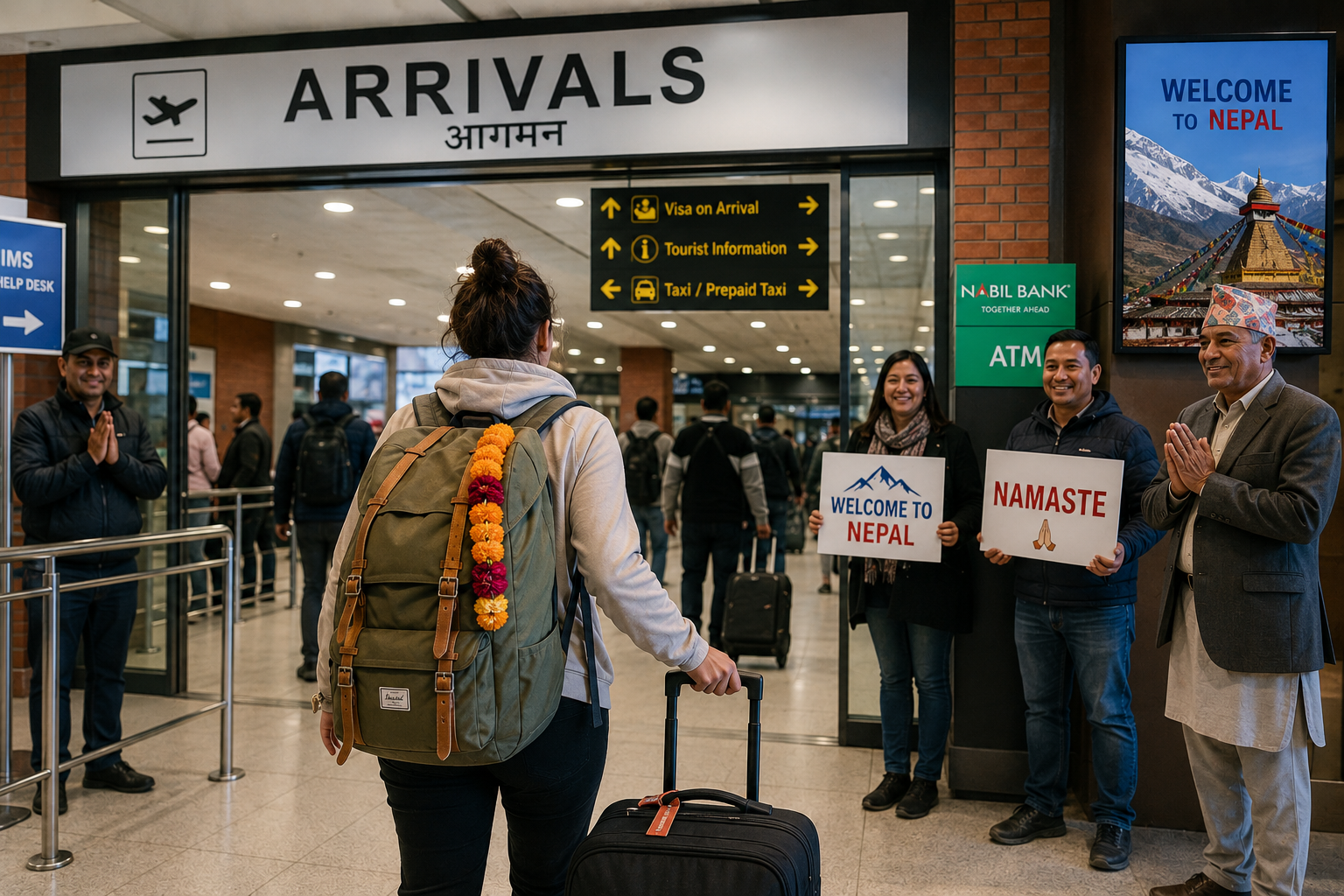
A step-by-step 2026 guide to arriving at Kathmandu Airport, including Nepal visa on arrival, immigration, SIM cards, money, taxis and your first 24 hours.
Last checked and updated: 7 July 2026
The doors open, warm air reaches the cabin, and the mountains you have been imagining for months are suddenly somewhere beyond the airport windows. Then the practical questions arrive all at once. Where do you fill in the visa form? Will the card machine work? Should you exchange money before immigration? Is the SIM counter still open? How do you reach Thamel without beginning your Nepal journey with an argument over a taxi fare?
Arriving in Nepal is not especially difficult, but Tribhuvan International Airport can feel busy, compact and slightly improvised after a long flight. A little preparation changes the whole experience. Instead of following whoever waves most confidently, you can move through the airport one step at a time, knowing what comes next.
This guide walks you from the aircraft door to your first hotel room in Kathmandu. It covers Nepal’s 2026 visa-on-arrival process, immigration, baggage, customs, airport Wi-Fi, SIM cards and eSIMs, cash, ATMs, taxis, ride-hailing apps and what to do during your first 24 hours in the city.
Your Nepal arrival checklist
- Passport with sufficient validity and blank pages
- Your first night’s accommodation name, address and phone number
- US dollar cash for the visa, even if you plan to pay by card
- Official visa application receipt, printed or saved offline, if completed before travel
- One spare passport photograph as a backup
- Travel insurance details and emergency contacts
- Unlocked phone if you intend to use a Nepali SIM
- Offline copy of your hotel location and booking confirmation
- Pathao installed if you may use a ride-hailing car
- A patient first-day plan with very little scheduled
Before You Fly: Five Minutes of Preparation That Can Save an Hour
The easiest arrival begins before you leave home. Put your passport, visa payment cash, accommodation details and travel documents somewhere you can reach without opening your main suitcase. Airport Wi-Fi is available, but you should not depend on a live internet connection to find your hotel address, insurance number or visa receipt.
Save the following information as screenshots:
- Your hotel name in English
- The full street or neighbourhood address
- A map pin
- The hotel’s Nepali phone number
- Your booking confirmation
- Your return or onward flight details
The official visa form asks for an address in Nepal. It does not need to be the address of every place you will stay. Your first hotel, guesthouse or host address is normally the most useful one to provide.
It is also worth reading our step-by-step guide to planning a Nepal trip and our honest list of things you will be glad you knew before travelling to Nepal. This arrival guide handles the airport. Those articles help you prepare for the country waiting outside it.
Use only official Nepal visa websites
This matters more in 2026 than it did before. Nepal Immigration has issued a warning about fraudulent websites and unauthorised online visa-fee payments. Search results can place commercial visa services above the official government portal, and some sites are designed to look convincingly official.
For an online tourist visa application, use the Government of Nepal’s official Nepali Port immigration portal. General visa information should be checked through the Department of Immigration or the Tribhuvan International Airport Immigration Office.
Completing the form online does not mean you have already received a visa. It prepares your application. Eligible travellers still pay the relevant fee and receive the visa through immigration.
Where You Are Arriving: Tribhuvan International Airport
Tribhuvan International Airport, usually shown on tickets as KTM, is Kathmandu’s main international gateway. It sits only a few kilometres from the city centre, yet the drive can take much longer than the map suggests because Kathmandu traffic moves according to the hour, the weather, roadworks and the mysterious collective mood of the city.
The airport is not enormous. International arrivals generally move through a simple sequence:
- Visa application and payment, if required
- Immigration
- Baggage collection
- Customs
- SIM, money and transport arrangements
- Exit to the public arrival and pickup area
Depending on where the aircraft parks, you may walk through an airbridge or be transferred to the terminal by bus. Follow the international arrivals signs and do not rush. Most passengers around you will be moving towards the same immigration hall.
Nepal Tourist Visa on Arrival in 2026
Most foreign visitors enter Nepal on a tourist visa. For eligible nationalities, a visa on arrival is available at Tribhuvan International Airport. Tourist visas issued on arrival are multiple-entry visas, which is useful if Nepal is part of a wider South Asian journey.
Current tourist visa fees
| Visa length | Official fee | Usually best for |
|---|---|---|
| 15 days | USD 30 | Short cultural trips and brief holidays |
| 30 days | USD 50 | Most first visits, including a trek and city time |
| 90 days | USD 125 | Long journeys, slow travel and extended stays |
Choose the duration carefully. A 15-day visa can feel shorter than expected once arrival and departure days, transport delays and trekking contingency days are counted. For many visitors, the 30-day option provides useful breathing room.
Tourist visas can be extended in Nepal, subject to immigration rules and the maximum permitted stay in a calendar year. For permit and extension context, read our complete Nepal visa and trekking permit guide.
Who should not rely on visa on arrival?
Indian citizens do not require a tourist visa to enter Nepal, but they must carry an accepted nationality document. Nepal’s airport guidance identifies a valid Indian passport or Election Commission voter card as the principal documents for adults. Aadhaar and driving licences are not accepted as international travel documents for this purpose.
Some other nationalities must obtain a visa before travelling. Eligibility rules can change, and Nepal made nationality-specific adjustments during 2026. Rather than relying on an old blog list, check the current official airport immigration FAQ or contact the nearest Nepali diplomatic mission before booking a non-refundable flight.
Gratis, or free, visa provisions may apply to certain travellers, including some children, SAARC nationals on a qualifying first visit of the year, Chinese tourists and eligible Non-Resident Nepali cardholders. These provisions can contain nationality-specific conditions, so confirm the rule that applies to your passport.
What you need for the visa process
- Your passport
- A completed tourist visa application
- The application receipt or barcode
- Your accommodation address in Nepal
- Payment for the visa duration selected
- A passport photograph as a sensible backup
Your passport should generally be valid for at least six months when entering Nepal. Airlines and diplomatic missions may also expect adequate blank pages. Check the requirement for your nationality before departure rather than discovering a problem at the airline desk.
Option 1: Complete the form before flying
This is usually the calmest option. Complete the tourist visa form on the official portal shortly before your trip, then save and print the submission receipt. The airport guidance states that the receipt remains valid for 15 days, so do not complete it months in advance.
Check every digit against your passport. A small error in a passport number or date of birth can create a much larger delay at the desk.
Option 2: Use an airport kiosk
If you have not completed the form beforehand, use one of the electronic kiosks in the arrivals area. Queues can form when several international flights land close together, particularly during the main autumn and spring travel seasons.
Keep your hotel address ready. The kiosk area is not the ideal place to begin searching through old emails while tired passengers wait behind you.
Paying the visa fee
After the form, proceed to the payment counter or bank counter and select the 15, 30 or 90-day visa. The airport states that cards and several currencies may be accepted, but it specifically advises passengers to carry US dollar cash as a backup.
Our practical advice: bring clean US dollar notes in the correct amount for your visa. Treat card payment as a convenience, not as your only plan. Network connections, terminals and queues do not always cooperate after a long flight.
Keep the payment receipt. You will need it at the immigration desk.
At the immigration desk
Join the correct line, then present your passport, application receipt and payment receipt. The officer may ask where you are staying, how long you intend to remain or why you are visiting. Straightforward answers are enough.
Before walking away, check the visa sticker or entry stamp. Confirm that the duration and entry date look correct. It is much easier to raise a question while you are still standing near immigration than after you have reached your hotel.
How long does the visa process take?
The official airport guidance says a visa on arrival is usually issued in less than an hour, but delays and queues are possible during peak periods. If you already hold a valid pre-arrival visa, you can normally move directly towards the appropriate immigration queue.
Do not book a tight domestic connection based on the best possible arrival time. International disembarkation, visa queues, baggage and the transfer between terminals all take time.
Baggage Collection: Slow Down Before You Leave the Hall
After immigration, follow the signs to baggage reclaim. Free baggage trolleys are available. Keep your baggage tag until you have collected everything.
If a bag does not arrive, is visibly damaged or has been opened, report it to the airline or baggage service desk before leaving the baggage-claim area. Ask for written confirmation or a property irregularity report. This document may be required by your travel insurer.
Do not assume a delayed bag will simply find you later without a report. Give the airline your hotel name, local phone number if available, email address and onward itinerary.
Customs: Green Channel or Red Channel?
Once you have your luggage, you pass through customs.
- Green channel: for passengers with nothing dutiable or restricted to declare
- Red channel: for passengers carrying goods or currency that must be declared, or anyone uncertain about an item
Nepal’s airport guidance says travellers carrying more than the equivalent of USD 5,000 in foreign currency should make a customs self-declaration. A declaration can also protect you when leaving Nepal with funds that were properly declared on entry.
Personal electronics used for your journey are generally straightforward, but valuable goods, commercial quantities, drones, specialist communications equipment, medicines, food products and expedition equipment may be subject to additional rules. Check the Department of Customs and your airline before travelling.
If you are unsure, use the red channel and ask. Choosing the green channel while carrying declarable goods can result in seizure or penalties.
Airport Wi-Fi: Useful, but Do Not Build Your Whole Arrival Around It
Tribhuvan International Airport provides free Wi-Fi. The airport currently identifies the network as Free_CAAN_WorldLink_WI-Fi. Network names and login methods can change, so confirm that you are joining the airport’s genuine connection rather than an imitation hotspot.
Use public Wi-Fi cautiously. Avoid banking, large payments or opening sensitive work systems unless you are using a trusted connection or VPN. The most useful airport Wi-Fi tasks are simple ones:
- Message your hotel or pickup driver
- Download or open your ride-hailing app
- Show a saved map pin
- Contact family to say you have arrived
- Activate a pre-purchased eSIM
Save essential information offline anyway. Free Wi-Fi is a helpful bridge, not an arrival strategy.
Money at Kathmandu Airport: What to Exchange and What to Keep
Nepal uses the Nepalese rupee, written as NPR or Rs. Cash remains important for taxis, small restaurants, local buses, market purchases, teahouses and many services outside the largest urban areas.
The airport has money-exchange counters and ATMs in the arrivals area. This makes it possible to obtain rupees before leaving the terminal, but it is still wise to arrive with the visa fee already available in a major foreign currency.
How much should you obtain at the airport?
You do not need to exchange your entire travel budget. Obtain enough for:
- Your journey to the hotel
- A SIM card or top-up
- Food and water
- A small hotel payment or deposit
- Unexpected first-day costs
Once rested, you can compare licensed money changers or bank counters in the city. Keep exchange receipts, especially if you may convert unused rupees before departure.
Using ATMs
Foreign cards generally work at many urban ATMs, but withdrawal limits, local fees and your own bank’s charges vary. A machine may decline one card and accept another. Carry at least two payment methods stored separately.
Choose to be charged in Nepalese rupees when your card or ATM offers a currency-conversion choice. Your own card provider will often give a better conversion than the machine’s optional home-currency conversion, although you should check your bank’s terms.
Using cards in Nepal
International cards are increasingly accepted by hotels, larger restaurants, airlines and established shops in Kathmandu and Pokhara. They are far less useful in villages, on trekking routes and at small family-run businesses. Power cuts, internet interruptions and terminal problems can also turn a card-friendly counter into a cash-only one.
Never let your card disappear out of sight. Keep transaction notifications enabled and check the amount before entering a PIN.
Do not pay ordinary expenses in foreign currency
A driver or shop may occasionally quote a price in dollars, euros or pounds because you have just arrived. Ask for the price in Nepalese rupees. Paying in local currency makes comparison easier and avoids improvised exchange rates.
Buying a Nepal SIM Card or eSIM
A local number is useful almost immediately. Hotels, guides and drivers often call rather than send long written directions. Ride-hailing apps work more smoothly when the driver can reach you, and mobile data becomes especially valuable when streets, alleys and building names do not match the map perfectly.
Nepal’s two major mobile networks are Nepal Telecom, often called NT or Namaste, and Ncell. Coverage varies by valley, road, village and trekking route. No network covers every mountain area reliably, so choose based on your actual itinerary rather than a general claim that one provider is always best.
Ncell tourist SIM and eSIM plans
As checked on 7 July 2026, Ncell lists the following tourist plans:
| Plan | Validity | Listed price | Included services |
|---|---|---|---|
| TouristPro Sprinter | 7 days | NPR 595 | Unlimited data and calls under fair-use rules, plus 100 SMS |
| TouristPro Explorer | 14 days | NPR 995 | Unlimited data and calls under fair-use rules, plus 100 SMS |
| TouristPro Voyager | 28 days | NPR 1,995 | Unlimited data and calls under fair-use rules, plus 100 SMS |
Prices and fair-use allowances can change. Check the official Ncell tourist SIM page before buying. Ncell states that tourist SIMs are available at Tribhuvan International Airport and that an original passport is required for registration and activation.
Ncell also offers a tourist eSIM through its online platform. This can be convenient if your phone supports eSIM and you want data without removing your home SIM.
Nepal Telecom SIM and eSIM
Nepal Telecom offers prepaid mobile services and an official eSIM portal. Availability and registration steps can differ between new customers and existing Nepal Telecom subscribers. Ask the official counter what documents and plans currently apply to foreign visitors.
What to bring to the SIM counter
- Your original passport
- An unlocked phone
- A passport photograph as a backup
- Your email address
- Enough Nepalese cash or an accepted payment card
Buy from an official operator counter, service centre or clearly authorised retailer. Make sure the SIM is registered in your name, activated and tested before you walk away.
Test these four things before leaving
- Make a short call
- Open a webpage using mobile data, not airport Wi-Fi
- Check your own Nepalese phone number
- Confirm how to view balance and purchase another data pack
For remote treks, ask your guide, lodge owner or recent travellers which network works along that specific route. Carry offline maps and do not treat mobile signal as an emergency system.
Long-stay visitors should also read our Digital Nomad’s Guide to Nepal, which covers connectivity, visas, working spaces and the practical rhythm of living in the country.
Getting from Kathmandu Airport to Your Hotel
The first sight outside the terminal can feel intense. Drivers hold name signs, relatives wait behind barriers, phones ring, luggage wheels catch on uneven ground, and several people may offer a taxi before you have decided where the official counter is.
Pause. Keep your bags close. You have four realistic options.
Option 1: Pre-arranged hotel or agency pickup
This is the easiest choice for first-time visitors, families, late-night arrivals and anyone carrying trekking equipment. Send the hotel your flight number, arrival date and expected time. Ask exactly where the driver will wait and what name will appear on the sign.
Before entering the vehicle, confirm the passenger name, hotel and booking details. Do not rely only on someone holding a familiar-looking sign.
Option 2: Official prepaid airport taxi
Tribhuvan International Airport operates a prepaid taxi service in the arrivals area. Tell the counter your destination, pay the displayed fare and retain the receipt. The assigned driver then takes you to your hotel.
This is usually the best balance for a tired first-time visitor. It may cost more than a ride negotiated outside, but the fare is agreed before departure and the journey is recorded through the counter.
Rates change, so use the current board rather than an old online price. For a typical central Kathmandu destination such as Thamel, travellers should expect a modest city transfer rather than a long-distance fare, with late-night, vehicle-size and traffic factors potentially affecting the price.
Option 3: Pathao car
Pathao operates app-based car rides across Kathmandu Valley. The app shows a fare or fare basis and connects you with a driver. It can be useful once you have mobile data or stable Wi-Fi.
Airport pickup locations are controlled, and vehicles collecting passengers use the designated arrival area rather than stopping wherever they like at the terminal entrance. Your driver may call to explain the meeting point. Use the in-app vehicle and driver details, then check the registration before getting in.
Ride-hailing is often cheaper than a prepaid airport taxi, but it is not always the easiest choice after a delayed flight, particularly if your phone has no local connection or you cannot identify the pickup area.
Option 4: A locally negotiated taxi
Regular taxis are available outside the controlled arrival area. If the meter is not being used, agree on the full fare in Nepalese rupees before placing your luggage in the vehicle. State the exact hotel and neighbourhood, not simply “Kathmandu”.
Avoid vague agreements such as “normal price” or “we will decide when we arrive”. A clear fare, destination and luggage arrangement prevents most misunderstandings.
What about the city bus?
Public buses connect the airport area with the city and are inexpensive, but they are not designed around a newly arrived traveller with a large backpack, suitcase and uncertain stop. They can be enjoyable later, once you understand Kathmandu’s routes and tempo. For your first journey, a taxi or arranged pickup is usually worth the extra cost.
How long does the drive take?
Traffic matters more than distance. Approximate driving conditions are:
- Boudha: relatively close to the airport, but junction traffic can slow the journey
- Patan or Jhamsikhel: across busy urban roads and bridges
- Thamel: commonly reached within roughly 25 to 60 minutes, depending on traffic
- Bhaktapur: in the opposite direction from central Kathmandu and usually a longer transfer
For a careful neighbourhood comparison, see our guide to where to stay in Kathmandu. Your first night’s location shapes the feeling of your arrival more than the star rating of the hotel.
Late-Night Arrivals
Kathmandu is still alive after dark, but a late arrival is not the moment to improvise everything. Arrange a hotel pickup or use the official prepaid taxi counter. Save the hotel’s phone number offline and tell reception that you will arrive late.
Carry a small amount of Nepalese cash if possible, but keep US dollars available for the visa. Airport ATMs and counters may be open around international flight arrivals, yet one closed counter or rejected card is enough to complicate the night.
Do not plan a long road transfer to Pokhara, Chitwan or a trekking trailhead immediately after landing. Sleep in Kathmandu, eat something warm, let your body catch up with the clock, and leave in daylight.
Your First 24 Hours in Kathmandu
The most common first-day mistake is treating arrival as the opening whistle for an itinerary. Travellers reach the hotel exhausted, shower quickly, then attempt three temples, a restaurant list and a gear-shopping mission before sunset. Kathmandu does not reward that kind of beginning.
A gentler first 24 hours works better.
Hour 1: Reach the hotel and stop moving
Check in, message home, charge your phone and confirm that your passport is safely stored. Drink sealed, filtered or properly treated water. Avoid drinking directly from the tap.
Hours 2 to 4: Eat something simple
Choose a clean restaurant close to your hotel. Dal bhat, thukpa, momo or a simple rice dish is a kinder beginning than a large celebratory meal with several unfamiliar foods and alcohol.
If food is part of why you came, our story of a full day of eating like locals in Nepal will give you a taste of what lies ahead.
Hours 4 to 8: Take one small walk
Walk around your neighbourhood without trying to “do” Kathmandu. Notice the tiny shrines beside shop doors, vegetable sellers arranging produce, scooters threading through lanes and the smell of incense mixing with dust and frying spices. Learn the route back to your hotel while it is still light.
That evening: Check tomorrow, then sleep
Confirm any guide, bus, domestic flight or hotel pickup scheduled for the next day. Set out the documents you need. Kathmandu mornings can begin early, and a rested traveller makes better decisions.
The next morning: Handle practical tasks
If you did not buy a SIM or enough cash at the airport, do it now. Visit an official telecom centre or licensed money changer. Trekkers can check permits, insurance details and equipment without the fog of an overnight flight.
Our first-time visitor’s guide to Nepali culture and language is a helpful next read before you begin exploring.
Arrival Advice for Different Travellers
Solo travellers
Share your flight and hotel details with someone you trust. Use a registered prepaid taxi, verified ride-hailing car or pre-arranged pickup. Sit where you feel comfortable, keep your phone charged and do not announce that nobody knows where you are staying.
Women travelling independently may also find our solo female travel guide to Nepal useful for transport, accommodation and cultural context.
Families with children
Arrange pickup before flying. Keep one small bag with snacks, water, medication, wipes and a change of clothing. Immigration queues can be tiring after an overnight journey. If a child receives a gratis visa, still expect to complete the immigration process and carry the appropriate travel document.
Trekkers
Do not place boots, medication, waterproof layers or irreplaceable documents only in checked baggage. If your main bag is delayed, you should still be able to spend a night in Kathmandu and begin solving the problem.
Before heading into the mountains, check that your policy genuinely covers your route. Our 2026 guide to travel insurance for trekking in Nepal explains altitude limits, helicopter evacuation and common policy gaps.
Digital nomads and long-stay visitors
An eSIM can provide immediate connectivity, but a locally registered number remains useful for deliveries, drivers and local services. Do not make an important work call on airport Wi-Fi. Reach your accommodation, test the connection and keep a backup data option.
Common Arrival Mistakes and How to Avoid Them
Using a lookalike visa website
Use only official Government of Nepal domains. Do not assume the first sponsored or highly ranked search result is the immigration department.
Depending entirely on card payment
Carry enough US dollar cash for the visa and keep another payment method separately. A card that works everywhere at home can still be declined by one airport terminal.
Completing the visa form too early
The airport states that the submission receipt is valid for 15 days. Complete it close enough to your travel date that it remains valid when you arrive.
Exchanging the entire travel budget at the airport
Exchange or withdraw what you need for the first day, then compare licensed options in the city.
Leaving baggage claim without reporting a problem
Report missing or damaged luggage before leaving the controlled area. Obtain written evidence for follow-up and insurance.
Buying a SIM without testing it
Make a call and open a webpage on mobile data at the counter. It is easier to correct activation there than after reaching a hotel across the city.
Entering a taxi before agreeing on the fare
Use the prepaid counter, an app fare or a clearly agreed Nepalese-rupee price.
Scheduling an immediate domestic connection
The domestic terminal is separate from international arrivals. The airport states that it is roughly 500 metres away and operates a connecting shuttle, but immigration and baggage delays can still make a tight connection risky.
Planning too much for the first afternoon
Your body has crossed time zones even if your itinerary refuses to acknowledge it. One meal and one walk are enough.
Frequently Asked Questions
Can I get a Nepal visa when I land in Kathmandu?
Most nationalities can obtain a tourist visa on arrival at Tribhuvan International Airport. Some passport holders must obtain a visa in advance, while Indian citizens do not require a visa. Check official eligibility before travel.
How much is Nepal’s visa on arrival in 2026?
The official fees are USD 30 for 15 days, USD 50 for 30 days and USD 125 for 90 days.
Can I pay the visa fee by card?
The airport says cards may be accepted, but it advises passengers to carry US dollar cash as well. Cash is the safest backup.
Do I need a printed visa form?
If you complete the online application, save the receipt and barcode offline and carry a printed copy when possible. You can also complete the form at an airport kiosk.
Do I need a passport photograph?
The electronic process may capture or upload the required image, but carrying one recent passport photograph is a sensible backup and can be useful for later permits or administrative tasks.
Is there free Wi-Fi at Kathmandu Airport?
Yes. Tribhuvan International Airport states that free Wi-Fi is available. Save essential information offline because public Wi-Fi can be slow or temporarily unavailable.
Can I buy a Nepal SIM at the airport?
Yes. Ncell officially sells tourist SIMs at Tribhuvan International Airport, and telecom services may also be available through other authorised counters. Carry your original passport and use an unlocked phone.
Should I buy an eSIM before arrival?
An eSIM is convenient for immediate data, particularly if you need to contact a driver. Check that your phone supports eSIM and that the plan includes the coverage and validity you need. A local physical SIM may still be useful for a Nepalese number.
What is the safest way from Kathmandu Airport to Thamel?
A confirmed hotel pickup or the official prepaid airport taxi is the easiest option for a first arrival. Pathao is a useful alternative once you have data and understand the designated pickup area.
How long does it take to reach Thamel?
Allow roughly 25 to 60 minutes in normal conditions, with longer journeys possible during congestion, rain or road disruption.
Can I connect directly to a domestic flight?
You can, but leave a generous buffer. The domestic terminal is separate, and your total arrival time includes disembarkation, visa processing, immigration, baggage, customs and terminal transfer. For weather-sensitive flights such as Lukla, an overnight stay is often the calmer plan.
What should I do if my luggage is missing?
Report it to your airline before leaving baggage claim. Obtain a written report and give the airline your Kathmandu contact details and onward itinerary.
How much cash should I carry?
Carry enough foreign cash for the visa and a modest amount of Nepalese rupees for your first day. Do not carry your entire travel budget in one place. Use a combination of cash and cards.
The Calmest Arrival Plan
There is no prize for being the first person from your flight to reach Thamel. The best arrival is the one in which you keep control of your documents, understand each payment, know who is driving you and reach your room with enough energy left to notice that you are finally in Nepal.
Complete the official visa form shortly before travel. Carry US dollars. Save your hotel address offline. Buy connectivity from an authorised provider. Use a registered taxi or verified pickup. Then let the first evening remain simple.
Kathmandu will still be there in the morning. Temple bells will carry over the rooftops, kettles will begin to whistle, shop shutters will rise and the city will introduce itself properly, not as an airport problem to solve, but as the beginning of the journey you came for.
Official Sources Used for This Guide
- Nepal Department of Immigration
- Official online tourist visa application
- Tribhuvan International Airport Immigration Office
- Tribhuvan International Airport passenger FAQ
- Nepal Department of Customs
- Ncell tourist SIM and eSIM information
- Nepal Telecom eSIM portal
- Pathao Nepal car service
Entry rules, mobile plans, airport counters and transport prices can change. Recheck official sources shortly before travelling.
Related Posts
Stay Informed With the Latest & Most Important News
Previous Post
Next Post
- Kathmandu Travel Guide: What to See, Where to Stay, Eat and How to Get Around
- From Mustang to the World: Shinta Mani Mustang Named the No. 1 Luxury Hotel on Earth
- Best Places to Visit in Nepal: A Complete Region-by-Region Guide for Every Traveller
- Trekking in Nepal: The Complete Guide to Choosing and Planning Your Himalayan Trek
- Beyond the Mountains: Why Nepal Could Become One of the World’s Great Food Destinations