Now Reading: The Unwritten Rules of Travelling in Nepal (That Locals Never Explain)
-
01
The Unwritten Rules of Travelling in Nepal (That Locals Never Explain)
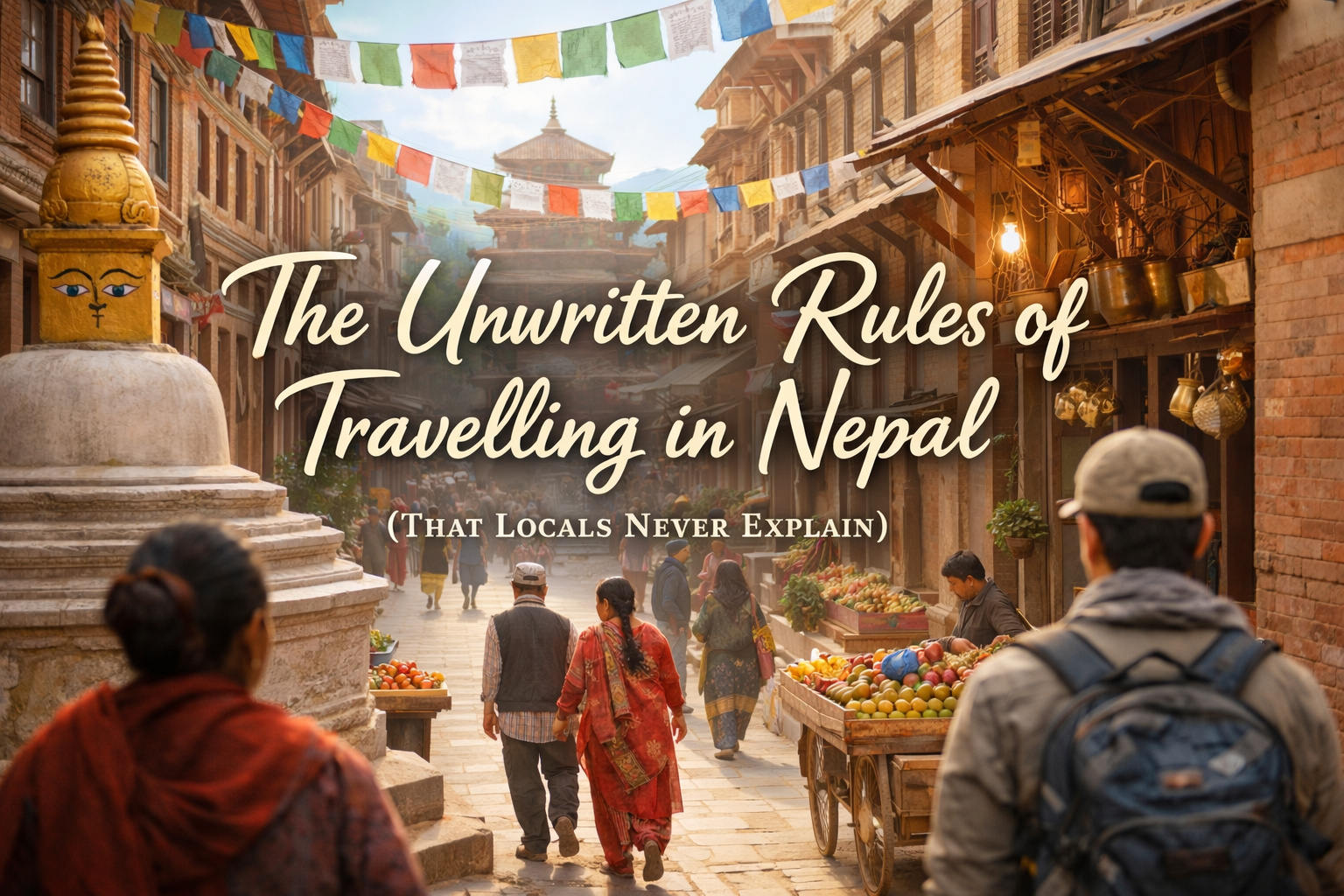

Most people arrive in Nepal with lists.
Permits. Routes. Packing checklists.
They land prepared, but not always ready.
What shapes your experience here rarely appears in itineraries. It lives in how you wait, how you speak, how you react when things do not go as planned. Nepal does not demand mastery. It asks for awareness.
This guide exists for that space between knowing where you are going and understanding how to be there.
Nepal Will Teach You a Different Relationship With Time
Time in Nepal is elastic.
Buses have schedules, but they follow readiness more than clocks. Shops open when shutters lift, not when Google says so. Meals are cooked when someone is free to cook them.
This can feel unsettling for travellers used to tight timelines. The instinct is to push, ask repeatedly, check again, and hurry others along.
That instinct works against you here.
Time in Nepal prioritises human flow over efficiency. If someone is late, it is rarely careless. It is because something else needed attention first.
How to prepare
- Add generous buffers between connections
- Avoid stacking activities tightly
- Treat delays as part of the journey, not interruptions to it
Once you stop fighting time, Nepal becomes calmer.
Greetings Carry Weight Even When Spoken Softly
“Namaste” is everywhere, but it is never empty.
It is not rushed. It is not thrown across rooms. It is delivered with intention, often with a pause that says, I see you.
Travellers often say it quickly, loudly, and repeatedly, meaning well but missing the tone. Locals will still smile, but something subtle is lost.
How to prepare
- Slow down when greeting people
- Use eye contact
- Let the gesture be gentle, not theatrical
A sincere Namaste opens more doors than fluent Nepali ever will.
Shoes and Thresholds Matter More Than Signs
In Nepal, thresholds mark transitions.
From public to private.
From outside life to inside life.
Shoes carry the outside world. Dust, roads, animals, weather. Removing them is an act of respect, not a rule enforced by signage.
Many homes and temples do not have signs telling you what to do. Locals assume you will observe.
How to prepare
- Wear shoes that are easy to remove
- Pause before entering spaces
- Follow what others do, even if no one instructs you
Attention is the etiquette here.
Food Is an Emotional Exchange
Meals in Nepal are rarely casual, especially in homes.
When someone cooks for you, they are offering more than food. They are offering care, effort, and pride. Dal bhat may appear simple, but it is deeply personal.
Travellers sometimes refuse food politely, thinking it is considerate. Often, it is received as distance.
How to prepare
- Accept food even if you eat lightly
- Praise the taste honestly
- Understand that second servings are affection, not pressure
Eating together is one of the fastest ways to be welcomed.
Personal Questions Are Invitations, Not Evaluations
You will be asked things that feel private.
Your age.
Your job.
Your family.
Your plans.
These questions are not probing status or boundaries. They are building familiarity. In a relationship-based culture, knowing someone means placing them within a social map.
How to prepare
- Answer simply or humorously
- Redirect gently if needed
- Do not assume judgment where there is curiosity
You are not being assessed. You are being included.
Privacy Looks Different When Life Is Shared
Space in Nepal is often communal.
Houses are close. Sounds travel. People know each other’s routines. What feels like an intrusion to visitors often feels like a connection to locals.
This shows up in unexpected help, unsolicited advice, or people watching what you are doing.
How to prepare
- Do not mistake attention for control
- Set boundaries kindly if needed
- Remember that visibility is normal here
Privacy is not absent; it is simply defined differently.
Plans Bend, Relationships Anchor
You may feel frustrated when arrangements change at the last minute.
Transport shifts. Meetings delay. Shops close early. What does not change is how people show up for each other.
Nepal values human presence over punctuality. A neighbour in need outranks a schedule. A guest outranks a task.
How to prepare
- Hold plans lightly
- Value interactions over outcomes
- Thank people even when plans unravel
Nepal rarely gives you what you expect. It often gives you something better.
Silence Is Not Something to Fill
Quiet moments are not awkward here.
Sitting without talking. Sharing tea without conversation. Walking without commentary. These are comfortable states.
Travellers sometimes feel pressure to entertain, explain, or connect verbally. Locals often connect simply by being there.
How to prepare
- Let silence happen
- Do not rush to fill gaps
- Observe more than you speak
Stillness is part of communication.
Bargaining Is a Social Dance
Yes, prices can be negotiated, but not aggressively.
Markets are places of conversation. Bargaining is expected, but it should remain friendly. Smiling matters. Tone matters.
Trying to win every exchange damages the interaction.
How to prepare
- Ask prices calmly
- Counter once or twice, not endlessly
- Walk away politely if needed
Fairness here includes dignity on both sides.
Clothing Signals Awareness, Not Obedience
Nepal is diverse. What feels normal in Kathmandu may feel out of place in rural villages.
Modesty is appreciated, especially around elders, religious sites, and family homes.
How to prepare
- Pack layers and scarves
- Cover shoulders and knees in villages and temples
- Dress in a way that does not demand attention
Blending in brings comfort you do not realise you need until you have it.
Help Arrives Before You Ask
You will be guided, corrected, assisted, and sometimes gently redirected.
Someone may walk you to a place instead of pointing. Someone may adjust your bag or tell you to sit differently. This is not control. It is care.
How to prepare
- Accept help graciously
- Say thank you often
- Understand that refusal may confuse more than acceptance
Independence is respected, but interdependence is normal.
Public Anger Closes Doors Quietly
Raising your voice, showing visible frustration, or expressing anger publicly rarely works here.
Nepalese communication values calm and restraint. Conflict is handled softly or indirectly.
How to prepare
- Lower your voice when problems arise
- Be patient with explanations
- Express disappointment gently
Calm earns cooperation faster than insistence.
Religion Is Everyday, Not Performative
Prayer happens alongside work. Offerings are made quickly. Bells ring without ceremony.
Temples are not staged experiences. They are part of daily movement.
How to prepare
- Observe before participating
- Follow local behaviour
- Ask respectfully when curious
You are entering living spaces, not exhibits.
Cameras Carry Responsibility
People may agree to photos out of politeness, not comfort.
Children, elders, monks, and workers deserve respect beyond aesthetics.
How to prepare
- Ask before photographing people
- Put the camera down sometimes
- Remember, moments matter even when undocumented
Not everything meaningful needs to be captured.
Nepal Gives Back What You Bring
Nepal does not reward efficiency, control, or certainty.
It rewards patience.
It rewards humility.
It rewards curiosity without entitlement.
The more you loosen your expectations, the more the country gives you moments that feel unplanned, intimate, and real.
You do not need to understand Nepal fully to travel well here.
You only need to arrive willing to listen, adapt, and let go.
Related Posts
Stay Informed With the Latest & Most Important News
- Top 15 Biggest Cities in Nepal by Population: Walk With Me Through Urban Nepal
- Two Weeks in Nepal: How to Plan the Ultimate Trip Across the Roof of the World
- Pokhara Calling: Why Nepal’s Lakeside City Will Steal Your Heart (and When to Go)
- Beyond Dal Bhat: A Traveller’s Guide to the Foods of Nepal
- No More Solo Trekking: Everything You Need to Know About Nepal’s 2026 Trekking Rules