Now Reading: Mardi Himal Trek: The Quieter Trail to Nepal’s Most Photogenic Peak
-
01
Mardi Himal Trek: The Quieter Trail to Nepal’s Most Photogenic Peak
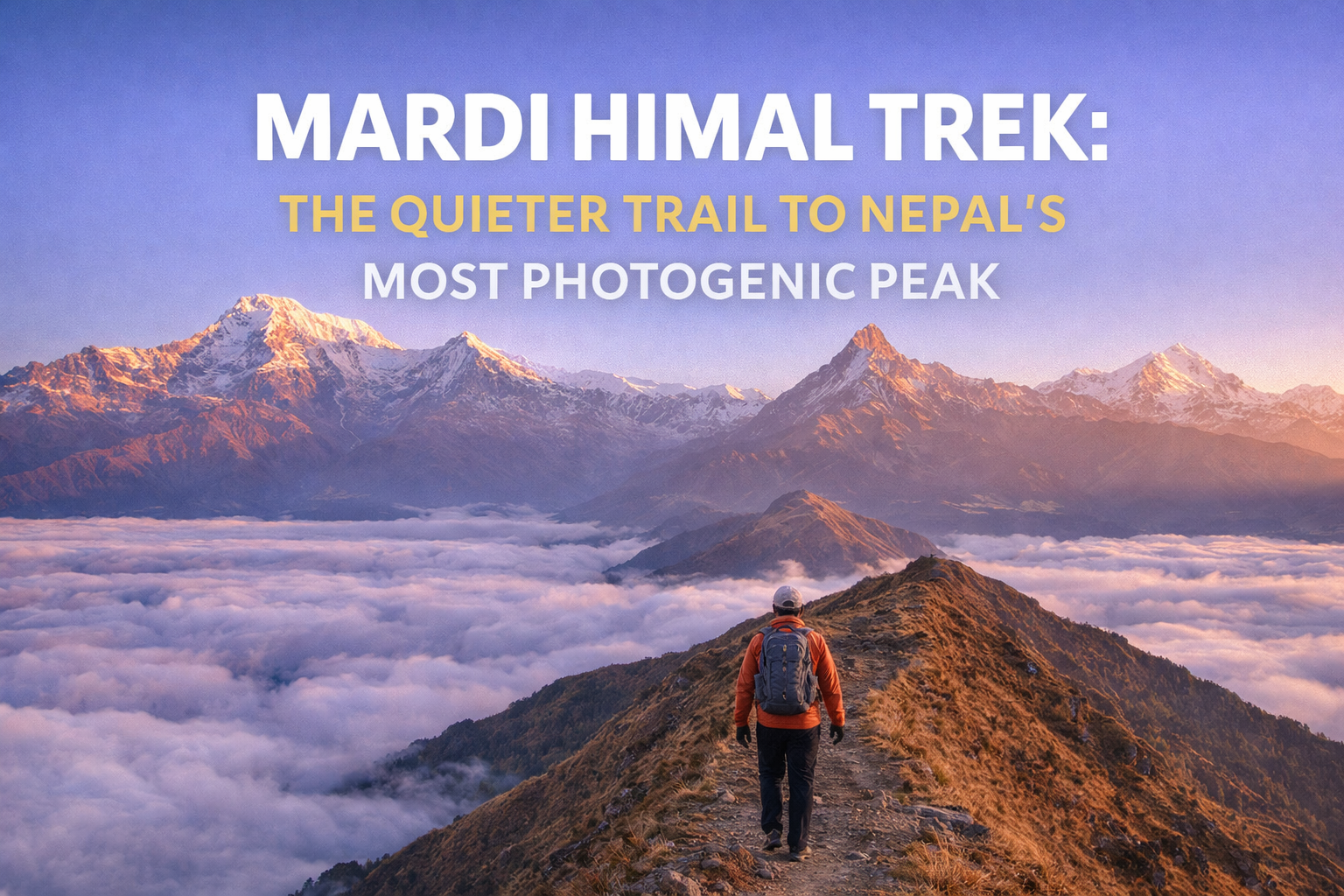
Mardi Himal Trek: The Quieter Trail to Nepal’s Most Photogenic Peak

Discover the Mardi Himal trek, Nepal's trending ridge walk with jaw-dropping Machapuchare views, cosy teahouses, and fewer crowds. Your complete guide inside.
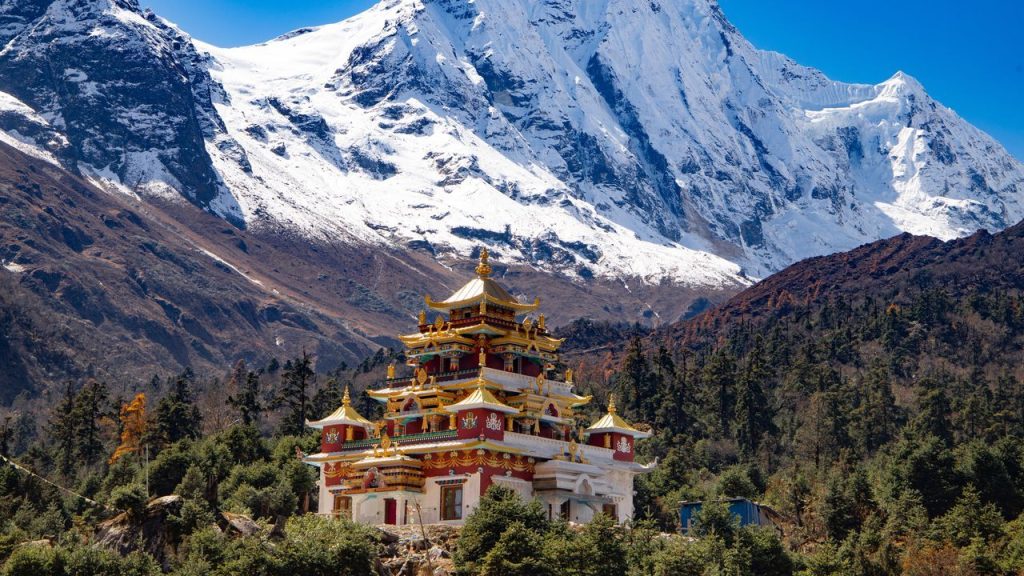
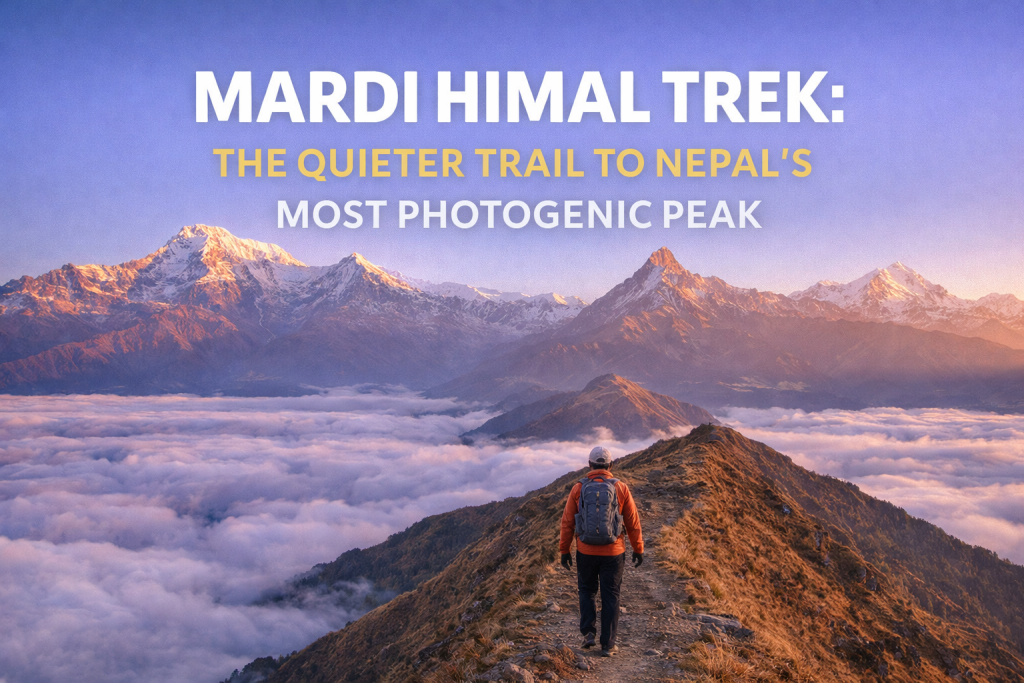
There is a moment on the Mardi Himal trek when the forest simply… ends. One minute you are ducking under moss-draped rhododendron branches, breathing in the earthy sweetness of damp bark. Next, you step onto a narrow ridge, and the entire Annapurna massif slams into view. Machapuchare, the sacred Fishtail peak, is so close you can count the ice flutes carved into its north face. Annapurna South glows pink in the morning light. And there is nobody else around.
If your social media feeds have been flooded with dramatic ridge-walk reels from Nepal lately, chances are you have been looking at the Mardi Himal trek. This relatively new route in the Annapurna region has been quietly building a reputation as one of the most photogenic short treks in the Himalayas, and for good reason. It delivers the kind of mountain theatre that longer, more famous trails promise but sometimes bury under crowds and long approach days.
Here is everything you need to know to walk it yourself.
Why the Mardi Himal Trek Is Blowing Up Right Now
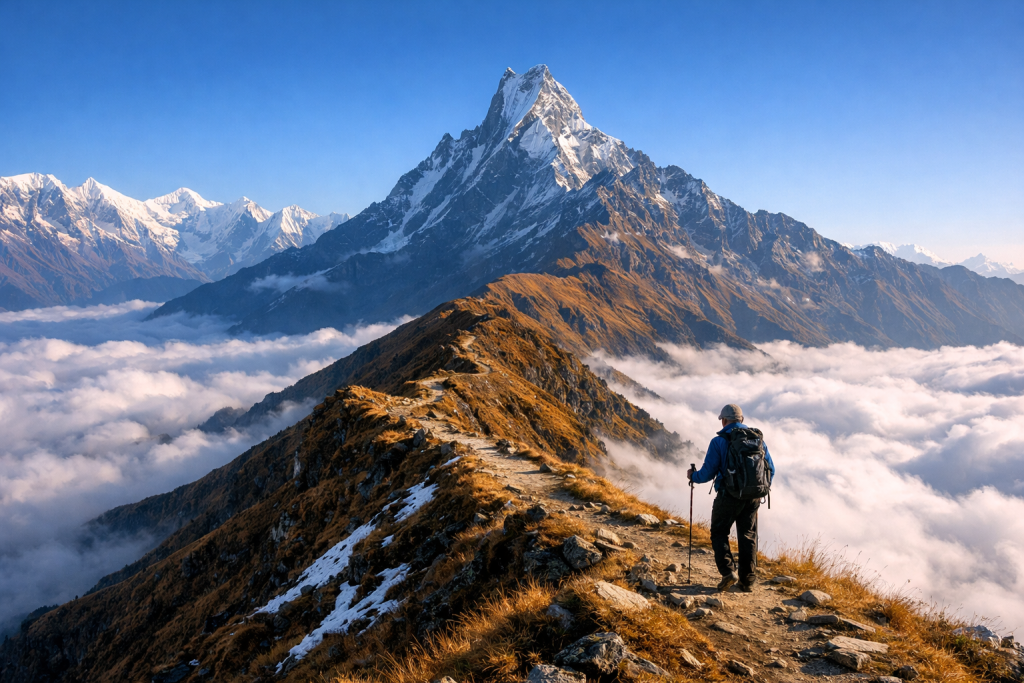
The Mardi Himal trek was officially opened to trekkers in 2012, but it spent years flying under the radar while neighbouring routes like the Annapurna Base Camp (ABC) trek and the Poon Hill circuit soaked up the attention. That changed when photographers and content creators discovered the ridge walk between Low Camp and High Camp. Unlike most Nepal treks that follow river valleys (where you spend your days looking up at mountains from below), the Mardi Himal trek puts you on the spine of a mountain. You walk with valleys dropping away on both sides and peaks spread before you at eye level. It is, quite literally, walking among the giants rather than beneath them.
The result? A trek that fits into five to seven days, starts right from Pokhara with no internal flights, and serves up the kind of panoramic Himalayan views that make strangers on the internet beg you for the location pin.
Your Day-by-Day Mardi Himal Trek Itinerary
This itinerary covers the classic five-day trekking route from Pokhara and back. You can extend it to seven days for a more relaxed pace or to add an acclimatisation day at High Camp, which is worth considering if you have not trekked at altitude before.
Day 1: Pokhara to Kande, Trek to Forest Camp (2,540m)
Your morning starts with a short drive from Pokhara’s lakeside to Kande, the trailhead. The road takes about an hour and a half, weaving through green foothills with glimpses of the Annapurna range ahead. From Kande, the trail climbs steadily through terraced farmland and oak forest, passing through the well-known Australian Camp (2,060m) and the village of Pothana before pushing on to Deurali (2,100m), where your ACAP and TIMS permits are checked.
From Deurali, the trail splits away from the main Annapurna Base Camp route and enters progressively denser rhododendron forest. If you are trekking in spring (March to May), prepare yourself: the rhododendrons explode into shades of crimson, pink, and white so vivid they look retouched. Forest Camp sits in a clearing at 2,540m, and the teahouses here are basic but welcoming. Expect a warm dal bhat, a simple twin room, and the sound of absolutely nothing except birdsong.
Walking time: 5 to 6 hours
Altitude gain: roughly 1,400m from Kande
Day 2: Forest Camp to High Camp (3,580m)
This is the day the Mardi Himal trek earns its reputation. The morning begins with a continued climb through the forest, the canopy still thick overhead and prayer flags appearing between branches. You will pass Low Camp at around 3,050m, where the trees begin to thin and Machapuchare makes its first proper appearance through the gaps. Keep your camera accessible because the views only intensify from here.
After Low Camp, you reach Badal Danda (Cloud Hill) at roughly 3,250m. The name is perfect: this is where the cloud line often sits, and on clear mornings you can watch the valleys below fill with white mist while the peaks above blaze in sunlight. It is one of the most photographed spots on the entire trek.
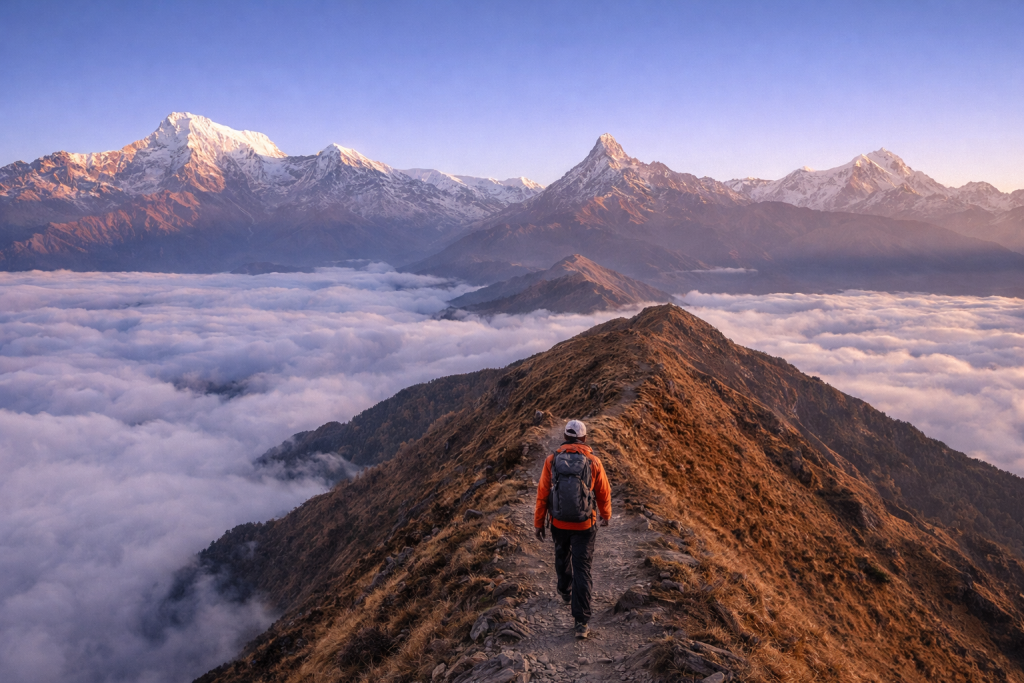
Beyond Badal Danda, the forest falls away entirely and you step onto the exposed ridge that defines this route. The trail traverses open grassland and alpine scrub, with the valley dropping steeply on both sides. Machapuchare towers ahead. Annapurna South looms to the left. Hiunchuli stands guard in the distance. There is no shelter from the wind up here, but there is also nothing between you and some of the most dramatic mountain scenery on the planet.
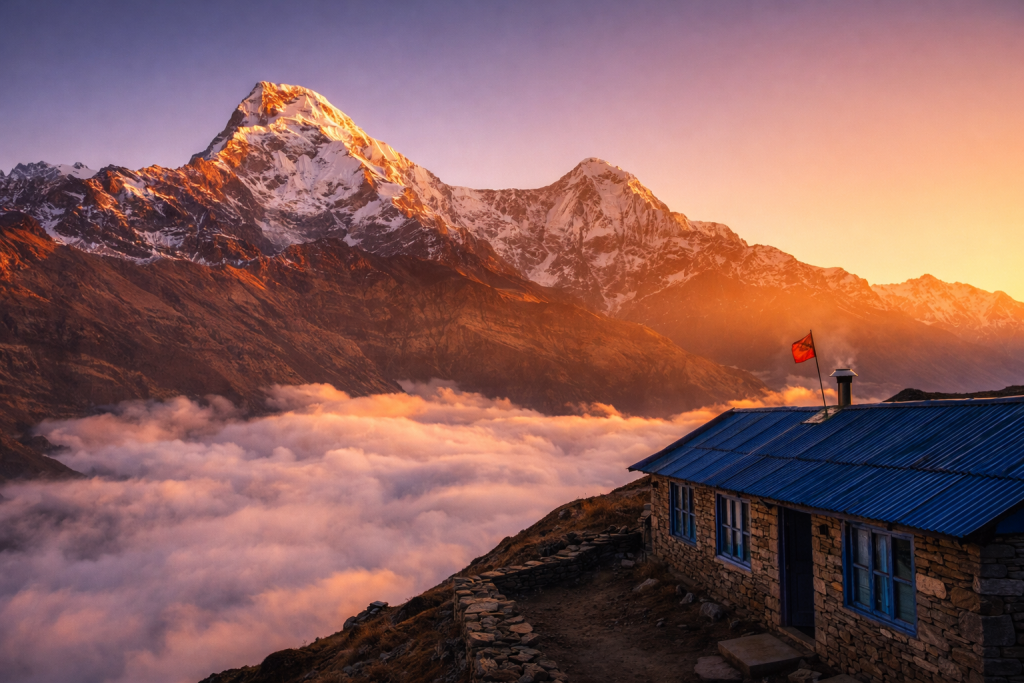
High Camp sits at 3,580m on a small alpine pasture with a handful of teahouses. Settle in, drink plenty of water, and watch the sunset paint the Annapurna range in shades of gold and amber. This is the moment you will remember long after you have gone home.
Walking time: 6 to 7 hours
Altitude gain: roughly 1,040m
Day 3: High Camp to Mardi Himal Base Camp (4,500m) and Back
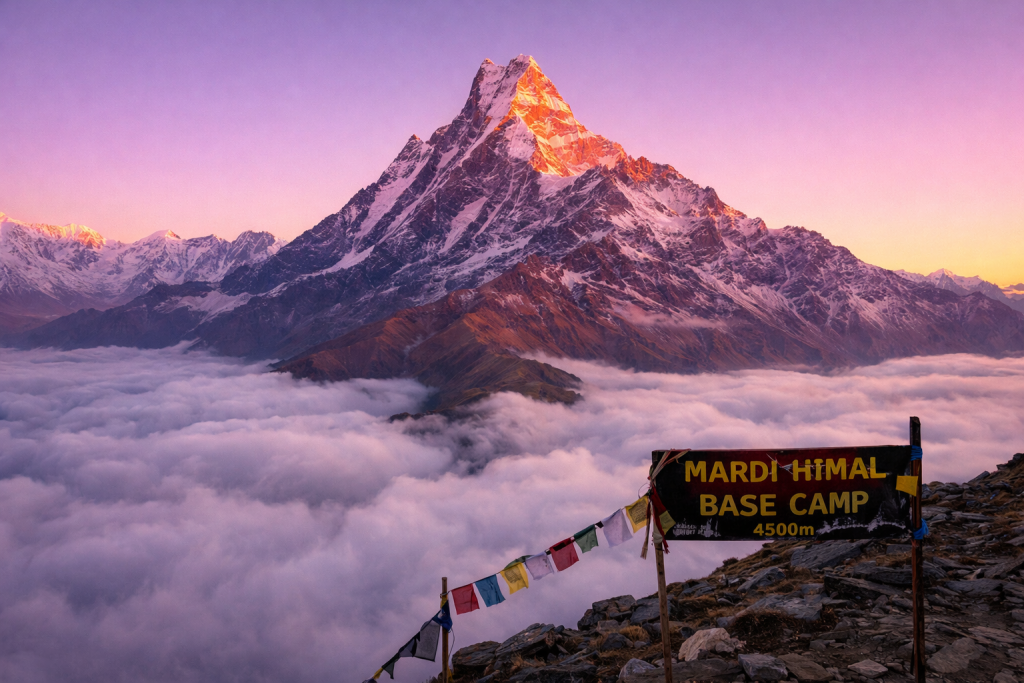
Set your alarm for 3:30 a.m. Yes, it will hurt. But the pre-dawn hike to Mardi Himal Base Camp (or the Upper Viewpoint at 4,200m, depending on conditions) is the crown jewel of this trek. You will climb through darkness with a headlamp, the cold biting at your cheeks, until the sky begins to lighten and the mountains materialise around you like a slow-developing photograph.
Reaching the viewpoint as the first rays of sunlight strike Machapuchare’s summit is an experience that borders on spiritual. The mountain fills your entire field of vision from this distance. You can see the fluted ice columns on its face, the sharp double summit that gives it the Fishtail name, and the sweep of glaciers that cascade down to the valley floor. Annapurna South, the Annapurna range, Dhaulagiri, and Mardi Himal itself complete the 360-degree panorama.
Take your time. Breathe slowly (the air is thin up here). Shoot your photos. Then descend back to High Camp for a well-earned breakfast before continuing down to Badal Danda or Low Camp for the night.
Walking time: 8 to 9 hours (round trip including descent)
Maximum altitude: 4,200m to 4,500m
Day 4: Descent to Siding Village (1,850m)
The descent follows a different route through the forest, keeping the scenery fresh. You will drop back through the rhododendron canopy, past mossy boulders and the occasional Himalayan tahr (a wild mountain goat) perched on a rocky outcrop above. The trail eventually reaches the traditional Gurung village of Siding, where stone-walled houses cluster on green terraces and locals greet you with a warmth that makes you want to stay for a week.
Siding offers a cultural counterpoint to the mountain drama of the previous days. Sit on a teahouse terrace, sip butter tea, and watch the last of the daylight fade over the valley.
Walking time: 5 to 6 hours
Altitude loss: significant descent through varied terrain
Day 5: Siding to Lwang, Drive to Pokhara
A gentle morning walk takes you through Ghalel village, past terraced rice paddies and local tea farms, to the roadhead at Lwang. From here, a vehicle picks you up for the drive back to Pokhara. By lunchtime, you can be sitting beside Phewa Lake with a cold drink in your hand, watching paragliders drift over the water, and wondering how a five-day trek just delivered one of the best mountain experiences of your life.
Walking time: 3 to 4 hours plus drive
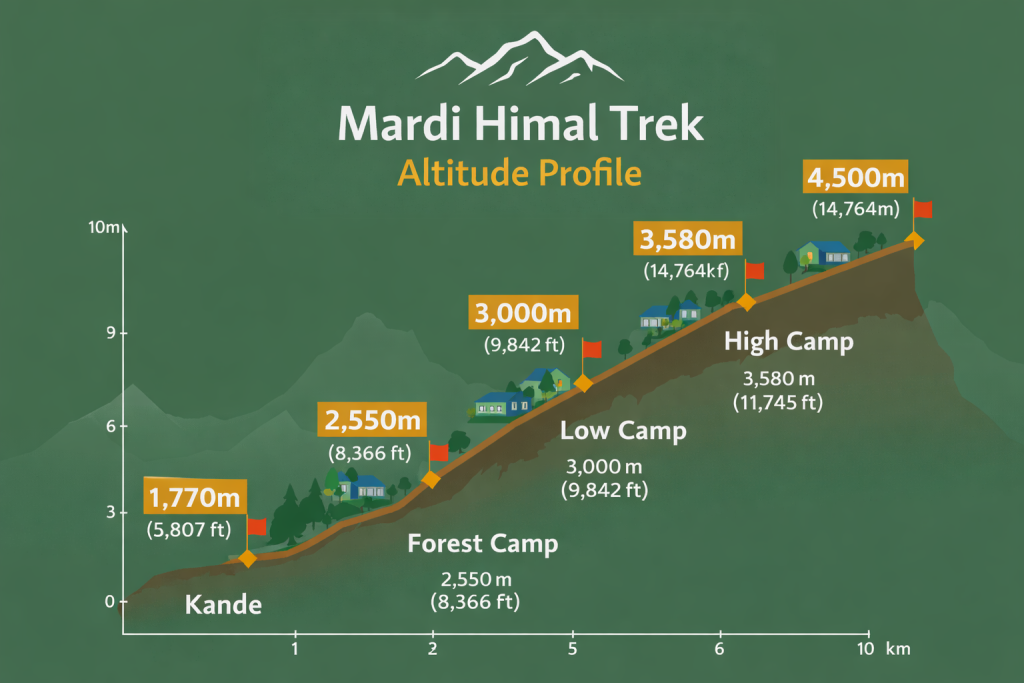
The Altitude Profile: What Your Legs Need to Know
Understanding the elevation changes on the Mardi Himal trek helps you pace yourself and avoid altitude sickness. Here is the altitude breakdown for each major stop along the route:
- Kande (trailhead): 1,770m
- Australian Camp: 2,060m
- Deurali (Pitam Deurali): 2,100m
- Forest Camp: 2,540m
- Low Camp: 3,000m
- Badal Danda (Cloud Hill): 3,250m
- High Camp: 3,580m
- Upper Viewpoint: 4,200m
- Mardi Himal Base Camp: 4,500m
The biggest single-day altitude gain happens on Day 2 (Forest Camp to High Camp), which covers over 1,000m of ascent. Drink at least three to four litres of water daily, ascend slowly, and listen to your body. If you feel headaches, nausea, or dizziness, tell your guide immediately. Most itineraries build in natural acclimatisation by spending a night at High Camp before the early morning push to Base Camp.
Teahouse Availability: Where You Will Sleep and Eat
The Mardi Himal trek is a fully teahouse-supported route, so you do not need to carry camping gear. That said, the teahouses here are smaller and fewer in number than on the ABC or Poon Hill circuits, which is part of what keeps the trail uncrowded. Here is what to expect at each stop:
Deurali and Forest Camp have the most established teahouses with basic twin rooms, shared bathrooms, and dining halls serving dal bhat, noodle soup, fried rice, egg dishes, and pancakes. Hot showers are usually available for a small fee. Prices are reasonable at these lower elevations.
Low Camp and Badal Danda have a handful of lodges. Rooms are simple (a bed, a mattress, a blanket), and the menus narrow slightly. Badal Danda may have only one or two operating teahouses, depending on the season. Bringing a sleeping bag is wise from this point forward.
High Camp has around three to four lodges clustered on the alpine pasture. Rooms are basic and cold at night, but the dining halls have wood or yak-dung stoves that become the social hub of the evening. Expect to pay more for food here (a dal bhat that costs 400 NPR in Pothana might run 700 NPR at High Camp), which is entirely fair given that every grain of rice is carried up by porters.
During peak season (October and March to April), booking ahead through your trekking agency is recommended, as High Camp’s limited beds fill up quickly.
Mobile Signal and Connectivity: Staying in Touch on the Trail
If you need to post that ridge-walk reel in real time, here is the reality check. Phone signal from both NTC and Ncell carriers is available at the lower elevations and on exposed ridge sections, but it drops out inside the dense forest between Deurali and Low Camp. WiFi is offered at most teahouses along the route (Deurali, Forest Camp, Low Camp, and High Camp all have some form of connectivity), though reliability decreases as you gain elevation.
Treat WiFi above Forest Camp as a pleasant bonus rather than something to depend on. Deurali is likely the last point where you will have a consistently reliable connection. At High Camp, you might get enough signal to send a WhatsApp message or upload a photo on a good day, but streaming or video calls are off the table.
Practical tip: download offline maps (Maps.me or Google Maps offline) before leaving Pokhara, and carry a portable power bank. Charging your phone at teahouses is possible but often costs a small fee (100 to 200 NPR), and outlets can be limited during peak hours.
The Ridge Walk: Why Photographers Are Obsessed
Let’s talk about the section that has made the Mardi Himal trek a social media sensation. Between Low Camp and High Camp, the trail leaves the forest canopy behind and follows an exposed alpine ridge. The valley drops sharply on both sides. The tree line recedes below you. And the mountain views that had been appearing in tantalising glimpses through the branches now fill every direction without interruption.
For photographers, this ridge is pure gold. Because you are on a spine rather than in a valley, you get unobstructed sightlines for both sunrise and sunset. While trekkers on valley routes lose the sun behind a mountain wall by mid-afternoon, the ridge gives you every last drop of golden hour light. Morning cloud inversions, where the valleys below fill with white mist while the peaks rise above like islands, are common and utterly mesmerising.
The ridge walk is exposed and requires careful footing in a few sections, but it is non-technical and safe in normal dry-season conditions. Wind can be strong, so a decent windproof layer is essential. And do not forget to actually look up from your camera once in a while. Some views are better absorbed with your own eyes first.
Practical Tips Before You Go
Best Time to Trek
Autumn (September to November) offers the clearest skies and the most stable weather. October is the peak month. Spring (March to May) brings warmer temperatures and the spectacular rhododendron bloom, though afternoon clouds are more common. Winter treks are possible for experienced trekkers, but expect freezing nights and potential snow above High Camp.
Permits and Guides
You need an ACAP (Annapurna Conservation Area Permit) and a TIMS (Trekkers’ Information Management System) card. As of current regulations, all trekkers in Nepal must be accompanied by a licensed guide from a registered trekking agency. Given that some sections of the Mardi Himal trail are poorly marked (especially in fog on the ridge), hiring a guide is both a legal requirement and a genuinely smart safety decision.
Budget
A guided Mardi Himal trek typically costs between $400 and $700 per person for a five to seven-day package, including accommodation, meals, transport, guide, porter, and permits. Independent costs vary, but budget around $30 to $50 per day for teahouse accommodation and meals if you are arranging things separately.
Fitness Level
The Mardi Himal trek is rated moderate. You do not need mountaineering experience, but you should be comfortable walking five to seven hours a day on uneven, uphill terrain. Some prior hiking experience and a reasonable level of cardiovascular fitness will make the experience far more enjoyable.
Start Planning Your Mardi Himal Trek
The Mardi Himal trek sits in a rare sweet spot: short enough to fit into a week, dramatic enough to rival treks twice its length, and quiet enough to feel like a genuine adventure rather than a tourist procession. That ridge walk, with Machapuchare towering so close it stops being a view and becomes a presence, is something that stays with you long after the muscle aches fade.
Nepal has dozens of incredible treks. But if you want the one that delivers the biggest visual punch in the shortest time, with fewer crowds and more moments of pure, breath-catching wonder… the Mardi Himal trek is calling your name. Book your guide, lace up your boots, and go see what all those Instagram reels have been trying to show you. The real thing is even better.
Related Posts
Stay Informed With the Latest & Most Important News
Previous Post
Next Post
Previous Post
Next Post
- Mardi Himal Trek: The Quieter Trail to Nepal’s Most Photogenic Peak
- Best Time to Visit Nepal: A Month-by-Month Breakdown for Every Traveller
- Poon Hill Trek: The Complete Guide
- Top 15 Biggest Cities in Nepal by Population: Walk With Me Through Urban Nepal
- Two Weeks in Nepal: How to Plan the Ultimate Trip Across the Roof of the World