Now Reading: Boudhanath Stupa: Walking the Living Mandala of Kathmandu
-
01
Boudhanath Stupa: Walking the Living Mandala of Kathmandu

There are places in the world you visit because they are famous.
There are places you visit because they are beautiful.
And then there are places you visit that quietly rearrange something inside you.
The first time you step into the open circle of Boudhanath Stupa, it does not overwhelm you.
It steadies you.
You approach through a narrow Kathmandu lane. A man pours tea from a steel kettle. A woman arranges strings of prayer beads in her doorway. A child chases pigeons across uneven stone. You could almost miss it.
And then the buildings open.
White.
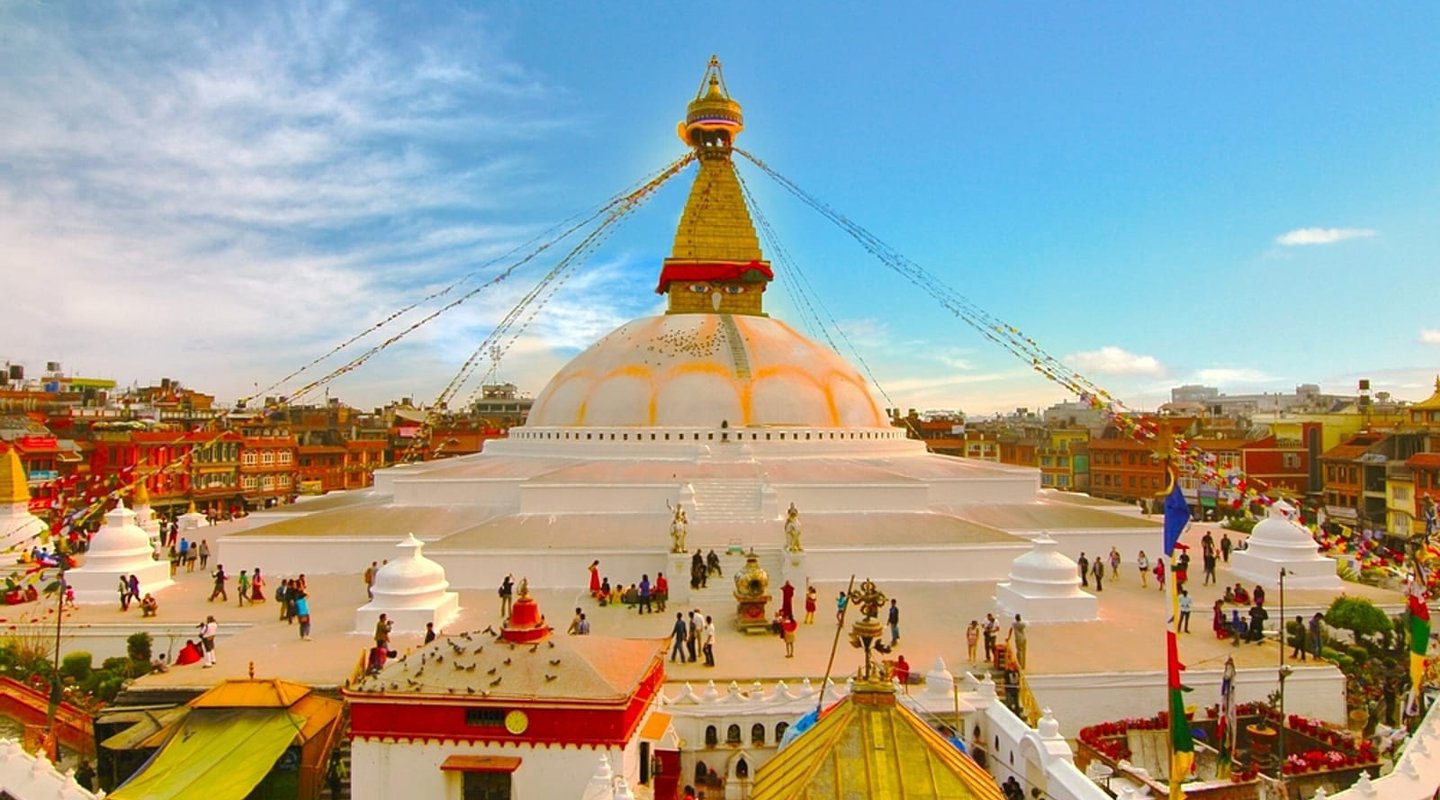
A vast dome rising against the Himalayan sky.
Golden spire ascending in calm symmetry.
Buddha eyes watching in four directions, not dramatic, not stern, simply present.
You stop walking without realising it.
And that is the beginning.
Recommended Read: UNESCO World Heritage Sites in Nepal: Complete Guide to All 10 Cultural & Natural Treasures
The First Circle: Why Boudhanath Feels Different
If you have travelled widely, you carry a mental map of monuments.
You know what awe feels like in Rome beneath the dome of St Peter’s.
You know what scale feels like at Angkor Wat at sunrise.
You know what stillness feels like in Kyoto’s temples.
You know what layered faith feels like inside Hagia Sophia.
Boudhanath does not compete with any of them.
It does something else.
It invites you in.
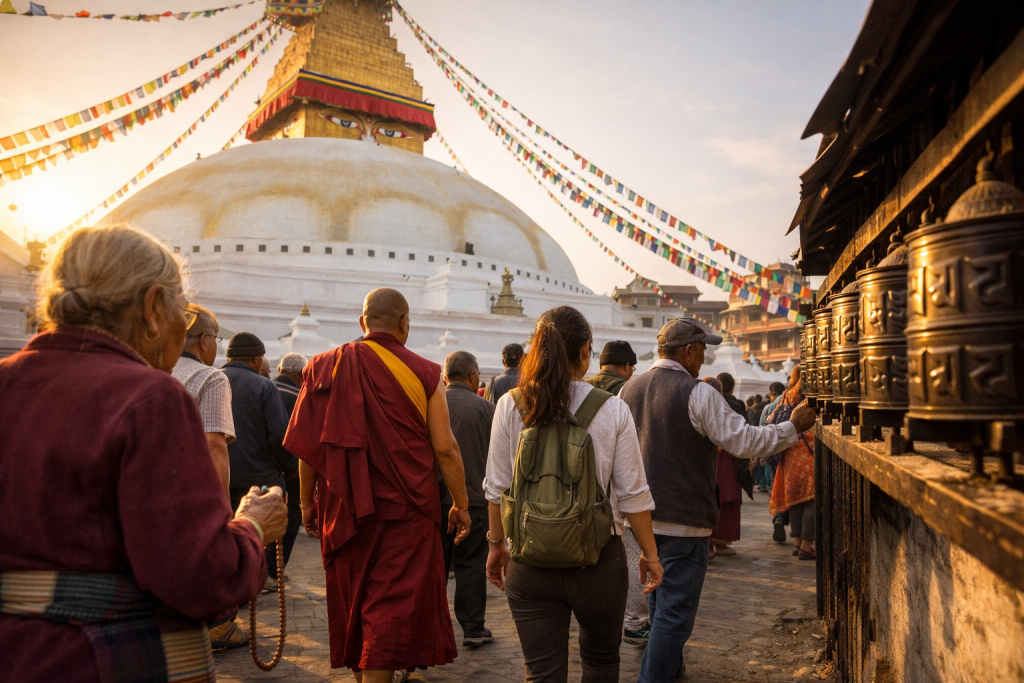
There are no velvet ropes. No prescribed viewing corridor. No elevated platform where you stand apart and photograph history from a safe distance.
Instead, you step into the movement.
Clockwise.
Always clockwise.
The ritual circumambulation, known as kora, continues whether you are there or not. Elderly Tibetan women counting mala beads. Nepali families walking together. Monks murmuring mantras. Shopkeepers taking a quiet round before closing.
You are not observing heritage.
You are entering it.
That difference is everything.
Before It Was UNESCO, Before It Was Nepal
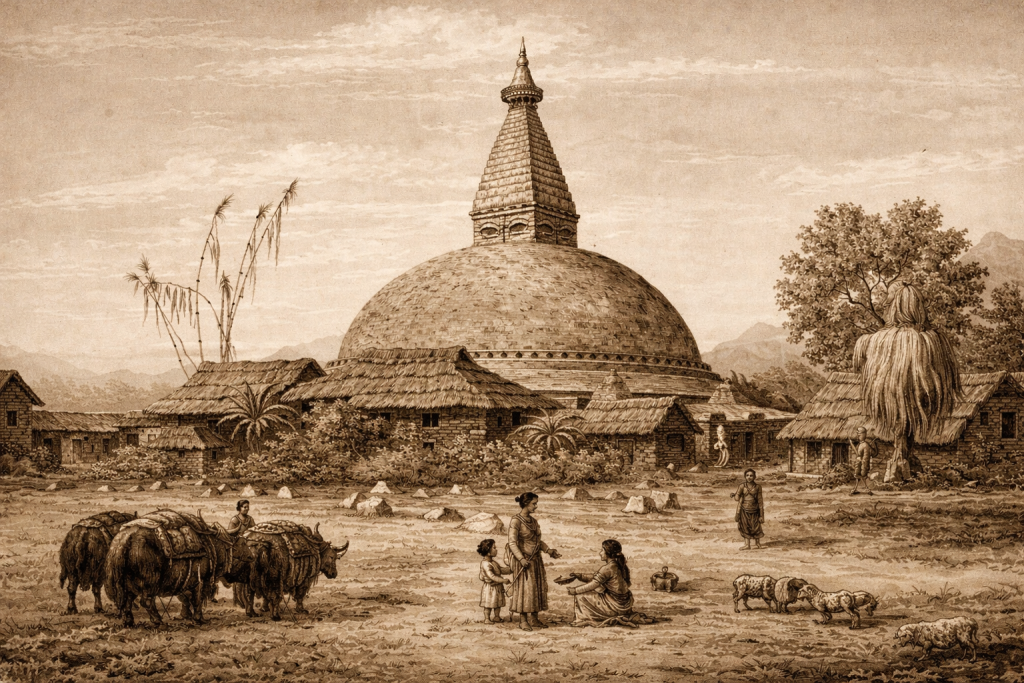
Today, Boudhanath is officially recognised as part of the Kathmandu Valley UNESCO World Heritage listing, inscribed in 1979.
But long before global recognition, this was already sacred ground.
Most historians trace the origins of the stupa to the Licchavi period in the 5th century. At that time, the Kathmandu Valley was not yet the Nepal we know today. It was a developing political landscape where early statecraft intertwined with sacred geography.
Temples and stupas were not decorative projects. They were declarations.
To build a monument like Boudhanath was to anchor spiritual legitimacy into territory. It mapped cosmic order onto earthly rule.
And yet, the story that survives most vividly is not about kings.
It is about a widow.
Legend says she asked a ruler for land to build a shrine. She was granted only as much land as a buffalo hide could cover. She cut the hide into thin strips and stretched them wide, encircling enough space to raise the great dome.
Whether historical or symbolic, the story reveals something deeply Nepali.
Power negotiates.
Devotion persists.
Humility reshapes authority.
From the beginning, Boudhanath belonged as much to ordinary people as to rulers.
The Trade Winds That Carved the Circle
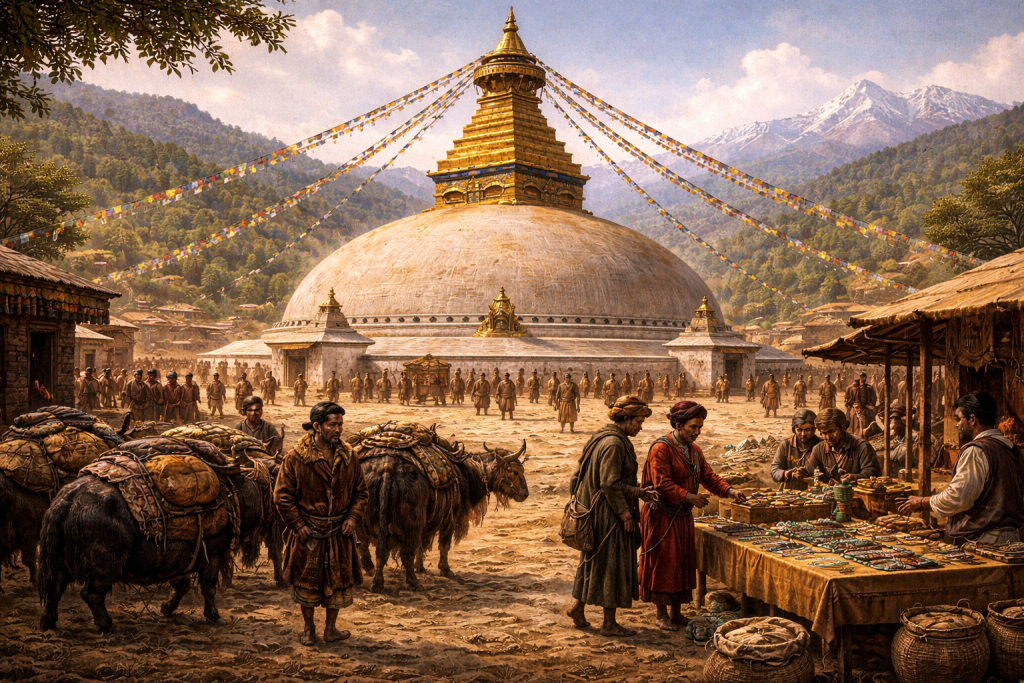
To understand why Boudhanath grew into one of the largest spherical stupas in the world, you have to look north.
For centuries, the Kathmandu Valley sat between two vast civilisational spheres: the Tibetan plateau and the Indian plains.
Salt from Tibetan lakes travelled south. Wool, turquoise, and gold descended from mountain passes. Metalwork, grains, and religious art moved north.
Boudhanath stood directly along this trade artery.
Merchants did not pass by casually. They stopped. They circled. They offered prayers before entering the Valley’s commercial hubs.
During the Malla period, between the 12th and 18th centuries, trade flourished. Royal courts displayed power in palace complexes like Kathmandu Durbar Square, but Boudhanath functioned as something subtler.
It was civilisational glue.
Religion strengthened trust. Trust strengthened trade. Trade strengthened kingdoms.
Unlike Angkor, which was eventually abandoned, or Petra, which faded into desert silence, Boudhanath never emptied.
Movement never stopped.
Conquest, Monarchy, and Quiet Continuity
In 1768, Prithvi Narayan Shah unified the Kathmandu Valley under a centralised monarchy. Political gravity shifted toward royal ritual sites like Hanuman Dhoka.
But Boudhanath did not lose relevance.
It could not.
The Valley’s Newar Buddhist communities were economically essential. Trade with Tibet remained vital. Spiritual continuity stabilised society.
Even under Rana oligarchic rule from 1846 to 1951, when political authority narrowed and Nepal isolated itself internationally, the stupa remained active.
Governments changed.
The kora continued.
That uninterrupted ritual cycle across political systems is rare in global heritage.
The Roman Forum shifted from republic to empire to ruin.
Angkor shifted from capital to the jungle.
Machu Picchu shifted from royal retreat to forgotten citadel.
Boudhanath shifted through regimes without shifting from life.
1959: When the World Moved In
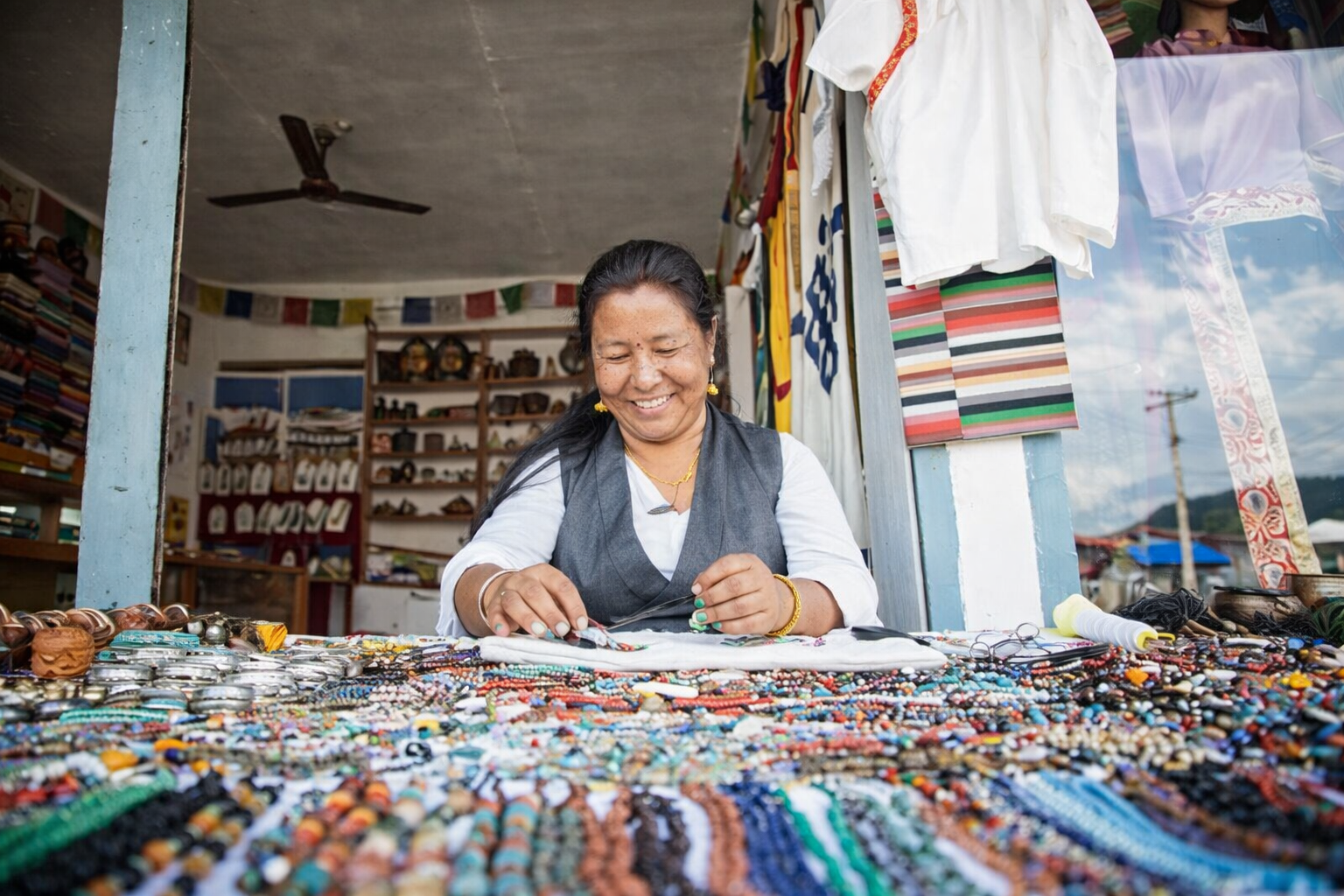
The modern identity of Boudhanath cannot be understood without 1959.
When thousands of Tibetans crossed the Himalayas seeking refuge, many settled around the stupa. What had been a significant Buddhist monument became a living Tibetan cultural heart.
Monasteries expanded. Schools were built. Ritual music, thangka painting, philosophical debate, and liturgical practice flourished.
Institutions such as Shechen Monastery became guardians of lineage traditions. Practitioners studying within networks connected to Kopan Monastery arrived from around the globe.
This transformed Boudhanath into one of the most important centres of Tibetan Buddhism outside Tibet.
For the world traveller, this is significant.
This is not just Nepali heritage.
It is a Himalayan heritage.
Exile and resilience are woven into architecture.
Sacred Geometry: Reading the Stupa
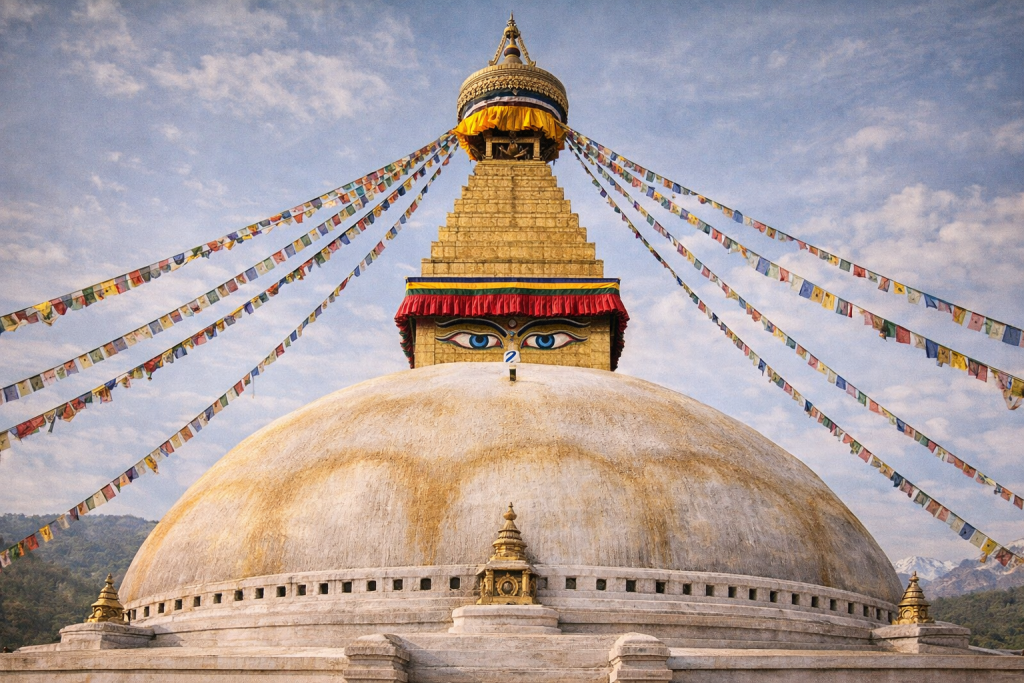
Stand still and look carefully.
The white dome represents the earth and the womb of creation.
The square harmika holds the all-seeing Buddha eyes. Between them is the Nepali number one, symbolising unity.
Above rise thirteen steps representing stages toward enlightenment.
The golden pinnacle symbolises liberation.
The entire structure forms a three-dimensional mandala.
When you walk clockwise, you are symbolically moving through the cosmos toward awakening.
This is not decorative symbolism.
It is a cosmology built in brick and lime plaster.
Compare it to Gothic cathedrals in Europe, where verticality draws the eye toward heaven. Compare it to Borobudur in Indonesia, where pilgrims ascend terraces representing stages of enlightenment.
Boudhanath does something different.
It centres you horizontally.
You do not climb it.
You circle it.
The spiritual journey here is not vertical transcendence.
It is a rhythmic return.
The Earthquake and the Vulnerability of Stone
In April 2015, the earthquake struck Nepal.
The spire cracked. Structural damage required dismantling and reconstruction.
For months, the centre of the square was scaffolded. The dome was incomplete.
And yet, people kept walking.
Butter lamps were lit around temporary barriers. Prayer wheels continued to spin.
Reconstruction followed traditional methods. Sacred relics were handled carefully. Artisans rebuilt not only stone but meaning.
When the stupa reopened in 2016, it was not merely repaired.
It felt reclaimed.
Global heritage sites often become fragile relics after a disaster.
Boudhanath returned to movement almost immediately.
That resilience is part of its power.
Visiting Boudhanath: What to Expect
Early morning is intimate. Elderly women begin their kora before sunrise. The air is cool. Chanting is soft.
Late afternoon glows. The dome reflects golden light. Rooftop cafés fill quietly.
Evening is luminous. Butter lamps flicker. The spire glows against the indigo sky. The rhythm deepens.
Allow at least two to three hours.
Walk slowly.
Sit on a rooftop terrace and observe.
Then walk again.
Boudhanath in Global Perspective
If you have travelled extensively, you begin to categorise monuments subconsciously.
Spectacle sites.
Ruin sites.
Imperial sites.
Boudhanath does not fit neatly into any category.
It is not abandoned like Angkor.
It is not imperial like the Vatican.
It is not archaeological like Petra.
It is not monumental in the way of the Pyramids.
It is living.
Its closest parallels might be places like Mecca’s tawaf around the Kaaba or Borobudur’s circumambulatory path, where movement itself is devotion.
But even then, Boudhanath remains uniquely intimate.
Here, you are shoulder to shoulder with grandmothers, monks, teenagers, refugees, tourists, and shopkeepers.
No hierarchy.
Just rhythm.
Why Boudhanath Stays With You
When you leave Kathmandu, it is not the size of the dome you remember.
It is the repetition.
The woman who has walked here every day for forty years.
The monk who smiled mid-mantra.
The way the city softened inside that circle.
In a world full of preserved ruins and curated heritage, Boudhanath offers something rarer.
Continuity.
And in that continuity, you feel something deeply human.
Not spectacle.
Not performance.
Presence.
The circle began long before you arrived.
It will continue long after you leave.
And for a traveller who has seen the world, that steady, unbroken rhythm is unforgettable.
Stay Informed With the Latest & Most Important News
Previous Post
Next Post
- The Newari Feast: A Guide to Nepal’s Most Elaborate Food Tradition
- Solo Female Travel in Nepal: What You Actually Need to Know
- Mardi Himal Trek: The Quieter Trail to Nepal’s Most Photogenic Peak
- Best Time to Visit Nepal: A Month-by-Month Breakdown for Every Traveller
- Poon Hill Trek: The Complete Guide