Now Reading: Bisket Jatra 2026: Inside Bhaktapur’s Most Electrifying New Year Festival
-
01
Bisket Jatra 2026: Inside Bhaktapur’s Most Electrifying New Year Festival
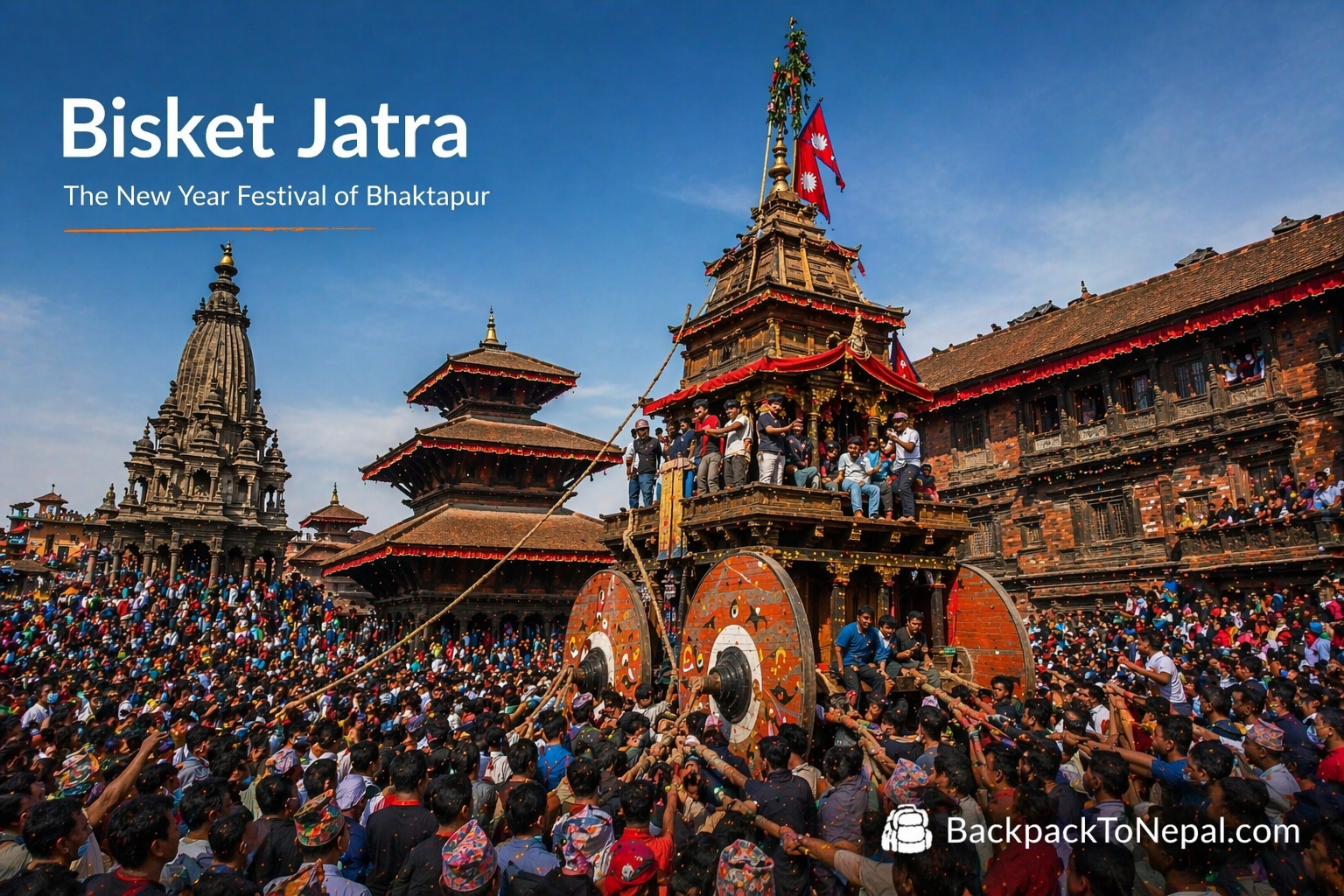

Experience Bisket Jatra 2026 in Bhaktapur: a nine-day Nepali New Year festival of chariot processions, tug-of-war battles, a towering ceremonial pole, and centuries of living Newar tradition.
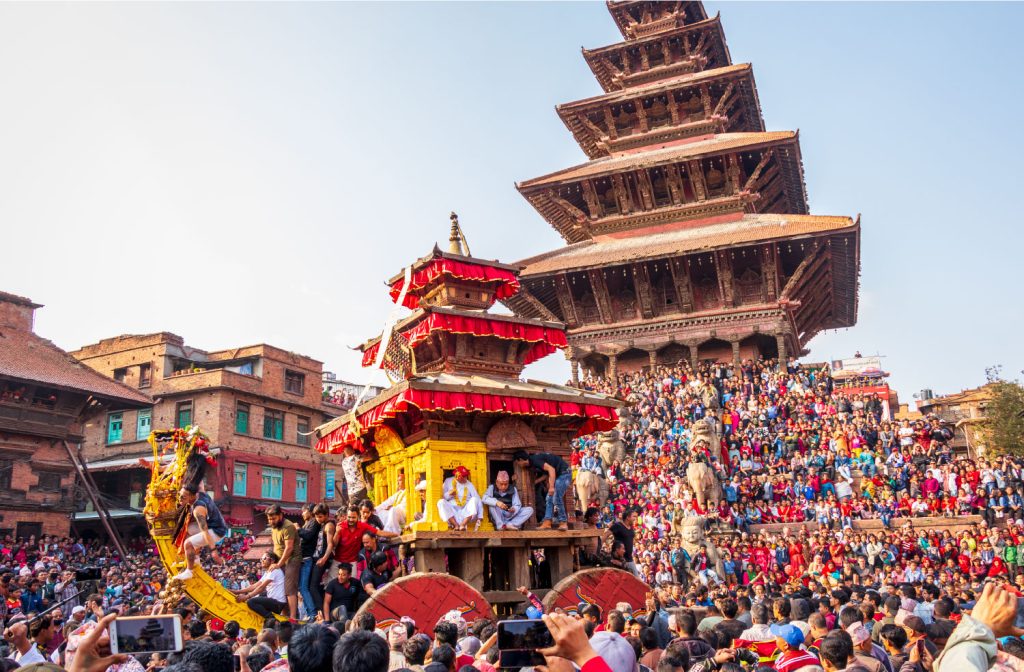
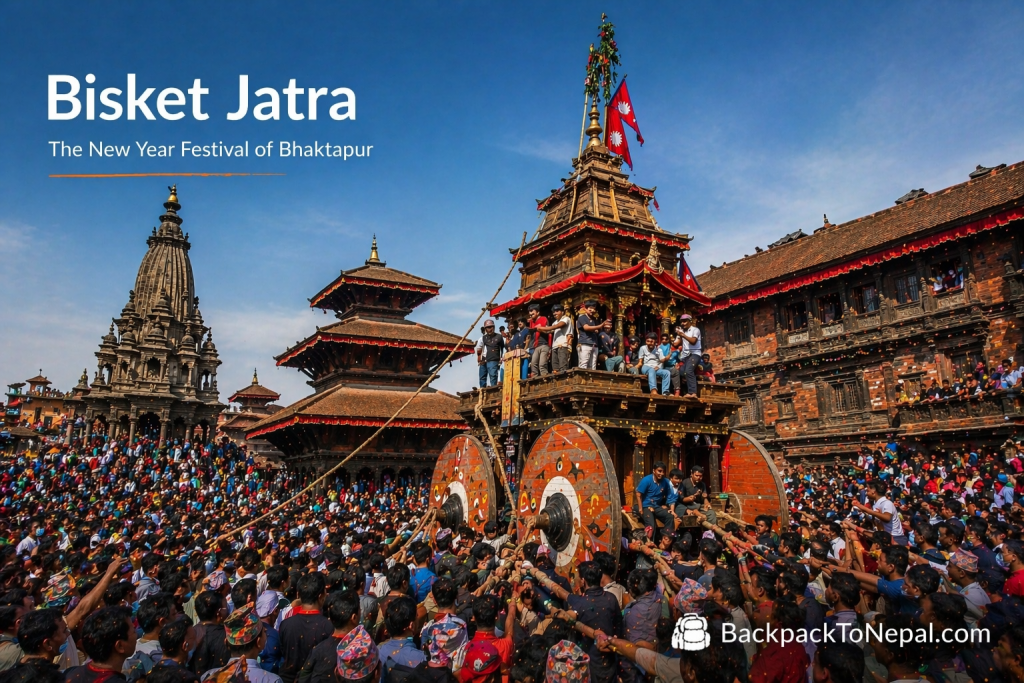
The drums start before dawn. You hear them first as a low throb somewhere beneath the cobblestones of Bhaktapur, rising through the soles of your shoes before your eyes have had time to adjust to the early light. By the time you reach Taumadhi Square, the crowd is already ten people deep. The smell of incense mingles with marigold garlands, cooking smoke, and the faint sweetness of rice wine being passed between neighbours. And then it appears: a towering wooden chariot, hand-carved and festooned with cloth and metalwork, carrying the fierce deity Lord Bhairav into the open air for the first time in a year. Bisket Jatra has begun.
If there is one festival in Nepal that stops you in your tracks and makes you feel like you have stepped straight into living history, this is the one. Bisket Jatra 2026 runs from April 10 to April 18 in Bhaktapur, and right now, as you read this, the ancient streets of that medieval city are alive with ritual, rivalry, devotion, and an energy that has barely changed since the days of the Malla kings. Whether you are already in Kathmandu or still planning your trip, here is everything you need to know about this extraordinary nine-day celebration.
What Is Bisket Jatra, and Why Does It Matter?
Bisket Jatra is the Newar community’s great New Year festival, observed every April in and around the ancient city of Bhaktapur in the Kathmandu Valley. It is also sometimes called Biska Jatra, Vishwodhoj Jatra, or Bisya Jatra, where “bi” refers to a giant serpent and “sya” means to kill, pointing directly to the mythological heart of the whole celebration. The festival runs for eight nights and nine days, from the 27th of Chaitra to the 5th of Baisakh in the Bikram Sambat calendar, bridging the final days of the old year with the first days of the new one.
What sets Bisket Jatra apart from almost every other festival you will encounter in Nepal is its rawness. This is not a pageant designed with visitors in mind. It is a living, breathing communal ritual that the people of Bhaktapur have performed largely unchanged since the Malla dynasty ruled these valleys between the 12th and 18th centuries. Historians trace the festival’s roots even further back, to the Licchavi period, when King Shivadeva II is said to have established the earliest form of the celebration. The Malla kings later elevated it into the grand chariot festival it is today, adding layers of ritual and spectacle that have stuck ever since.
The central thread running through everything is the serpent. Multiple legends circulate in Bhaktapur about the festival’s origin, and they all end in the same place: two deadly serpents are killed, and their defeat is commemorated each year with chariots, poles, and the kind of communal energy that makes the whole city feel like one enormous, beating heart.
The Mythology Behind the Festival
Ask ten people in Bhaktapur why Bisket Jatra exists, and you will hear at least three different stories. The most widely retold involves a cursed princess whose husbands died on their wedding nights, killed by two serpents that emerged from her nostrils while she slept. No one could explain the deaths until a young prince with tantric powers arrived, dared to marry her, and spent their wedding night awake. When the serpents appeared, he cut them down with his sword, broke the curse, and saved both the princess and the kingdom. The festival exists to honour that victory of knowledge and courage over ancient evil.
A second legend ties the festival to a heroic commoner named Sekhar Achaju, who possessed magical rice husks capable of transforming people. His story ends with sacrifice, drought, and a king who eventually understood what he had lost. To honour Sekhar Achaju and his wife, the king created a new festival built around displaying the carcasses of the serpents on a long wooden pole, a tradition that became the ceremonial Lingo still raised and felled in Pottery Square today.
Whatever the legend you hear, the symbolism is consistent: the victory of good over evil, the breaking of a curse, and the arrival of a new year with a clean slate. It is a remarkably optimistic thing to build a nine-day festival around, and when you are standing in the square watching hundreds of men strain on ropes to raise a 25-metre wooden pole into the sky, you feel every bit of it.
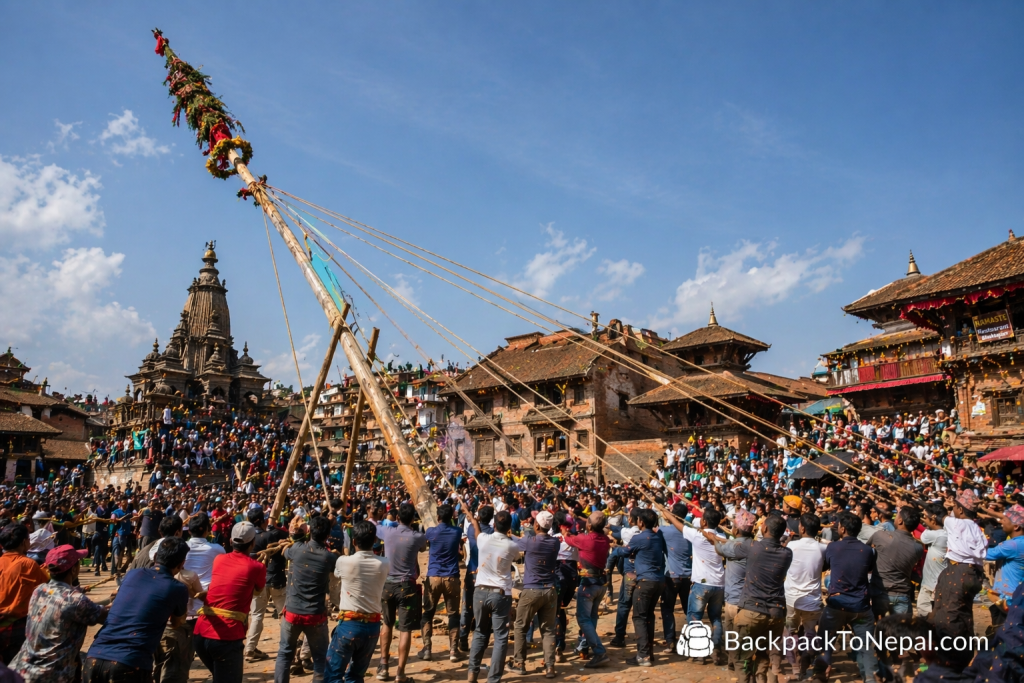
The Festival Day by Day: What Actually Happens
Day One: The Chariot Rolls Out
The festival opens at Taumadhi Square with the most visually spectacular moment of the entire nine days. The great wooden chariot carrying Lord Akash Bhairav, a fierce manifestation of Shiva and the guardian deity of Bhaktapur, is wheeled into the square flanked by the soaring Nyatapola Temple on one side and the Bhairavnath Mandir on the other. A second chariot carrying Goddess Bhadrakali, Bhairav’s consort, accompanies it.
Then the tug of war begins. Residents from the upper part of the city (Thane) and the lower part (Kwone) take up ropes on opposite sides of the chariot and pull with everything they have. The idea is simple: whichever half of the city wins gets the honour of the chariot visiting their neighbourhood first. The crowd noise alone is enough to make your chest vibrate. People lean back on the ropes until their legs are almost horizontal. Children scramble for better vantage points on walls and rooftops. Prayers are murmured, drums pound, and cymbals crash. It is the kind of scene that reminds you how thin the line is between festival and something far more ancient.
The Third Day: Buffalo Sacrifice and Sacred Meat
On the third day, the rituals take on a more deeply tantric character. A buffalo is sacrificed to Bhairavnath in a ceremony that has been performed for centuries, and the consecrated meat is distributed among devotees. The offering is understood not as violence but as sacred exchange: life given in devotion, blessing returned in kind. If you are attending the festival as a visitor, this is one of the more confronting moments, but it is also one of the most honest. Bisket Jatra does not soften itself for outside eyes.
Day Four: The Lingo Rises
The raising of the Lingo, the ceremonial pole known in Newari as Lyo Sin Dyo, at Pottery Square (Lyo Sin Khel) is the structural centrepiece of the entire festival. This pole stands approximately 25 metres tall and is raised entirely by collective human effort, with dozens of men hauling on ropes while others guide the base. Watching it go up is breathtaking in the most literal sense: you hold your breath until it locks into position.
The Lingo is decorated with colourful flags and cloth banners. According to local belief, it represents the serpent carcass from the founding myth, its erection marking the end of the old year and the beginning of something new. There is also a more personal dimension to it: locals believe that whoever witnesses the Lingo falling at year’s end will see their own enemies fall too. The ritual of bringing it down is called Satruhanta Jatra, meaning the downfall of one’s enemy. You can feel why that belief has survived for centuries.
New Year’s Day: Baisakh 1
This is the day the whole festival builds toward. Baisakh 1, 2083 BS, falling on April 14, 2026, by the Gregorian calendar, is the Nepali New Year, and Bhaktapur celebrates it with an intensity that nowhere else in the valley quite matches. Devotees pour into the city from across the Kathmandu Valley and beyond. Traditional music fills every alleyway. Families perform Sagun rituals, sacred offerings comprising eggs, fish, lentil cakes, rice wine, and meat, representing the tantric elements of nature and prosperity. There is feasting, there is prayer, and there is an atmosphere of genuine collective joy that is impossible to manufacture.
In the evening, the Lingo is ceremonially brought down in the Satruhanta Jatra. Then, in a moment of extraordinary theatrical power, the chariots of Bhairav and Bhadrakali are rolled together and allowed to collide. This collision is not accidental. It symbolises the sacred union of male and female cosmic energies, the meeting of destruction and creation that underlies the arrival of spring. By the time the drums fall quiet that night, the new year has truly begun.
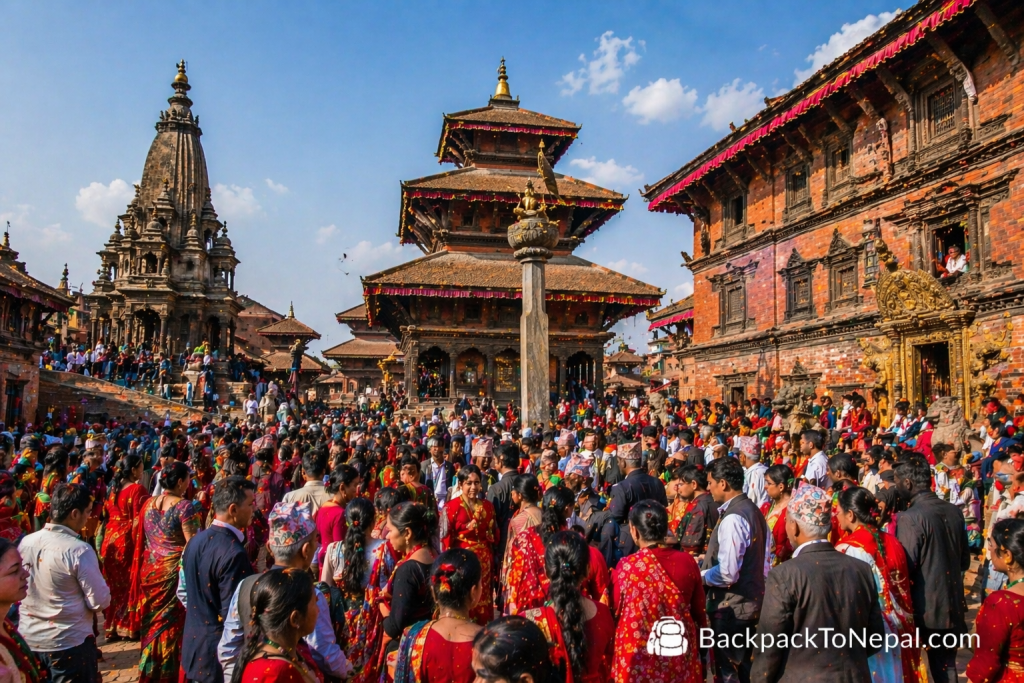
Sindoor Jatra in Thimi: The World Turns Orange
The day after the New Year, the action shifts a few kilometres down the road to Madhyapur Thimi, and the visual register of the festival changes completely. Sindoor Jatra is the three-day sub-festival that Thimi holds as its own contribution to the Bisket Jatra cycle, and it is one of the most photographically extraordinary things you will see anywhere in Nepal.
Dozens of palanquins carrying the idols of local deities are carried through Thimi’s streets while crowds throw clouds of sindoor, bright vermillion-orange powder, into the air. It is a bit like Holi, but louder, more devotional, and deeply specific to Newari religious practice. The orange powder settles on everything: the gods, the carriers, the crowd, the ancient brick walls. By midday, the entire town is tinted the color of marigolds. It is joyful and chaotic and completely unforgettable. If you missed Holi earlier in the year, Sindoor Jatra is your chance to experience something equally vivid and arguably more spiritually charged.
On the second day of Baisakh, the neighbouring village of Bode hosts its own ritual: the tongue-piercing ceremony. One selected resident spends the entire day with a metal spike piercing his tongue, roaming the village carrying multiple lit torches on his shoulders, while he neither speaks nor eats. The community believes this act of devotion and endurance draws blessings and good fortune to the village for the year ahead. It is intense and quietly moving to witness, and it speaks to a spiritual commitment that goes far beyond performance.
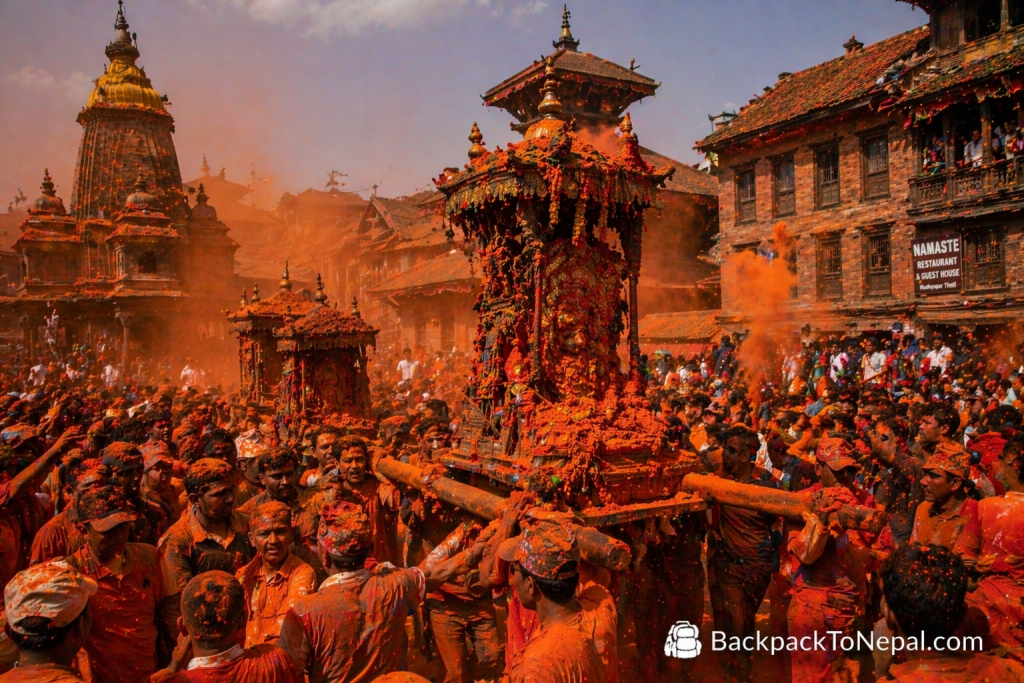
The Final Days: Processions, Deities, and Farewell
The days following the New Year carry their own rhythms. Processions dedicated to Mahakali, Mahalaxmi, Brahmayani, Maheshwari, and Bhairav move through different neighbourhoods of Bhaktapur, each one accompanied by traditional music, incense, and offerings. The chariot makes its way back through the city’s ancient toles (neighbourhoods), stopping at shrines and squares according to a route that has been followed for hundreds of years. On the final day, April 18, the chariot returns to Taumadhi Square for one last tug of war before being dismantled and stored until next year. The city exhales. The new year is properly underway.
Where to Be and When: A Visitor’s Guide
Getting to Bhaktapur
Bhaktapur sits about 13 kilometres east of Kathmandu and is easily reachable by local bus, microbus, or taxi from Kathmandu or the tourist hub of Thamel. The drive takes around 30 to 45 minutes, depending on traffic. During Bisket Jatra, traffic into the city can be significantly heavier than usual, so plan to arrive early, especially on New Year’s Day and the first day of the chariot procession. Hiring a taxi for a fixed price the night before removes the stress of flagging one down in the morning rush.
Once you enter Bhaktapur, foreign visitors pay a heritage entry fee, currently around USD 15. This is entirely worth it: your fee contributes directly to the upkeep of the UNESCO World Heritage Site, and the city you are walking into is genuinely one of the best-preserved medieval urban landscapes on the planet.
The Key Squares and Streets
Most of the main Bisket Jatra action unfolds in and around three areas. Taumadhi Square is where the chariot processions and tug of war take place, flanked by the Nyatapola Temple, one of the tallest pagoda temples in Nepal. Pottery Square (Lyo Sin Khel) is where the ceremonial Lingo is raised and brought down. Bhaktapur Durbar Square, a UNESCO-listed complex of palaces, temples, and courtyards, provides the grand architectural backdrop for much of the New Year’s Day worship. Wander between these three areas freely, and get happily lost in the lanes in between. The alleys of Bhaktapur are as much a part of the experience as the main squares.
Practical Tips for Festival Visitors
Arrive early on the key days. The chariot procession and tug of war on Day One can draw enormous crowds very quickly, and the best viewing spots along the chariot route are claimed by locals and experienced visitors well before the action starts. The same applies to New Year’s Day: if you want to be close to the Lingo for the raising and later the falling, find your spot by mid-morning.
Dress modestly and respectfully. Bisket Jatra is a living religious festival, not a street party. Covering your shoulders and avoiding short clothing is a basic courtesy that will be noticed and appreciated. Remove your shoes before entering any temple or shrine.
Keep your camera ready, but read the moment. Some rituals are deeply sacred and are not the right context for pointing a lens directly at devotees’ faces. Ask permission when in doubt, smile first, and you will find people in Bhaktapur to be extraordinarily generous with their festival.
Expect crowds, noise, and occasional jostling, especially during the tug of war. The energy is electric but not dangerous if you stay aware and keep children close. Security is tightened across the festival period, and police presence is visible throughout the key sites.
Book your accommodation early. The days around Nepali New Year are among the busiest in the entire travel calendar for the Kathmandu Valley. Bhaktapur has a small but lovely selection of guesthouses within or just outside the heritage zone. Alternatively, stay in Kathmandu and make day trips to specific festival events.
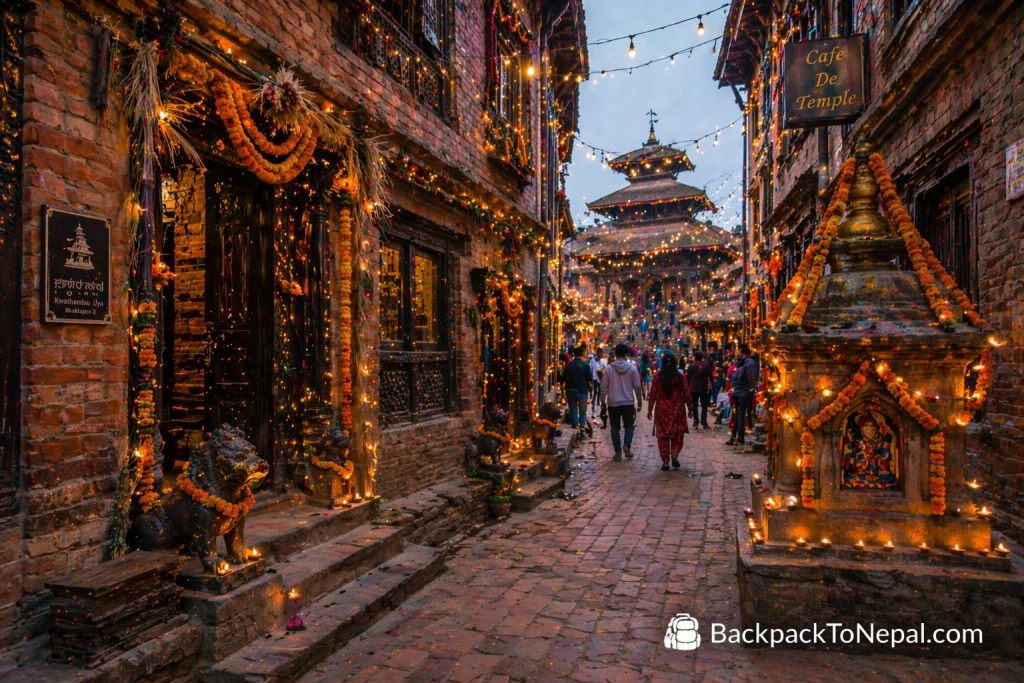
Beyond the Festival: Bhaktapur Itself
Even without Bisket Jatra, Bhaktapur is one of the most rewarding cities in Nepal to explore. The pace here is slower and more contemplative than Kathmandu, the streets are cleaner, and the traditional Newari architecture is extraordinarily well preserved. Pottery Square is famous beyond the festival for its resident potters, who work at their wheels in the open air just as their ancestors did. The National Art Museum houses a remarkable collection of thangka paintings and bronze sculptures. The city’s yoghurt, known as juju dhau or “king curd,” is so legendary that people make the trip from Kathmandu specifically to eat it.
During Bisket Jatra, all of these qualities are amplified. The squares are more alive, the food stalls more numerous, the courtyards busier with families and friends who have returned home for the new year. Eating a bowl of beaten rice with spiced potato and dried fish at a pavement stall while drums echo off 600-year-old brick walls is one of those moments that you will not find in any tour brochure but will remember for years.
What Makes Bisket Jatra Unlike Any Other Festival in Nepal
Nepal has extraordinary festivals. Dashain, Tihar, Indra Jatra, Holi: each one is vivid and layered and deeply worth experiencing. But Bisket Jatra occupies a singular position because of its completeness. It is not a single ceremony or a single day. It is nine days of continuously unfolding ritual across multiple venues and communities, each day with its own character and its own spiritual logic. You can attend once and scratch the surface. You can attend for five days and begin to understand the structure. You could come back every year for a decade and still find things you had not noticed before.
There is also something quietly remarkable about the way it bridges the sacred and the communal. The tug of war between Thane and Kwone is not a performance: it is a genuine competition rooted in neighbourhood identity and civic pride, and the side that wins feels real satisfaction. The Sagun offerings are not symbolic in an abstract sense: families genuinely believe they are providing for the year ahead. The tongue piercing in Bode is not street theatre: it is an act of personal devotion that the entire village takes seriously. When you stand in the middle of all of this, you feel the distance between spectator and participant begin to blur, and that is exactly what the best festivals do.
Start Planning Your Bisket Jatra Trip
Bisket Jatra 2026 is running right now at the time of writing this article (on 12th April), from April 10 to April 18. The biggest days are still ahead of you: New Year’s Day on April 14, with the Lingo falling and the chariot collision in the evening, and Sindoor Jatra in Thimi on April 15. If you are already in Nepal, get yourself to Bhaktapur. If you are still planning, mark the dates for next year in your calendar and build your Nepal trip around them.
Nepal rewards the traveller who digs a little deeper, who steps off the trekking trail or out of the tourist restaurant and into something older and stranger and more alive. Bisket Jatra is exactly that: a nine-day window into a civilisation that has been quietly extraordinary for over a thousand years, and that is generous enough to let you witness it. The chariot is already rolling. The drums are already playing. All you have to do is show up.
Related Posts
Stay Informed With the Latest & Most Important News
Previous Post
Next Post
- Happy New Year 2083: What the New Year Looks, Tastes, and Feels Like in Nepal
- Weekend Escapes from Kathmandu: Nagarkot, Dhulikhel and Bandipur
- Bisket Jatra 2026: Inside Bhaktapur’s Most Electrifying New Year Festival
- Volunteering in Nepal: How to Find Ethical Opportunities and What to Expect
- Nepal vs Bhutan: Which Himalayan Kingdom Should You Visit First?