Now Reading: Bhaktapur Durbar Square: Walking Through the Last Great Malla Kingdom
-
01
Bhaktapur Durbar Square: Walking Through the Last Great Malla Kingdom
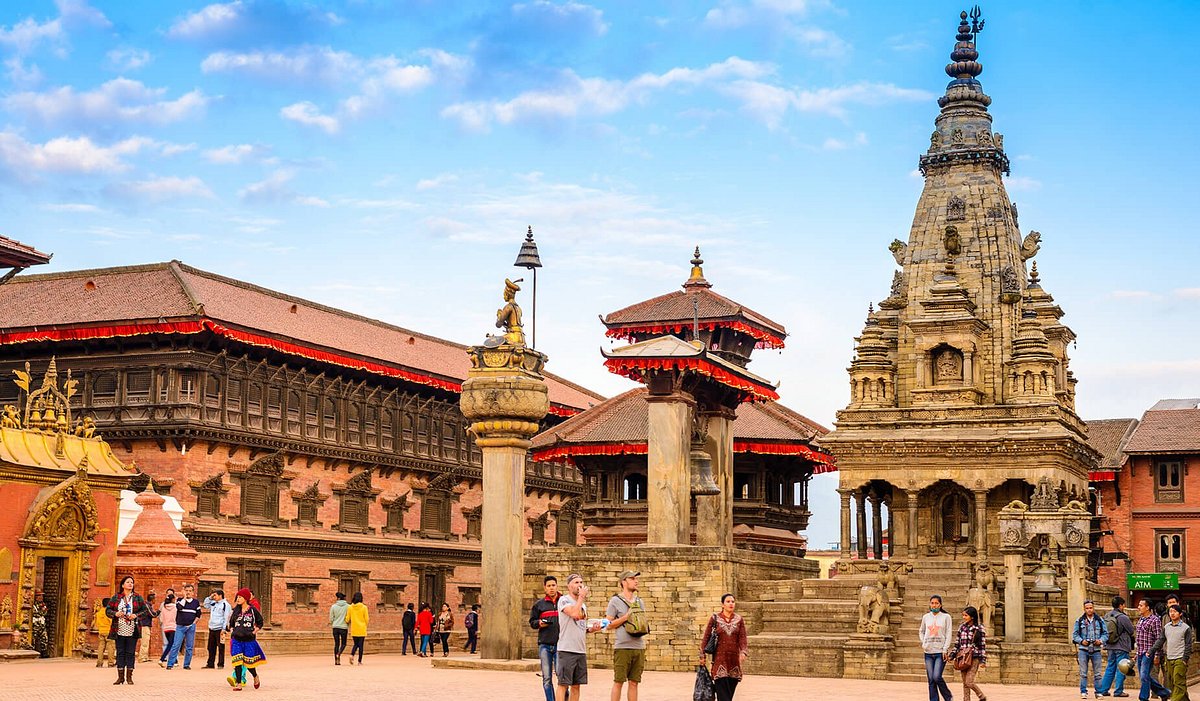

There are places in Nepal where history is preserved.
And then there is Bhaktapur Durbar Square, where history still lives.
Step through the ancient city gates of Bhaktapur, and you immediately feel it. The air changes. The pace softens. The streets narrow into brick-lined corridors polished by centuries of footsteps. Clay pots dry in the sun. Temple bells echo through the morning. Women in red shawls move toward shrines with offerings balanced carefully on brass plates.
At the heart of it all stands Bhaktapur Durbar Square, one of the three royal palace squares of the Kathmandu Valley, and one of Nepal’s most extraordinary UNESCO World Heritage Sites.
But Bhaktapur is not just architecture.
It is devotion.
It is resilience.
It is a city that refuses to forget who it is.
Let’s wander through it together.
Recommended Read: UNESCO World Heritage Sites in Nepal: Complete Guide to All 10 Cultural & Natural Treasures
A City of Devotees: Origins of Bhaktapur
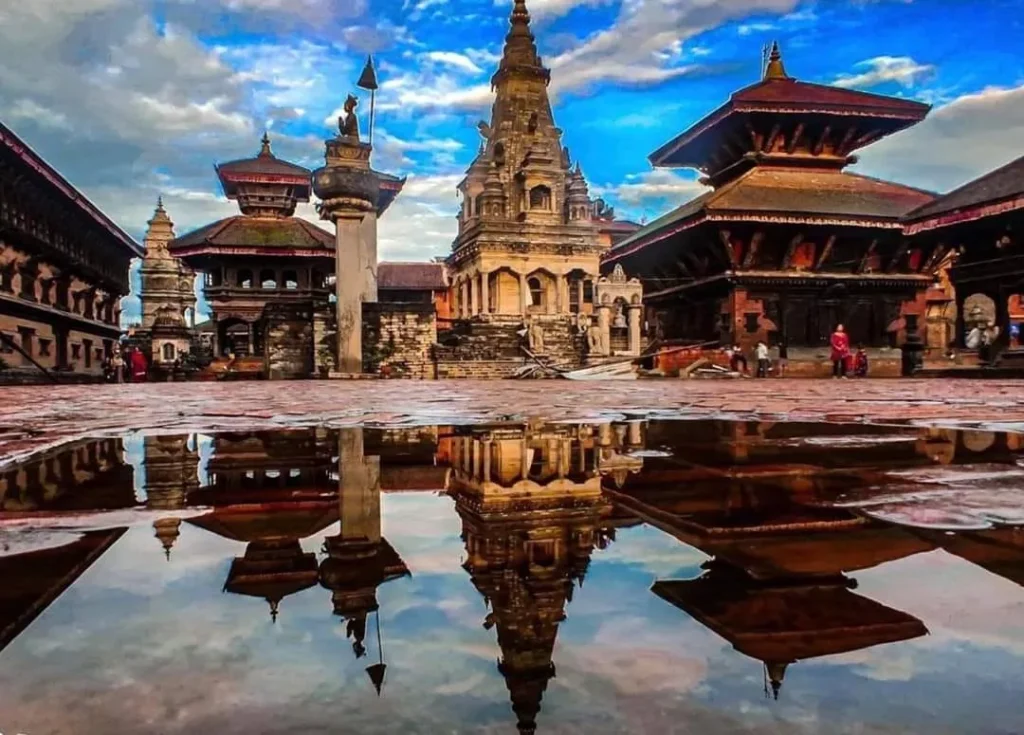
The name “Bhaktapur” comes from two words: Bhakta, meaning devotee, and Pur, meaning city. The “City of Devotees.”
Long before the Shah kings unified Nepal, before colonial borders were imagined, before modern Kathmandu became crowded and hurried, Bhaktapur was a powerful, independent kingdom ruled by the Malla dynasty.
Founded in the 12th century by King Ananda Malla, Bhaktapur flourished between the 14th and 18th centuries as a political, cultural, and artistic capital of the Kathmandu Valley. During this period, the valley was divided into three rival kingdoms: Kathmandu, Patan, and Bhaktapur. And competition, especially among the Malla rulers, produced something remarkable.
They competed not only in politics.
They competed in beauty.
Temples were built taller.
Palaces are more elaborate.
Carvings are more intricate.
Courtyards are more refined.
What we see today in Bhaktapur Durbar Square is the result of this artistic rivalry. It is a living museum of Newar craftsmanship at its finest.
Entering the Square: The Royal Heart of Bhaktapur
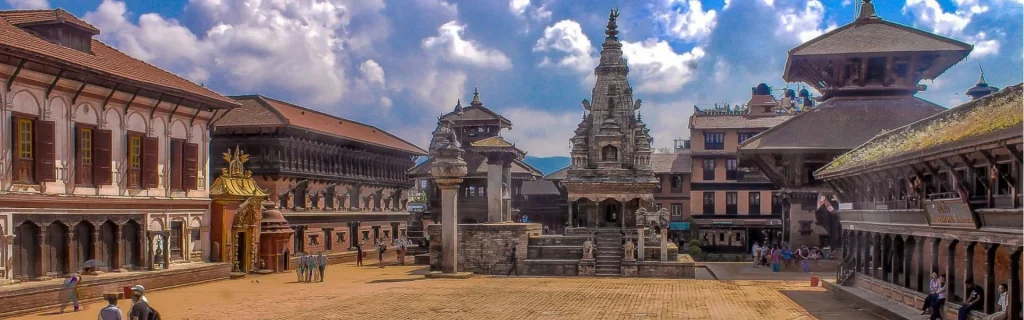
As you approach the square, the first thing you notice is the texture.
Everything is brick. Burnt red. Earthy. Solid. The sunlight makes the square glow warm in the late afternoon. There is no chaotic traffic here. No rush. Only open space and layered history.
This square was once the royal court of the Malla kings. It was where coronations happened. Where edicts were announced. Where religious festivals began. Where diplomacy was conducted.
And today, it is where locals still gather.
Children run across the stone pavements. Elders sit in quiet conversation. Devotees move between temples with flowers and incense.
Bhaktapur does not feel staged.
It feels inhabited.
The 55-Window Palace: A Masterpiece of Woodcraft
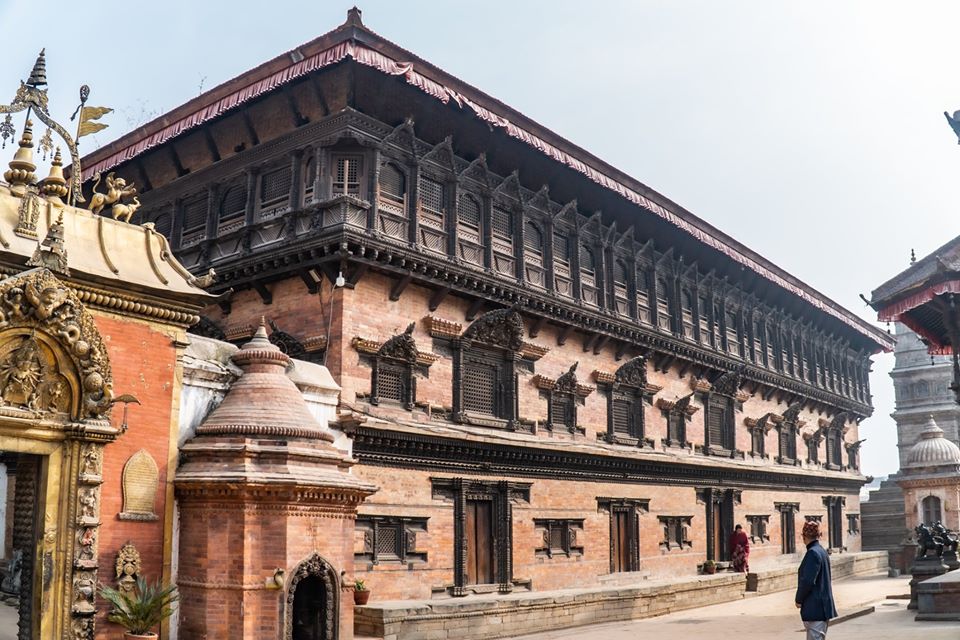
The first structure that captures your attention is the magnificent 55-Window Palace.
Originally built in the 15th century and later expanded by King Bhupatindra Malla in the 17th century, this palace is a triumph of Newar wood carving. Its façade is symmetrical and disciplined, but the windows are where the artistry explodes.
Fifty-five intricately carved wooden windows line the palace wall, each framed with delicate detail. Look closely, and you’ll notice mythical creatures, divine figures, floral patterns, and symbolic guardians woven into the wood.
It is not decorative excess.
It is devotion carved into architecture.
Behind these windows once lived royalty. Decisions that shaped the valley were made inside these walls. Today, parts of the palace house the National Art Museum, preserving centuries-old paubha paintings, stone sculptures, and ritual objects.
The palace survived political upheaval, the Shah conquest, and even the devastating 2015 earthquake. Its restoration stands as a quiet symbol of Bhaktapur’s resilience.
The Golden Gate: Threshold of Divinity
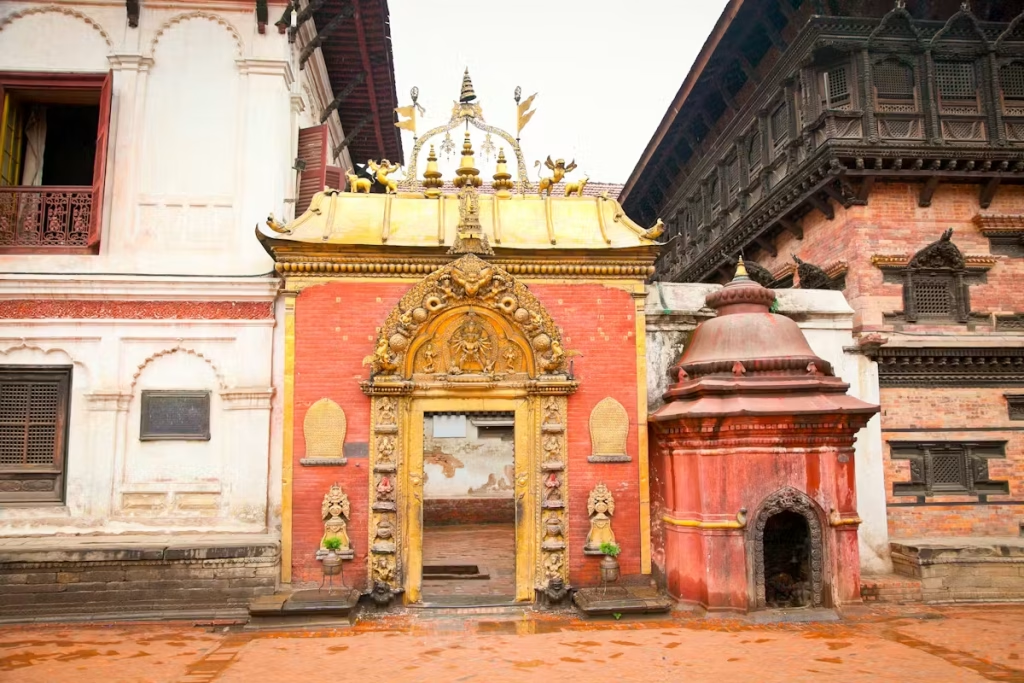
Just beside the palace stands the glittering Golden Gate, locally known as Lun Dhwākhā.
If there is one piece of metalwork in Nepal that feels almost impossibly detailed, it is this gate.
Commissioned in the 18th century, the Golden Gate is an extraordinary example of repoussé art. At its centre stands Goddess Taleju, the royal deity of the Malla kings, surrounded by protective deities and mythical creatures.
This gate was not merely ornamental.
It marked the sacred entrance into the inner courtyard of the palace, accessible only to royalty and priests.
Stand in front of it for a moment. Watch how light reflects off the gilded surface. Notice how even centuries later, it commands reverence.
Crossing that threshold would once have meant stepping into the spiritual and political core of the kingdom.
Nyatapola Temple: Strength in Symmetry
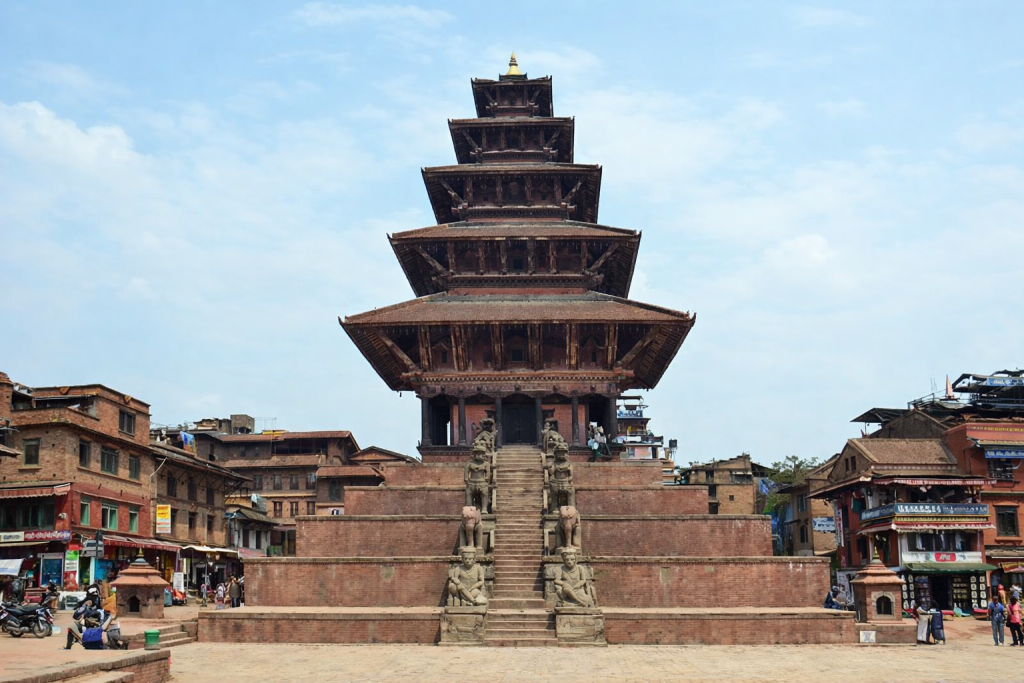
Walk a little further toward Taumadhi Square, and rising above everything else is the majestic Nyatapola Temple.
Built in 1702 by King Bhupatindra Malla, Nyatapola is the tallest pagoda-style temple in Nepal, standing on a five-tiered plinth that ascends like a staircase into the sky.
Each level of the staircase is guarded by pairs of figures:
Wrestlers.
Elephants.
Lions.
Griffins.
Goddesses.
Each pair is symbolically ten times more powerful than the one below.
The temple is dedicated to Siddhi Lakshmi, a powerful tantric goddess. Despite multiple earthquakes, including the 1934 and 2015 disasters, Nyatapola remained standing with minimal damage. Its engineering and symmetrical design are a testament to the brilliance of Malla-era architecture.
Climb the steps slowly.
Turn around halfway.
From the top, Bhaktapur unfolds beneath you in red rooftops and distant hills. It is one of the most beautiful viewpoints inside the valley.
Vatsala Temple and the Stone Bell
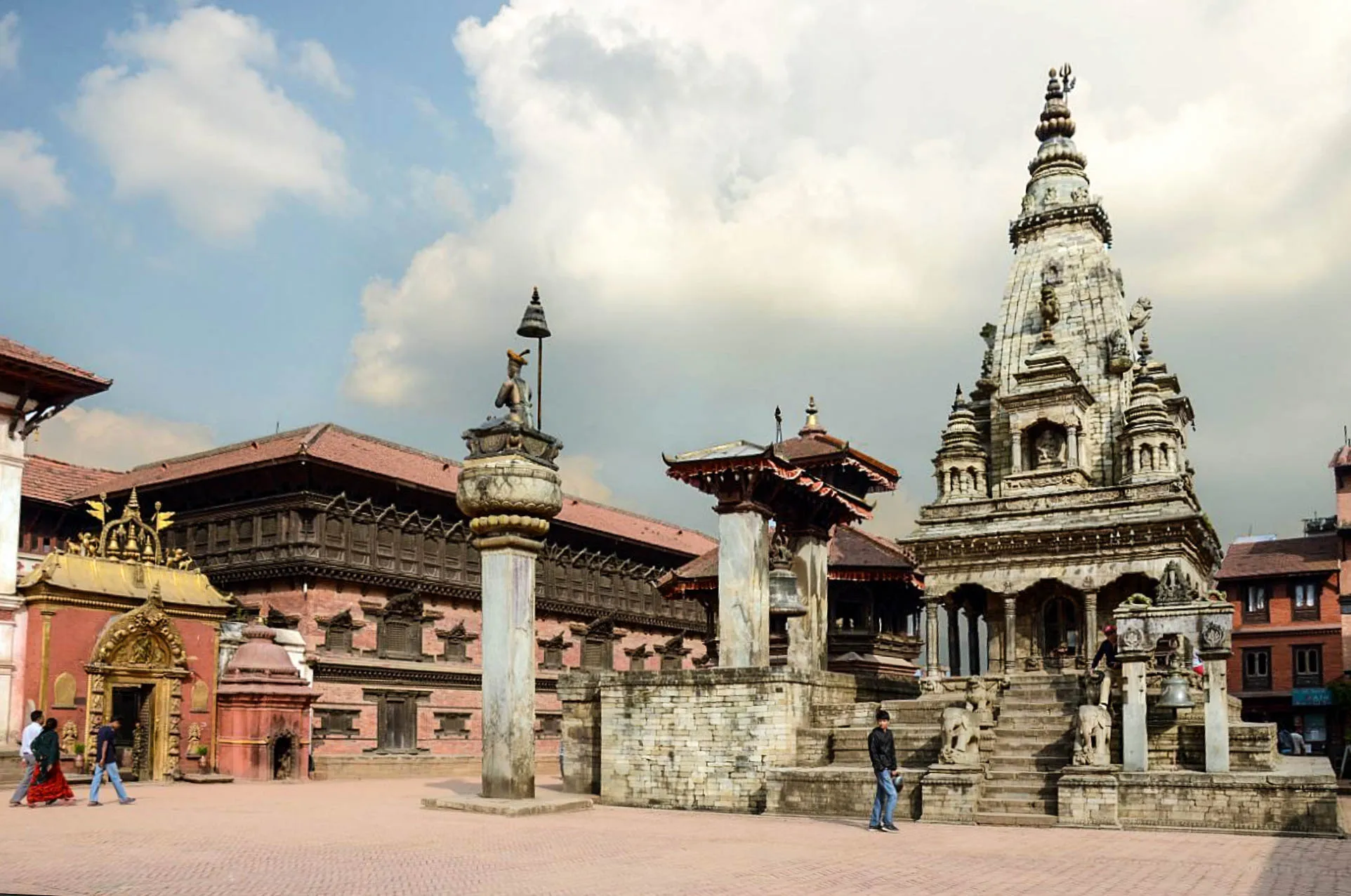
Back in Durbar Square itself once stood the Vatsala Temple, a unique stone shikhara-style structure inspired by North Indian temple architecture. Though heavily damaged in the 2015 earthquake, reconstruction efforts continue carefully, respecting original design principles.
Nearby hangs the famous stone bell of Bhaktapur. Legend says it was rung only during times of great emergency or important royal announcements.
Locals sometimes call it the “barking bell,” because when struck, its sound carried so far that even dogs across the city would begin barking.
In a pre-modern world without digital communication, sound was power.
The Malla Kings: An Era of Artistic Brilliance and Sacred Power
To understand Bhaktapur Durbar Square, you must understand the Malla kings.
For nearly five centuries, from the 12th to the 18th century, the Malla dynasty shaped the Kathmandu Valley into one of South Asia’s most refined urban civilisations. Bhaktapur, known historically as Bhadgaon or Khwopa in the Newar language, became a powerful and culturally sophisticated kingdom under their rule.
The Mallas were not just administrators or warriors. They were patrons of art, poetry, architecture, ritual, and philosophy. Their court language was Sanskrit, but Newar culture flourished in daily life. Religious life blended Hinduism and Vajrayana Buddhism seamlessly, creating a spiritual ecosystem visible in every courtyard shrine.
The golden age of Bhaktapur came especially under kings like Yaksha Malla in the 15th century. During his reign, the kingdom expanded economically and militarily. Trade routes connected the valley to Tibet and northern India. Bhaktapur prospered through commerce in grains, textiles, metalwork, and artisanal crafts.
But after Yaksha Malla’s death, the valley fragmented into three rival kingdoms: Kathmandu, Patan, and Bhaktapur. This division could have weakened the region.
Instead, it ignited artistic rivalry.
Each kingdom sought to outshine the others in grandeur. Bhaktapur responded not with aggression, but with beauty.
Temples rose higher.
Courtyards became more elaborate.
Woodcarvings grew increasingly intricate.
Public squares were expanded and formalised.
King Bhupatindra Malla, who ruled from 1696 to 1722, stands out as one of Bhaktapur’s most visionary rulers. It was during his reign that the magnificent Nyatapola Temple was constructed in 1702. He also expanded the royal palace complex, including the 55-Window Palace, elevating it into a masterpiece of symmetrical Newar design.
Bhupatindra Malla was not only a king but a poet. His statue still stands in the square, hands folded in eternal prayer toward the temples he commissioned. When you see that statue, kneeling in stone with eyes fixed on divinity, you realise something important.
Power here was inseparable from devotion.
The Malla kings ruled from palace courtyards that were physically intertwined with temples. Their legitimacy flowed not only from military strength but from spiritual alignment with Taleju, the royal goddess. The Golden Gate marked the sacred threshold to that inner spiritual-political space.
Durbar Square during the Malla era was not simply administrative.
It was ceremonial.
It was cosmic.
It was the axis around which the kingdom revolved.
Coronations took place here. Festivals were orchestrated here. Judicial announcements were made here. The square was both a throne room and a temple complex, merging worldly authority with divine sanction.
Walking through Bhaktapur today, you are not seeing ruins.
You are walking through the architectural language of Malla ambition.
The Shah Conquest: Unification, Transition, and Cultural Survival
By the mid-18th century, the political landscape of Nepal was shifting.
To the west, in the hill kingdom of Gorkha, King Prithvi Narayan Shah had a vision. He sought to unify the small kingdoms of the Himalayan region into one consolidated state. His strategy was deliberate and strategic. Control the Kathmandu Valley, and you control trade between India and Tibet.
In 1768, he captured Kathmandu.
Soon after, Patan fell.
Bhaktapur remained the final stronghold of Malla resistance.
In 1769, after a decisive battle, Bhaktapur was conquered. The last Malla king, Ranajit Malla, was defeated. With that, centuries of Malla sovereignty ended, and the Shah dynasty established control over the valley.
It was a profound political turning point.
The Durbar Square that once symbolised independent royal authority now stood under a new ruler.
Yet here is what makes Bhaktapur remarkable.
The conquest changed governance, but it did not erase identity.
Unlike cities that collapse culturally after regime change, Bhaktapur retained its Newar traditions. Rituals continued. Festivals remained. The temples did not fall silent. The architecture was not destroyed or radically altered.
Instead, the square transitioned from an active royal court into a preserved royal memory.
Under Shah rule, political focus gradually shifted toward Kathmandu. Bhaktapur became less central to state administration. Ironically, this reduced political importance helped preserve its architectural integrity. Without large-scale modernisation or reconstruction during the Rana and later periods, much of Bhaktapur’s medieval layout survived.
The square became quieter, but not abandoned.
Local communities continued to care for the temples.
Priests continued rituals to Taleju.
Craft guilds passed down techniques.
Festivals still erupted into colour and chaos.
Bhaktapur adapted without surrendering its essence.
Today, when you stand in Durbar Square, you are standing at a crossroads of Nepal’s political history. The brick beneath your feet has witnessed the height of Malla splendour and the rise of Shah unification.
The square holds both stories.
It tells of kings who competed through artistry.
It tells of a conqueror who unified a nation.
And it tells of a community that carried its culture forward through both.
Festivals: When the Square Comes Alive
If you visit during Bisket Jatra, Bhaktapur transforms into something electric.
Massive wooden chariots are pulled through the streets in dramatic tug-of-war processions. Crowds gather. Drums thunder. Masked dancers perform ancient rituals. The entire square becomes a stage where myth and community meet.
Other festivals like Dashain, Tihar, and Indra Jatra fill the courtyards with lights, flowers, and prayer.
Bhaktapur is not preserved in glass.
It is practised.
Craft, Clay, and Continuity
Just a short walk from Durbar Square is Pottery Square, where artisans still spin clay by hand, shaping pots exactly as their ancestors did.
Woodcarvers continue restoring temples using traditional tools.
Metalworkers cast statues in age-old foundries.
Painters create paubha art rooted in tantric symbolism.
Bhaktapur did not freeze in time.
It carried time forward.
Earthquake and Restoration: A Story of Resilience
The 2015 earthquake was devastating. Many temples collapsed. Courtyards were reduced to rubble.
But what followed was equally powerful.
Local communities, international conservationists, and heritage experts came together to restore Bhaktapur stone by stone. Traditional building techniques were revived. Old bricks were reused where possible. Carvings were reconstructed with painstaking precision.
The restoration was not just about rebuilding structures.
It was about protecting identity.
Today, when you walk through the square, you may see scaffolding in some corners. But you also see hope.
Walking Through at Dawn
If you want the most immersive experience, come at sunrise.
The square is quiet.
The pigeons gather near temple roofs.
Incense smoke rises gently from shrines.
A lone bell rings in the distance.
There are no tour groups yet.
Only locals beginning their day.
In that stillness, Bhaktapur reveals its truest self.
You realise this is not just a UNESCO site.
It is a breathing city layered with devotion.
Why Bhaktapur Durbar Square Matters
Bhaktapur Durbar Square matters because it tells the story of:
• The brilliance of the Malla era
• The transition to Shah unification
• The endurance of Newar culture
• The power of community-led preservation
It is architecture as memory.
It is a ritual of resistance.
It is history you can walk through.
For travellers seeking more than photographs, Bhaktapur offers something deeper.
It offers connection.
Final Reflection
As the sun sets and the brick walls glow amber, you sit on the temple steps and watch the square slowly empty. A shopkeeper closes wooden shutters. A priest lights evening lamps. A child chases pigeons one last time.
You realise that Bhaktapur does not impress through scale alone.
It moves you because it feels whole.
Whole in its history.
Whole in its devotion.
Whole in its resilience.
And as you walk back through the narrow brick alleys, you carry something with you.
Not just images.
But a quiet understanding that some cities do not just preserve the past.
They embody it.
Stay Informed With the Latest & Most Important News
Previous Post
Next Post
- Solo Female Travel in Nepal: What You Actually Need to Know
- Mardi Himal Trek: The Quieter Trail to Nepal’s Most Photogenic Peak
- Best Time to Visit Nepal: A Month-by-Month Breakdown for Every Traveller
- Poon Hill Trek: The Complete Guide
- Top 15 Biggest Cities in Nepal by Population: Walk With Me Through Urban Nepal